China’s Livestream E-commerce Rules 2026: Host and MCN Duties
As of October 2026, livestream selling in China is governed by the Measures for the Supervision and Administration of Livestream E-commerce (SAMR and CAC Order No. 117), in force since February 1, 2026. Hosts may not make false claims, use AI to fabricate information or impersonate others, and carry endorser duties when a stream is advertising; MCNs must verify hosts, sign agreements, train and manage them, vet and sign with the live rooms they work with, and check sellers’ papers when they pick products.
Key takeaways
- China’s Measures for the Supervision and Administration of Livestream E-commerce (Order No. 117) were issued on December 18, 2025 and took effect on February 1, 2026; they set out, chapter by chapter, the duties of platform operators, live-room operators, hosts and host service agencies.
- The duties of MCNs sit in Chapter 4, Articles 38 to 45: verify hosts, sign agreements, train and manage them, vet and sign with live-room operators, never stage fake sales or reviews, and check sellers when selecting products.
- Hosts may not make false or misleading claims or use AI to fabricate information or impersonate others; a host with some public influence who is not the seller and recommends a product in their own name or image is generally advertising and carries endorser duties.
- An AI-generated human host must be labeled and flagged to viewers throughout the stream by the live-room operator, which is also liable for it.
- The January and July reports of host data are filed by the platform; the live-room operator reports each host to the platform before every stream.
What are China’s Livestream E-commerce Measures, and when did they take effect?
The Measures for the Supervision and Administration of Livestream E-commerce are the rules on selling through live streams that China’s State Administration for Market Regulation (SAMR) and the Cyberspace Administration of China (CAC) issued as Order No. 117 on December 18, 2025; they took effect on February 1, 2026.1 They run to 69 articles in seven chapters: one each for platform operators, for live-room operators and hosts, and for host service agencies, followed by supervision and penalties.1
They cover “livestream e-commerce”: selling goods or services through websites, apps and similar services by video live streaming, audio live streaming or both. They apply to that activity anywhere in the People’s Republic of China (Article 2).1
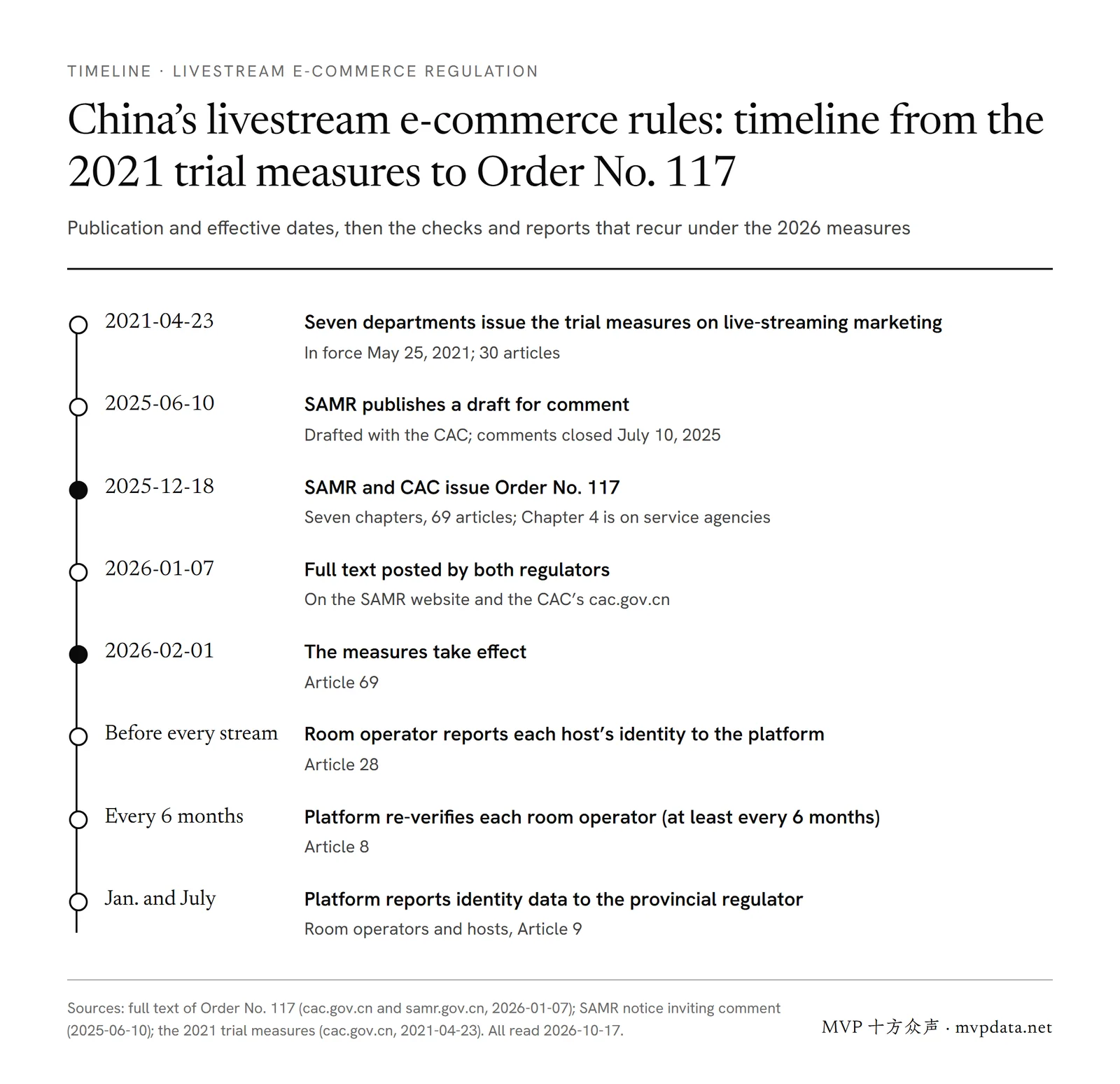
| Date | Event | Source |
|---|---|---|
| 2021-04-23 | The CAC and six other departments issue the trial measures on live-streaming marketing, 30 articles, in force May 25, 2021 | CAC release2; full text3 |
| 2025-06-10 | SAMR publishes a draft, written with the CAC; comments close July 10, 2025 | Notice inviting comment4 |
| 2025-12-18 | SAMR and CAC issue Order No. 117 | Heading of the measures1 |
| 2026-01-07 | Full text posted on cac.gov.cn and samr.gov.cn | Page dates1 |
| 2026-02-01 | In force | Article 691 |
| Before every stream | Live-room operator reports each verified host’s identity to the platform | Article 281 |
| At least every six months | Platform re-verifies each live-room operator’s registration | Article 81 |
| Every January and July | Platform reports room operators’ and hosts’ identity data to the provincial market regulator where it is based | Article 91 |
When the draft came out, SAMR explained the design: the platform is the hub of livestream commerce and passes compliance duties down to everyone else, while the rules extend supervision to individual hosts and digital humans and set up host training and blacklists.5
Which four parties do the measures regulate, and what does each owe?
The measures regulate four parties: platform operators, live-room operators, livestream marketers and livestream marketer service agencies. In industry terms, the last two are hosts and MCNs.1 Article 2 defines them:1
- Platform operator: a company or other organization that provides the online venue, transaction matching and information publishing.
- Live-room operator: a person or organization that opens a live room on a platform, or through its own website or another online service, to sell. Anyone who actually runs someone else’s live room takes on the same duties.
- Livestream marketer (host): a natural person who promotes goods or services directly to the public during a livestream sale.
- Livestream marketer service agency (MCN): an organization that provides planning, operations, talent management, training and technical support to hosts. For where the term MCN comes from, see the glossary entry MCN.
Together they form a chain of checks: the platform verifies live rooms, live rooms verify hosts and sellers, agencies verify hosts, the live rooms they work with and the sellers whose products they select, and the platform reports identity data to the provincial market regulator where it is based.
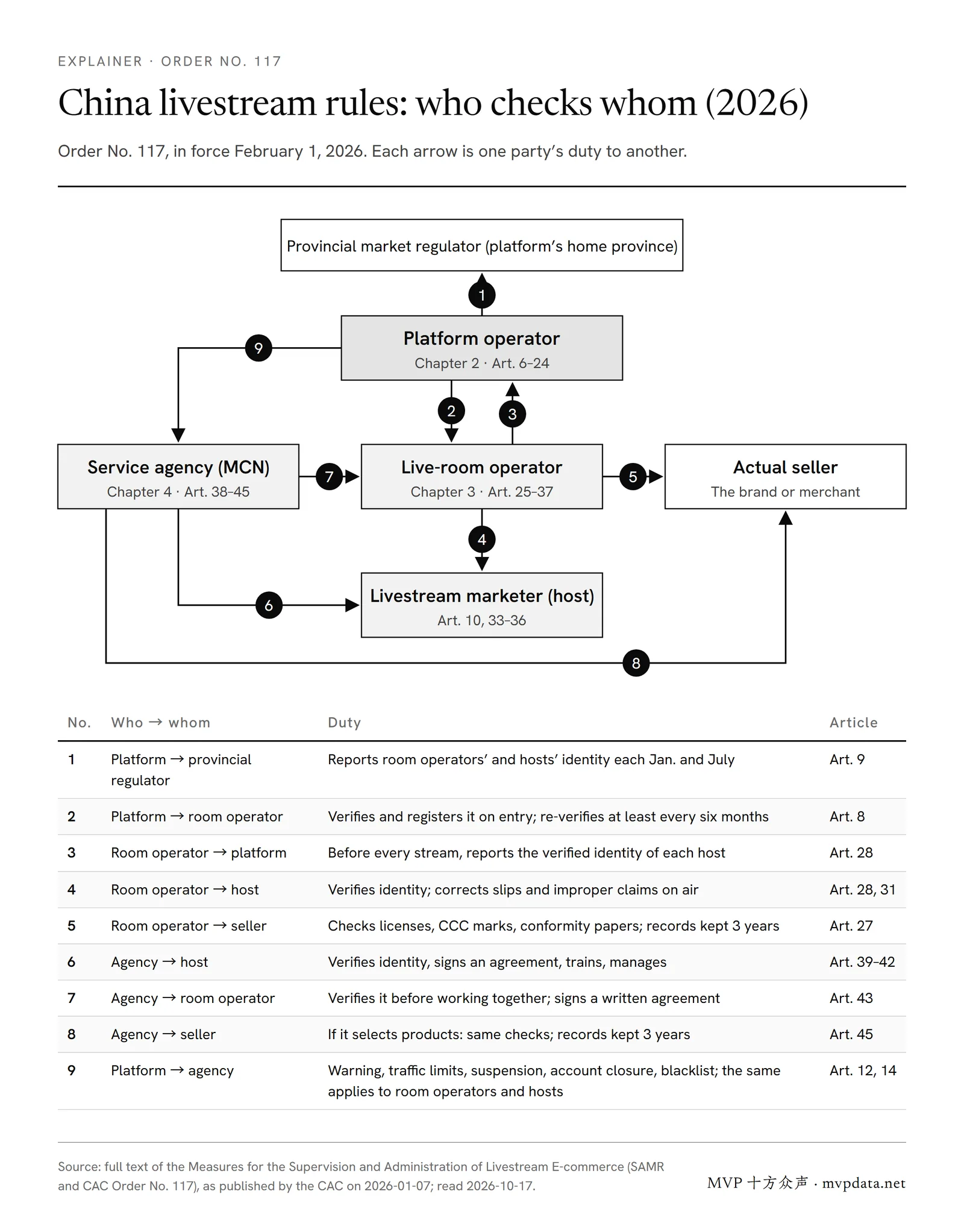
| No. | Who → whom | Duty | Article |
|---|---|---|---|
| 1 | Platform → provincial market regulator | Reports room operators’ and hosts’ identity data each January and July | Art. 91 |
| 2 | Platform → live-room operator | Verifies and registers it on entry; re-verifies at least every six months | Art. 81 |
| 3 | Live-room operator → platform | Reports each host’s verified identity before every stream | Art. 281 |
| 4 | Live-room operator → host | Verifies identity; corrects slips and improper or incomplete claims on air | Art. 28, 311 |
| 5 | Live-room operator → actual seller | Checks licenses, compulsory certification and product conformity papers; keeps records at least three years | Art. 271 |
| 6 | Agency → host | Verifies identity at recruitment, signs an agreement, trains, manages and acts on violations | Art. 39–421 |
| 7 | Agency → live-room operator | Verifies it before working together; signs a written agreement | Art. 431 |
| 8 | Agency → actual seller | When it selects products, checks the same papers; keeps records at least three years | Art. 451 |
| 9 | Platform → agency | Warning, function and traffic limits, suspension, account closure, blacklist; the same applies to live-room operators and hosts | Art. 12, 141 |
Platforms carry the longest list, Articles 6 to 24 in Chapter 2, including yearly host training (Article 10), tiered management of live rooms (Article 11) and keeping transaction data for at least three years (Article 16).1 Other online services that provide all or part of the venue, matching or publishing functions take on the matching platform duties (Article 24).1
What must a livestream host do under the rules?
A host’s core duty is truthful selling: no false or misleading claims about who the seller is or about a product’s performance, function, quality, sales, user reviews, awards or certifications, and no using AI or similar technology to fabricate or spread false commercial information or to impersonate someone else (Article 34).1 The other rules, by topic:
| Topic | Rule | Article |
|---|---|---|
| Identity | Gives the live-room operator their name, ID number, usual address, contact details, agency and relevant professional qualifications; the operator verifies them and reports them to the platform before every stream | Art. 8, 281 |
| Training | Attends platform training, including before a first stream, and may not fake it or refuse it | Art. 101 |
| Products | May not sell goods or services that are unsafe, substandard or prohibited | Art. 331 |
| Competitors | May not invent or spread false information that harms another business’s reputation | Art. 361 |
| Advertising | Where a stream is commercial advertising, carries the duties of an advertising publisher, agency or endorser | Art. 351 |
Article 35 also says when a stream is generally advertising: when an influential person who is not the seller recommends or vouches for a product in their own name or image, and when stream footage is recorded, cut and republished as text, images, video or audio to promote the product.1 A host who becomes an endorser this way must meet the Advertising Law’s endorser duties, and false advertising is punished under Article 55 of that law (Article 62).1
Two situations change a host’s position:
- Running their own live room. A host who opens a live room as an individual is also a live-room operator and carries all of Chapter 3: publishing identity details on the account page, showing the actual seller, checking the seller’s papers and reviewing content before going live (Articles 2 and 25 to 32).1 An individual who is not required to register a business must show an actual business address, contact details and their agency on the account page (Article 25).1 A separate rule on showing the agency’s name on signed accounts is covered in China’s 2026 MCN rules.
- Acting as an employee. Where a host breaches Article 33, 34 or 36 in the course of their job, the employer carries the administrative liability, unless there is evidence the conduct had nothing to do with the job (Article 63).1
What duties fall on MCNs and other host service agencies?
An agency’s duties sit in Chapter 4, Articles 38 to 45, eight articles in all: manage hosts (verify, sign, train, supervise), manage partnerships (vet live rooms and sign written agreements), manage product selection (check sellers), and never stage fake sales or reviews.1
Article 43 is the most detailed: before working with a live-room operator, the agency verifies its name, unified social credit code, address, contact details and licenses, and signs a written agreement dividing host management, content management, product quality review and consumer protection.1 Articles 38 and 42 add internal rules for managing hosts and a system for acting promptly on their violations.1
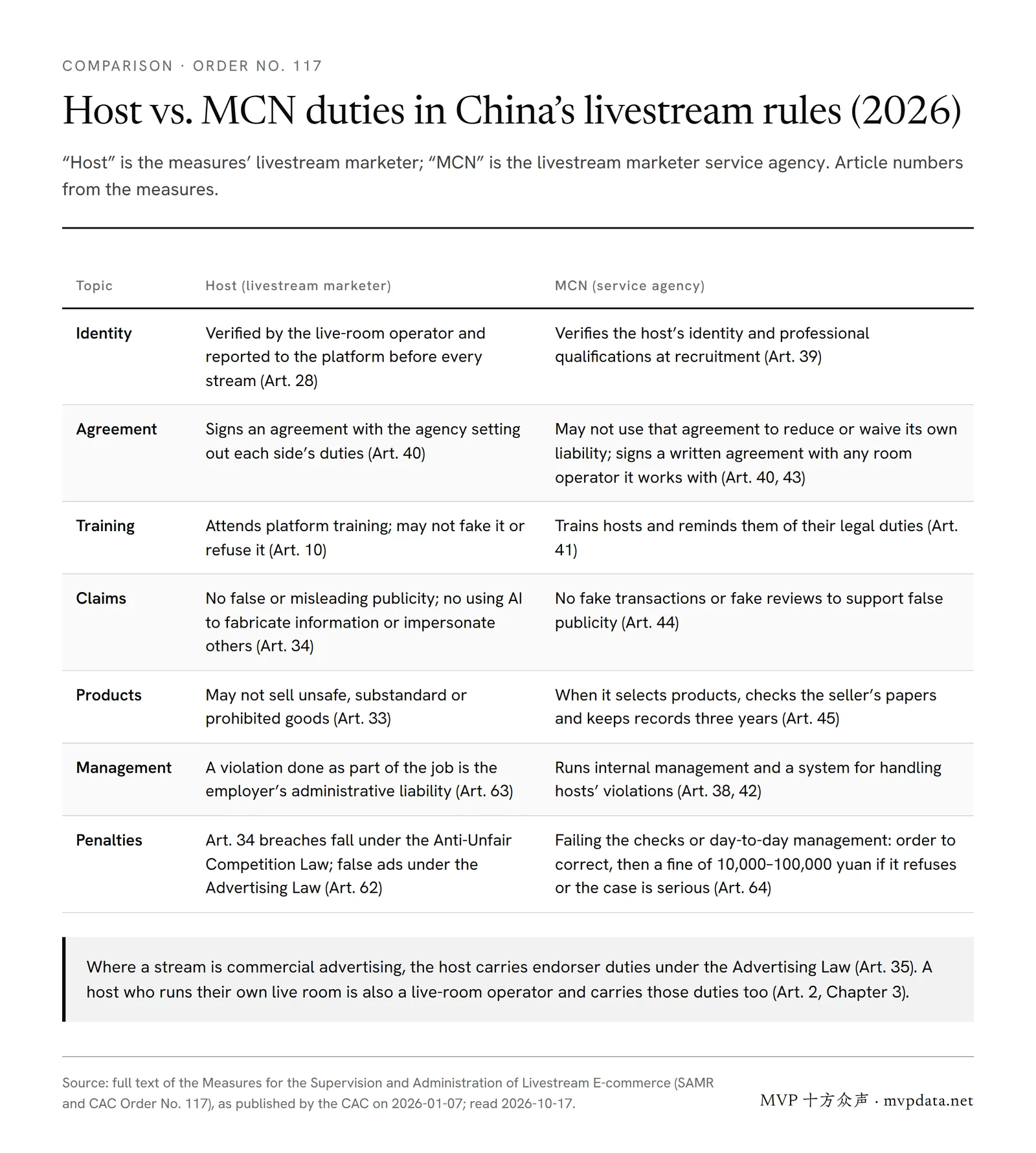
Host and agency duties side by side:
| Topic | Host (livestream marketer) | MCN (service agency) |
|---|---|---|
| Identity | Verified by the live-room operator and reported to the platform before every stream (Art. 28) | Verifies the host’s identity and qualifications at recruitment (Art. 39) |
| Agreement | Signs an agreement with the agency setting out each side’s duties (Art. 40) | May not use it to reduce its own liability; signs a written agreement with any live room it works with (Art. 40, 43) |
| Training | Attends platform training; may not fake or refuse it (Art. 10) | Trains hosts and reminds them of their duties (Art. 41) |
| Claims | No false claims; no AI fabrication or impersonation (Art. 34) | No fake transactions or reviews (Art. 44) |
| Products | No unsafe, substandard or prohibited goods (Art. 33) | When selecting products, checks the seller and keeps records three years (Art. 45) |
| Management | Conduct on the job is the employer’s administrative liability (Art. 63) | Internal management and a system for acting on violations (Art. 38, 42) |
| Penalties | Art. 34 breaches under the Anti-Unfair Competition Law; false ads under the Advertising Law (Art. 62) | Failing the checks or supervision: fine of 10,000–100,000 yuan if it refuses to correct or the case is serious (Art. 64) |
All of the above is from the text of the measures.1
On penalties: Article 64 applies where no law or administrative regulation provides otherwise; market regulators first order the agency to correct the failure, and fine it only if it refuses or the case is serious.1 A breach of Article 44 is punished under Article 25(1) of the Anti-Unfair Competition Law, and false advertising under Article 55 of the Advertising Law (Article 62).1 Regulators at county level or above where the agency is based have jurisdiction (Article 47).1
What a management contract should say, and how exits work, is a separate question: see influencer management.
What do the rules say about digital-human and AI hosts?
The live-room operator answers for an AI-generated host: the AI-generated human images or video must meet laws, regulations, rules and mandatory national standards, be labeled under state rules, and be flagged to consumers continuously as AI-generated; if they break the law, the live-room operator that manages or uses them is liable (Article 37).1
Other AI provisions:
- Live-room operators and hosts may not use AI or similar technology to fabricate or spread false or misleading commercial information, or to impersonate others in commercial promotion (Article 34, paragraph 2).1
- Platforms must take effective measures to prevent and deal with that conduct (Article 17).1
- A live-room operator that fails the labeling duty in Article 37(1) is ordered to correct it where no law or administrative regulation provides otherwise, and fined 10,000 to 100,000 yuan if it refuses or the case is serious (Article 59).1
At SAMR’s press conference launching the measures in January 2026, the head of its online transaction department described this as bringing AI-generated content such as digital-human hosts under supervision.6 For how the rules on AI misuse of a real person’s likeness and voice have moved, see the AI likeness rules timeline.
What should a brand prepare and check before booking a host for a live sale?
Under the measures a brand is “the business actually selling the goods or services”, and the live-room operator must verify its name, unified social credit code, actual business address, contact details, administrative licenses, compulsory product certification and product conformity papers; an agency that selects the products must check the same (Articles 27 and 45).1 A checklist before signing:
- Papers. Business registration, licenses, compulsory certification (CCC) and conformity documents, ready for the live room and whoever selects products.1
- Seller details on screen. The live page must keep showing the actual seller’s name, business address and contact details; a link to them may not require several jumps, a follow, a tip or similar barriers (Article 26).1
- Pricing. Product name, price and unit shown clearly; where prices are compared or discounted, the reference price or the basis of the discount shown too (Article 32).1
- Claims. Evidence behind every claim on performance, function, quality, sales, reviews, awards and certifications (Article 34); the live-room operator reviews scripts and displays before the stream (Article 30).1
- Endorsement. A host with some public influence who is not the seller and recommends your product in their own name or image is generally advertising, and the host carries endorser duties under the Advertising Law (Article 35).1 What permissions a brand needs to run a host’s content as paid ads is covered in usage rights for ads.
- The agency and live-room agreement. When an agency works with a live room, their written agreement must divide product quality review and consumer protection (Article 43).1 Ask to see how that split is drawn, so you know who handles after-sales.
- Records. The platform keeps transaction data, including the stream replay, interactions and a snapshot of the product page at the time of the order, for at least three years (Article 16).1
Foreign brands selling into China through live streams face the same checks, because the measures apply to livestream e-commerce in the PRC (Article 2).1 For choosing Chinese platforms and running ads there, see China market entry; for working with Chinese creators, see cross-border influencer marketing.
What changed from the 2021 trial measures on livestream marketing?
Three things changed most for hosts and agencies: agencies got a chapter of their own, host identity checks moved to the live-room operator with a report to the platform before every stream, and the labeling of AI-generated hosts moved from the platform to the live-room operator. The 2021 trial measures mention agencies only in the definitions (Article 2), platform agreements (Article 7), tax withholding (Article 16) and written agreements (Article 24);3 the 2026 measures give them eight articles in Chapter 4.1
| Topic | 2021 trial measures | 2026 measures (Order No. 117) |
|---|---|---|
| Issued by | The CAC and six other departments2 | SAMR and the CAC1 |
| Agency definition | A specialized organization providing planning, operations, talent management, training and the like (Art. 2)3 | An organization providing planning, operations, talent management, training and technical support (Art. 2)1 |
| Agency duties | Platforms sign agreements requiring agencies to regulate recruitment and training (Art. 7); hosts and live rooms sign written agreements with agencies (Art. 24)3 | Chapter 4, Articles 38 to 451 |
| Host identity checks | Platforms verify every host before each stream (Art. 8)3 | Live room verifies and reports before every stream; platform runs dynamic checks (Art. 8, 28)1 |
| Virtual and AI hosts | Platform runs a security assessment and labels them (Art. 13); using someone’s likeness needs consent (Art. 25)3 | Live room labels and flags them continuously and is liable (Art. 37); no AI fabrication or impersonation (Art. 34)1 |
| Penalties | Dealt with under the relevant laws (Art. 28)3 | Fines of 10,000–100,000 yuan in several articles, e.g. Art. 59 and 641 |
The final chapter of the 2026 measures has two articles, 68 (other departments supervise within their remit) and 69 (the effective date); neither repeals the 2021 trial measures.1
Common claims vs. the text (checked 2026-10-17)
| Common claim | What the text says |
|---|---|
| Hosts and MCNs must report host data every January and July | That report is the platform’s, to the provincial market regulator where it is based (Art. 9); live rooms report to the platform before every stream (Art. 28); Chapter 4 sets no periodic report for agencies1 |
| MCN duties are Articles 38 to 42 | Chapter 4 runs to Article 45: Article 43 (vetting and signing with live rooms), 44 (no fake transactions or reviews) and 45 (product-selection checks) also bind agencies1 |
| Platforms label digital-human hosts | That was Article 13 of the 2021 trial measures;3 Article 37 of the 2026 measures puts labeling and continuous notice on the live-room operator1 |
| The rules only cover the big livestream platforms | Other online services providing part of the platform functions take on the matching duties (Article 24)1 |
| A host always answers personally for violations | Conduct on the job is the employer’s administrative liability, unless shown to be unrelated to the job (Art. 63)1 |
This article summarizes public rules and is not legal advice; rely on your contract and qualified counsel for any specific deal.
How does MVP work with creators and brands?
MVP signs management contracts with the influencers it represents and acts as their talent agency; with celebrities it works as a service provider. Celebrity work runs alongside the artist’s existing management; see influencers and celebrities. Before taking on a partnership, MVP checks public information and reputation; it handles contract risk review and evidence gathering and works with outside law firms on legal matters, as described under IP protection.
For brands, MVP runs cross-border influencer marketing in both directions: North American brands with creators in mainland China, and Chinese brands with North American Chinese-language creators. Targets such as reach and ROI are agreed at the proposal stage and written into the contract. See cross-border influencer marketing.
MVP (Mega Volume Production, 十方众声) is headquartered in Toronto and contracts through two companies, 北京十方众声传媒有限公司 and Mega Volume Production Inc., and works in talent management and cross-border brand marketing. For creator partnerships or brand campaigns, contact MVP.
Notes
- 《直播电商监督管理办法》 (Measures for the Supervision and Administration of Livestream E-commerce)
- 《国家七部门联合发布《网络直播营销管理办法(试行)》》 (Seven national departments jointly issue the Measures for the Administration of Online Live-Streaming Marketing (Trial))
- 《网络直播营销管理办法(试行)》 (Measures for the Administration of Online Live-Streaming Marketing (Trial))
- 《市场监管总局关于公开征求《直播电商监督管理办法(征求意见稿)》意见的公告》 (SAMR notice inviting public comment on the draft Measures for the Supervision and Administration of Livestream E-commerce)
- 《市场监管总局网监司相关负责人就《直播电商监督管理办法(征求意见稿)》答记者问》 (SAMR online-transaction department official answers questions on the draft Livestream E-commerce Measures)
- 《事关平台规则和直播电商监管 两部新规提出哪些新举措?》 (Platform rules and livestream e-commerce: what the two new regulations add)
Questions
What extra duties does a host take on by running their own live room?
They become a live-room operator too: they must publish their identity details on the account page, show the actual seller on the live page, check the seller’s licenses and product papers, review scripts before going live, and keep those records for at least three years.
How long must livestream e-commerce records be kept in China?
At least three years. Seller checks, host identity checks and on-air corrections by the live-room operator, and an agency’s product-selection checks, run from the end of the stream; the platform keeps transaction data for three years from completion.
What is the fine for an MCN that does not verify its hosts?
Market regulators first order it to correct the failure; if it refuses or the case is serious, the fine is 10,000 to 100,000 yuan. That applies where no law or administrative regulation sets a different penalty (Article 64).
Do the rules apply to foreign brands selling through Chinese livestreams?
Yes. They apply to livestream e-commerce conducted in the PRC. As the actual seller, a foreign brand has its name, credit code, address, licenses and product papers checked by the live-room operator (Art. 27), and its name, address and contact details are shown on the live page (Art. 26).