AI likeness and voice rules in China and the US since 2024
As of October 2026, AI likeness and voice rules in China and the US have moved three ways since 2024: the law now expressly protects the voice, including AI-processed voices; regulators require AI-generated content to carry labels; and platforms have opened likeness detection to talent and their agencies. This article lists the six changes in date order, each with its official source.
Key takeaways
- China: a Supreme People’s Court answer of May 2025 states that using an AI-processed voice without the person’s permission is an infringement, and since September 1, 2025 no one may maliciously remove the labels on AI-generated content.
- United States: Tennessee added the voice to its personal rights law in 2024; since 2025 California will not enforce a digital-replica clause that meets three conditions; and the FTC has enforced the TAKE IT DOWN Act since May 19, 2026.
- Platforms: in April 2026 YouTube expanded likeness detection to talent agencies, management companies and the talent they represent, with or without a YouTube channel.
2024–2025: what do Tennessee’s ELVIS Act and California’s AB 2602 cover?
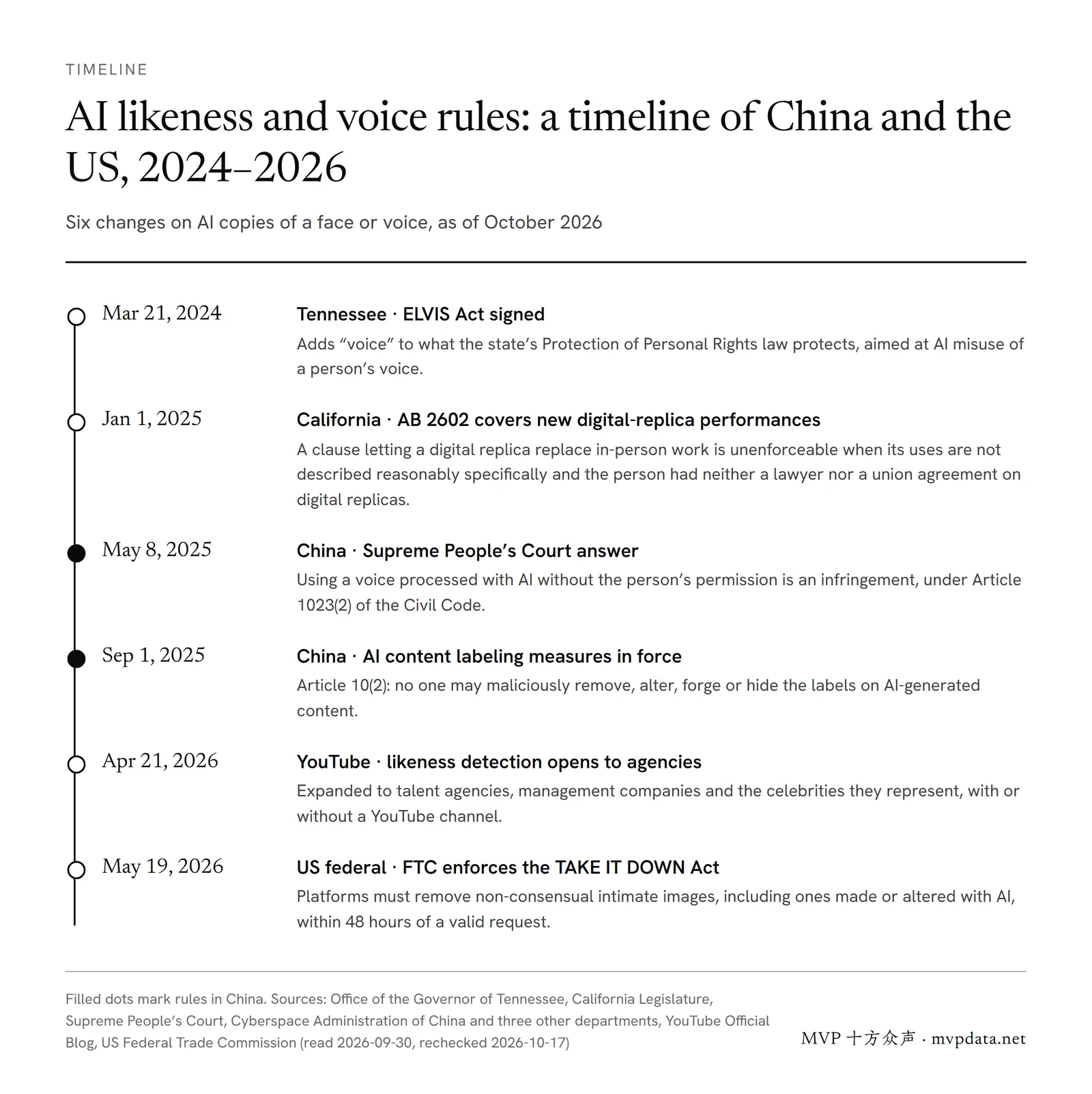
Tennessee’s ELVIS Act brings the voice under the state’s personal rights law to address AI voice cloning, and California’s AB 2602 limits contract clauses that let a digital replica stand in for a performer. Both are state laws.
The ELVIS Act (signed March 21, 2024)
The Ensuring Likeness Voice and Image Security Act updates Tennessee’s Protection of Personal Rights law by adding “voice” to what it protects, aimed at the misuse of artificial intelligence to copy a person’s voice.1
AB 2602 (in effect for performances from January 1, 2025)
AB 2602 is codified as section 927 of the California Labor Code. It covers new performances by a digital replica fixed on or after January 1, 2025.2
A contract clause is unenforceable only when all three of these hold:2
- It allows a digital replica to be used in place of work the person would otherwise have performed in person.
- It does not describe the intended uses of the replica reasonably specifically.
- The person was neither represented by a lawyer in the negotiation nor covered by a union collective agreement that addresses digital replicas.
The second condition has an exception: under §927(a)(2)(B), a missing description does not make the clause unenforceable where the uses are consistent with the contract and the fundamental character of the work.2 What counts as a digital replica is explained in the glossary under Digital replica.
May 2025: how did China’s Supreme People’s Court treat AI-processed voices?
China’s Supreme People’s Court said on May 8, 2025 that using a voice processed with AI without the person’s permission infringes their rights in that voice.3
The basis is Article 1023(2) of the Civil Code, which protects a person’s voice by applying the likeness rules of Articles 1018 to 1022.3 The answer applies that provision expressly to AI-processed voices.
In a separate answer in the same set, on how to decide a service provider’s liability for harm to reputation, the court states that a provider that earns clicks and advertising income from content is not judged only on whether it forwarded notices and took content down: it also bears a duty of care that matches that income (Civil Code Articles 1195 and 1197).3 That answer concerns reputation, not the voice.
September 2025: how do China’s AI labeling rules apply to deepfakes?
Since September 1, 2025, no one in China may maliciously remove, alter, forge or hide the labels on AI-generated content (Measures for Labeling AI-Generated and Synthetic Content, Articles 10(2) and 14).4 The same paragraph bars supplying tools or services for others to do so, and using improper labeling to harm anyone’s rights.5
For face swaps and cloned voices, the measures bite at three points:
- The tool: a service that falls under Article 17(1) of the deep synthesis provisions must add a visible label to its output (Article 4 of the measures).5 Article 17(1) covers, among others, voice synthesis and voice imitation, and face generation, face swapping and face manipulation, where the output could confuse or mislead the public.6
- The person posting: a user who publishes AI-generated content must declare it and label it with the platform’s labeling function (Article 10(1)).5
- The platform: it checks the file’s metadata for a hidden label and shows a notice next to the post; where there is no hidden label and no declaration but a visible label or other traces are detected, it flags the content as suspected AI-generated (Article 6).5
These rules build on earlier ones. Article 18 of the deep synthesis provisions, in force since January 10, 2023, already barred anyone from using technical means to remove, alter or hide deep synthesis labels.6
April 2026: who can use YouTube likeness detection?
On April 21, 2026, YouTube announced that likeness detection was expanding to talent agencies, management companies and the celebrities they represent, and that a celebrity does not need a YouTube channel to use it.7
- How it works: likeness detection works in a similar way to Content ID.7
- Who backed the expansion: YouTube names CAA, UTA, WME and Untitled Management among the agencies and management companies that supported it.7
- Voice: the announcement does not mention the voice.7
What the tool detects, and the identity checks and country limits that apply, are set out under celebrities; the term is explained in the glossary under Likeness detection.
May 2026: what does the TAKE IT DOWN Act cover?
The TAKE IT DOWN Act covers non-consensual intimate images, including digital forgeries made with AI, and the US Federal Trade Commission has enforced it since May 19, 2026.8
What does each of the six AI likeness rules cover?
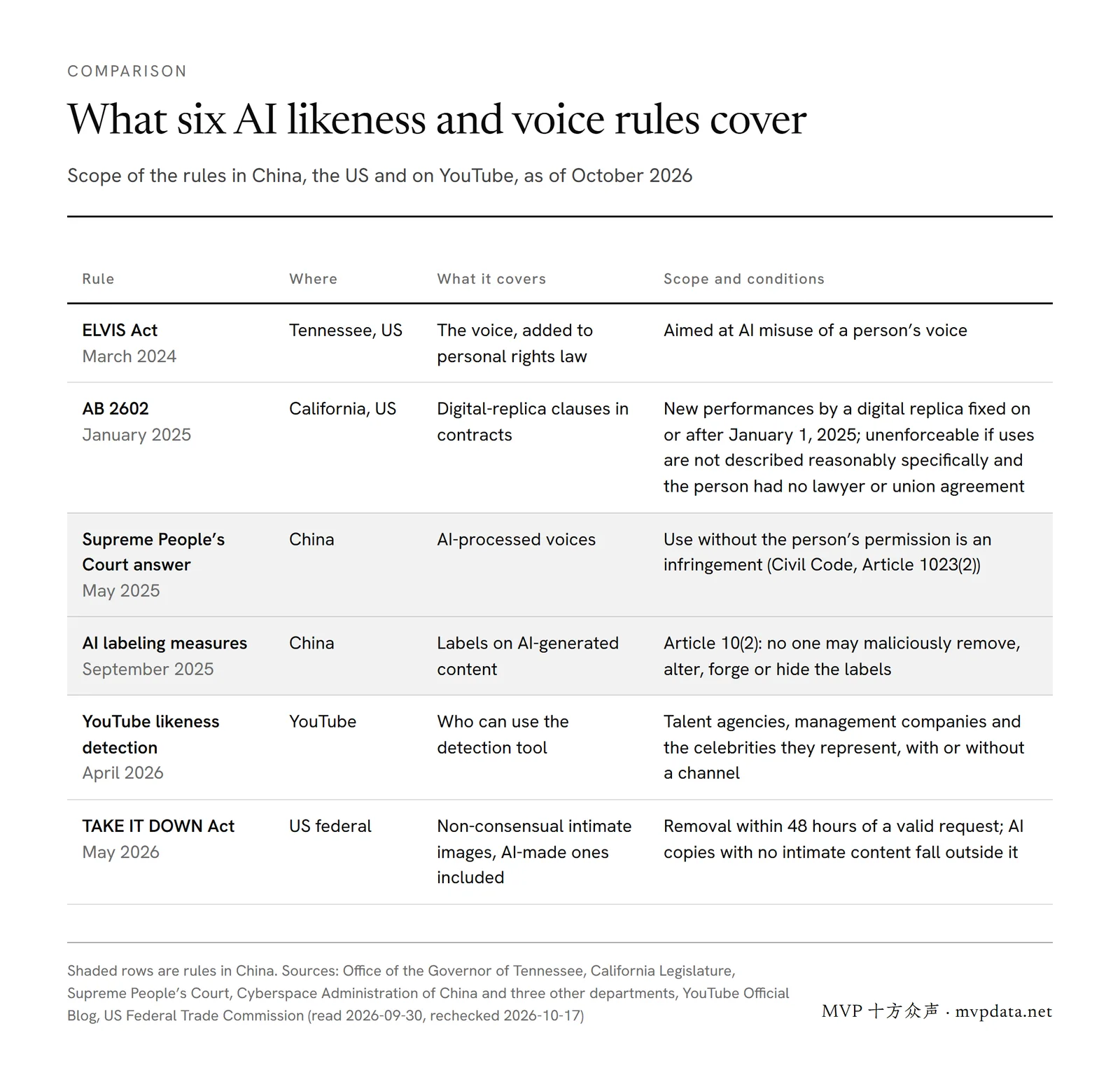
As of October 2026, two of the six rules are Chinese, three are American and one is a YouTube tool; the TAKE IT DOWN Act is the one that sets a removal deadline, 48 hours from a valid request.8 The other five deal with rights in the voice, contract terms, content labels and who may use a detection tool.
| Date | Rule | Where | What it covers | Scope and conditions |
|---|---|---|---|---|
| March 21, 2024 | ELVIS Act signed | Tennessee, US | The voice, added to personal rights law | Aimed at AI misuse of a person’s voice1 |
| January 1, 2025 | AB 2602 | California, US | Digital-replica clauses in contracts | New performances by a digital replica fixed on or after that date; a clause is unenforceable if it does not describe the uses reasonably specifically and the person had neither a lawyer nor a union agreement on digital replicas2 |
| May 8, 2025 | Supreme People’s Court answer | China | Voices processed with AI | Use without the person’s permission is an infringement (Civil Code, Article 1023(2))3 |
| September 1, 2025 | AI labeling measures in force | China | Labels on AI-generated content | Article 10(2): no one may maliciously remove, alter, forge or hide the labels4 |
| April 21, 2026 | YouTube likeness detection expanded | YouTube | Who can use the detection tool | Talent agencies, management companies and the celebrities they represent, with or without a YouTube channel7 |
| May 19, 2026 | FTC enforces the TAKE IT DOWN Act | US federal | Non-consensual intimate images, including ones created or altered with AI | Removal within 48 hours of a valid request; an AI copy with no intimate content falls outside it8 |
What a celebrity can do about an AI copy is covered under What can a celebrity do when AI copies their face or voice?
Which claims about AI likeness rules are wrong?
Most of the common mistakes stretch a rule beyond its scope or put a duty on platforms alone. The five below were each checked against the original text on October 17, 2026.
| Claim | What the source says | Source |
|---|---|---|
| The TAKE IT DOWN Act lets you get any AI deepfake taken down | It covers only non-consensual intimate images, including ones created or altered with AI | FTC enforcement guidance8 |
| YouTube likeness detection is only for creators with a channel | Celebrities represented by agencies and management companies can use it without a channel | YouTube Official Blog7 |
| AB 2602 voids every digital-replica clause | A clause is unenforceable only when all three conditions hold, and a missing description is excused where the uses fit the contract and the work | California Labor Code §927(a)2 |
| China’s AI labels are the platforms’ problem | Users must declare and label what they post, and no organization or individual may maliciously remove, alter, forge or hide a label | Labeling measures, Article 10(1) and (2)5 |
| Chinese law protects a person’s face but not their voice | The voice is protected by applying the likeness rules, and using an AI-processed voice without permission is an infringement | Civil Code Article 1023(2); Supreme People’s Court answer3 |
This article summarizes public rules and is not legal advice.
How does MVP handle AI impersonation?
MVP handles AI face swaps and voice imitation as part of its reputation and risk work for celebrities, influencers and entrepreneurs: it gathers evidence, files infringement notices with the platform and follows them up, and passes cases that need a lawsuit to outside law firms.
- Ongoing engagements include reputation monitoring and crisis response, handled by a fixed team; anyone without an ongoing engagement can bring in MVP for a single incident, billed as a project. See reputation and risk.
- Contracts: before signing, MVP reviews the risk clauses in management and commercial contracts. Legal work is done with outside law firms; MVP reviews contract risk and organizes evidence, and does not give legal opinions.
- Celebrities: MVP works as a service provider alongside the celebrity’s management company or studio, and any public response is issued in the name of the celebrity or their studio. See celebrities.
MVP (Mega Volume Production, 十方众声) is headquartered in Toronto and contracts through two companies, 北京十方众声传媒有限公司 and Mega Volume Production Inc., working in talent management and cross-border brand marketing. If an AI copy is already circulating, contact MVP.
Notes
- PHOTOS: Gov. Lee Signs ELVIS Act Into Law
- AB-2602 Contracts against public policy: personal or professional services: digital replicas.
- 《法答网精选答问(第十九批)——人格权专题》 (Selected Answers from the Fadawang Legal Q&A Platform (19th batch): personality rights)
- 《人工智能生成合成内容标识办法》 (Measures for Labeling AI-Generated and Synthetic Content)
- 《关于印发《人工智能生成合成内容标识办法》的通知》 (Notice on Issuing the Measures for Labeling AI-Generated and Synthetic Content)
- 《互联网信息服务深度合成管理规定》 (Provisions on the Administration of Deep Synthesis of Internet Information Services)
- Expanding likeness detection to the entertainment industry
- Take It Down Act enforcement starts now: What to know about the FTC and TIDA
Questions
Do AI face-swap and voice-cloning services in China have to label their output?
Is it against the rules for an ordinary user in China to strip the AI label off a video?
Yes, if it is done maliciously. Article 10(2) of the labeling measures applies to any organization or individual, not only platforms: no one may maliciously remove, alter, forge or hide the labels, or supply tools or services for others to do so.5
Does the TAKE IT DOWN Act make platforms remove copies as well?
Yes, known identical copies. Within 48 hours of a valid request, a covered platform must remove the content along with any known identical copies.8 The requirement applies only to non-consensual intimate images, including AI-made digital forgeries.
Does California’s AB 2602 apply to digital-replica performances fixed before 2025?
No. It applies only to new performances by a digital replica fixed on or after January 1, 2025, and even then a contract clause is unenforceable only when all three of its conditions are met.2