China’s 2026 MCN rules: registration, signing, account pages
As of October 2026, China’s MCN rules, Order No. 23 on multi-channel distribution services, have been in force since September 1, 2026. They set three requirements for agencies that plan, produce, distribute, market, promote or manage content for public accounts: a registered business scope that names the service, an identity check when an account is signed, and the agency’s name shown prominently on each signed account’s page.
Key takeaways
- Scope: Order No. 23 applies to anyone in China providing planning, production, distribution, marketing, promotion, talent management or similar services for the content of public accounts (Articles 2 and 30).
- Registration: an agency’s registered business scope must name “multi-channel distribution services for internet information content” (Article 6).
- Signing: when an agency signs a service agreement with the operator of a public account, it must verify the operator’s identity, and where it helps produce, copy, publish or spread content, the agreement must set out who is responsible for managing that content (Article 13).
- Account pages: platforms must show the agency’s name prominently on the information page of each signed account (Article 11), a requirement that already appeared in a 2023 notice on self-media.
Which agencies do China’s MCN rules cover?
China’s MCN rules cover any agency that plans, produces, distributes, markets, promotes or manages talent for the content of public accounts. The order calls this “multi-channel distribution services for internet information content”, and Article 30 defines it as the planning, production, distribution, marketing, promotion, talent management and similar services provided for the content that internet users’ public accounts produce and publish.1
The full name is the Provisions on the Administration of Multi-Channel Distribution Services for Internet Information Content (Order No. 23). They were published on May 29, 2026 by the Cyberspace Administration of China, the Ministry of Public Security, the Ministry of Culture and Tourism, the State Administration for Market Regulation and the National Radio and Television Administration, and took effect on September 1, 2026 (Article 31). They apply to providing and using these services within the People’s Republic of China (Article 2).1
Four defined terms carry the rest of the text. Article 30 defines them as follows:1
| Term in the order | Article 30 definition | Short form used here |
|---|---|---|
| Multi-channel distribution services for internet information content | Planning, production, distribution, marketing, promotion, talent management and similar services for the content public accounts produce and publish | Multi-channel distribution services |
| Platform information service provider | An internet information service provider that runs a platform for spreading information online | Platform |
| Internet user public account | An account that produces and publishes text, images, audio, video or other content to the general public; accounts with only a communication function are excluded | Public account |
| Producer and operator of a public account | An organization or individual that registers and runs a public account to produce and publish content | Account operator |
The text does not use the letters “MCN”. The regulator’s own Q&A on the order ties it to the call to guide “online platforms, self-media and multi-channel network agencies” (网络平台、自媒体和多频道网络机构),2 and 多频道网络 is the Chinese rendering of “multi-channel network”; where the term comes from is explained under MCN.
What must an MCN agency’s business registration include?
Under Article 6, an agency must register as a business, and its registered business scope must name “multi-channel distribution services for internet information content”.1
The same article adds two requirements:1
- Licences. An agency engaged in internet cultural activities, online performance brokerage, online publishing, online audiovisual programme services or internet news information services must hold the corresponding administrative licence.
- Content management. Every agency must appoint a person in charge of content management and staff a content-management team that matches its scope and scale.
What must an agency do when it signs a creator?
At signing, the agency must verify the account operator’s identity and, where it helps make or publish the content, write responsibility for that content into the service agreement. Article 13 breaks down into three points:1
- Identity check. When signing a service agreement with the operator of a public account, the agency must verify the operator’s identity, for example through the national online identity authentication service or by checking identity documents.
- Content responsibility. Where the agency provides services to produce, copy, publish or spread the account’s content, the agreement must also set out responsibility for managing that content.
- Operator’s rights. The agency must protect the lawful rights and interests of the account operators it signs, as the law and the agreement provide.
The party checked is the “producer and operator” of the account. Article 30 defines that as an organization or an individual, so the check applies whether the creator signs personally or through a company.1
Will a signed account’s page show the agency’s name?
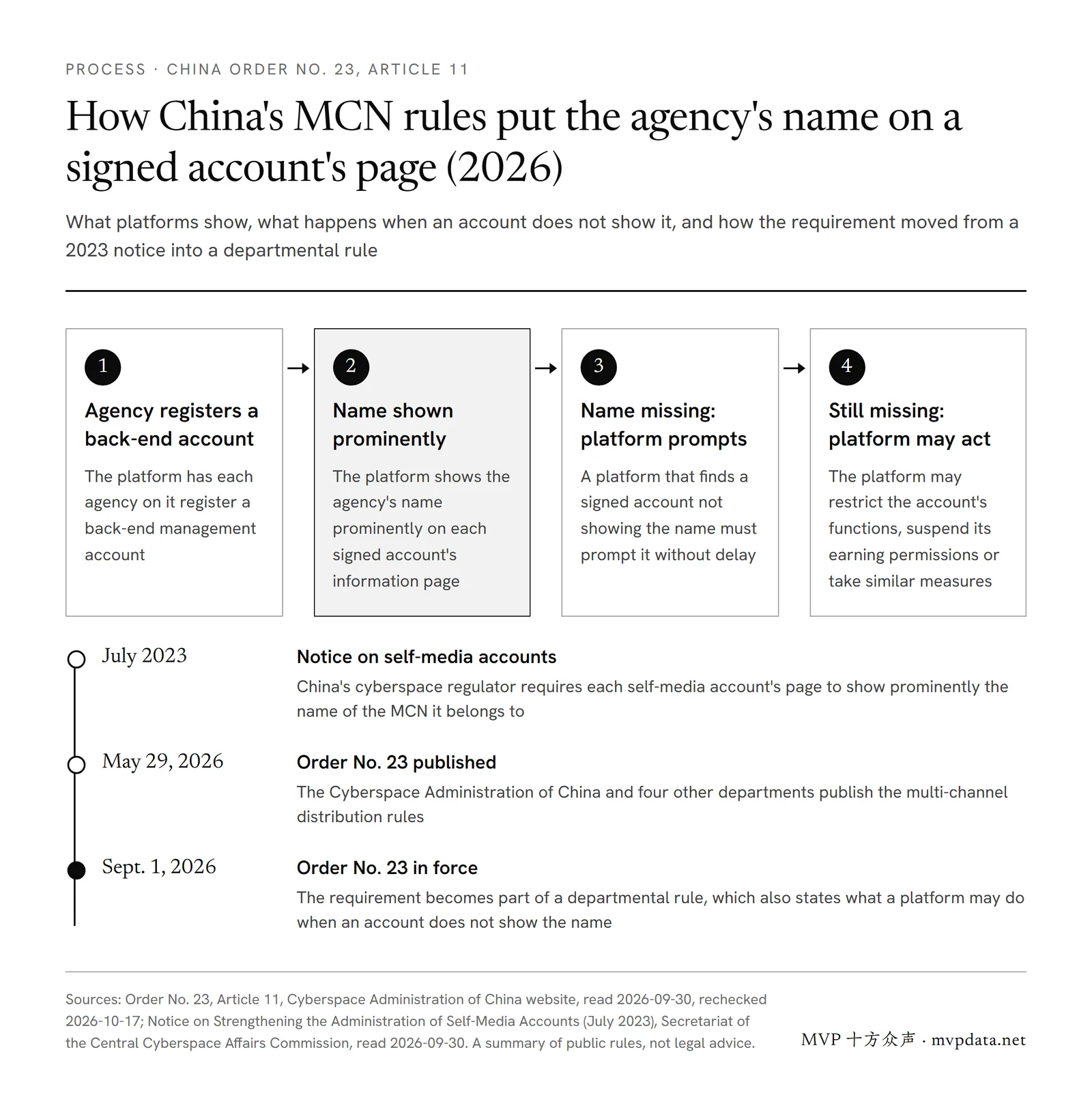
Yes. Article 11 requires platforms to have the agencies on them register a back-end management account, and to show prominently, on the information page of each signed account, the name of the agency the account belongs to. A platform that finds an account not showing it must prompt the account promptly; if it still does not, the platform may restrict the account’s functions, suspend its earning permissions or take similar measures under the law and its agreements.1
The requirement dates from 2023: item 11 of the Notice on Strengthening the Administration of Self-Media Accounts, issued by the secretariat of China’s cyberspace regulator on July 5, 2023 and made public on July 10, already required the name of the MCN an account belongs to to be shown prominently on the account’s homepage.3 Order No. 23 writes the requirement into a departmental rule and states what a platform may do when an account does not show the name.
| Date | Document | What it says about the agency’s name |
|---|---|---|
| July 2023 | Self-media notice, item 11 | Show the MCN’s name prominently on the account’s homepage3 |
| May 29, 2026 | Order No. 23 published | Article 11: platforms show the agency’s name prominently on each signed account’s information page1 |
| September 1, 2026 | Order No. 23 in force | Accounts not showing it are prompted; if still missing, functions may be restricted and earning permissions suspended1 |
What does this mean for creators and agencies?
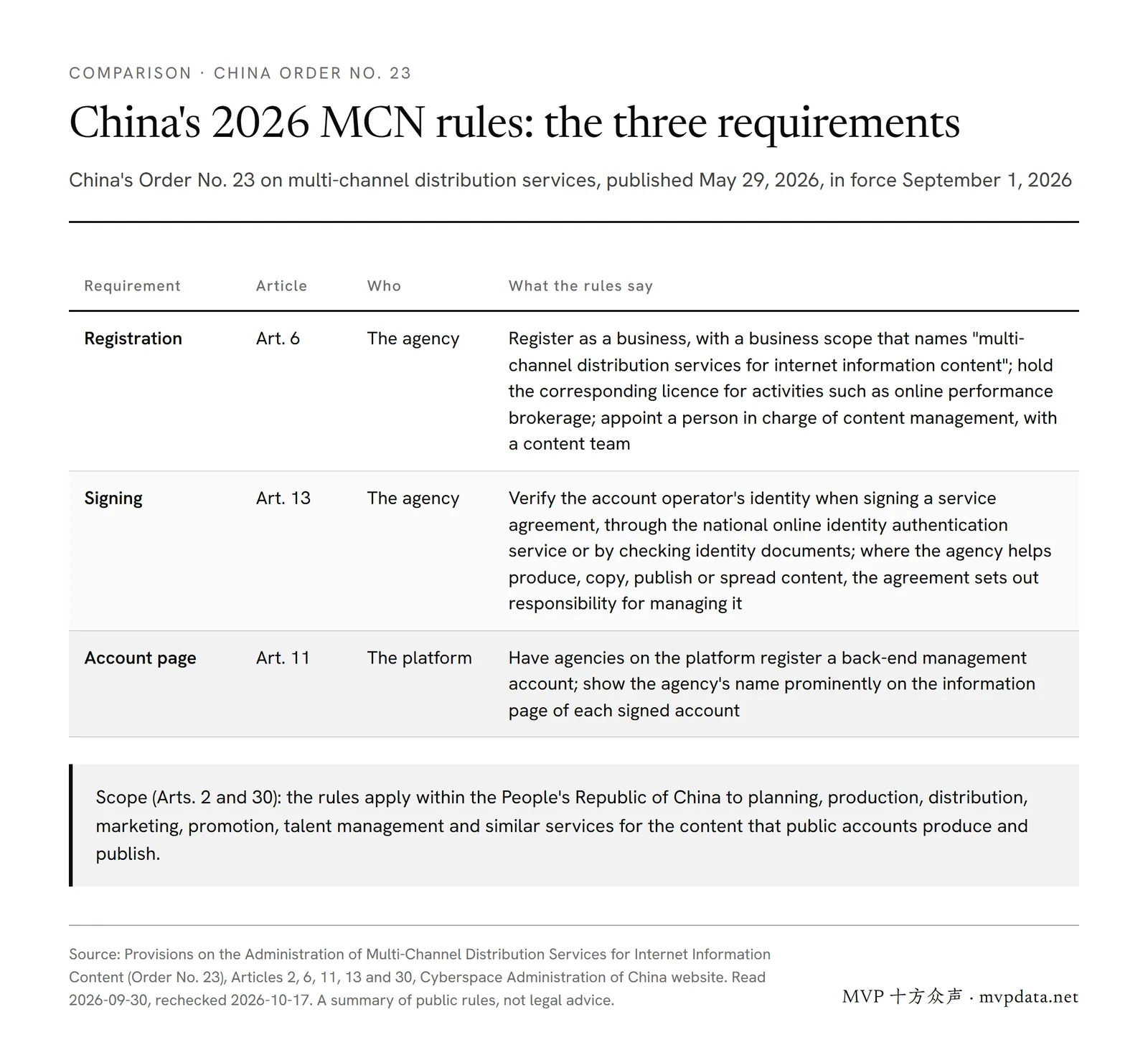
For creators, the signing relationship becomes public: the agency an account has signed with is shown on the account’s information page. At signing, the agency has to verify the identity of the account’s operator, and where it takes part in producing or publishing content, the service agreement has to say who is responsible for managing that content.
For agencies, the registered business scope, the licences their activities need and a person in charge of content management are all set out in the order; platforms, for their part, show the agency’s name and prompt and act on accounts that do not show it. Who carries each requirement:1
| Requirement | Article | Who | What the rules say |
|---|---|---|---|
| Registration | Art. 6 | The agency | Business scope names “multi-channel distribution services for internet information content”; licences for the activities that need them; a person in charge of content management and a content team |
| Signing | Art. 13 | The agency | Verify the account operator’s identity when signing the service agreement; where the agency helps produce, copy, publish or spread content, the agreement sets out responsibility for managing it |
| Account page | Art. 11 | The platform | Have agencies register a back-end management account; show the agency’s name prominently on each signed account’s information page |
Before signing, a creator can use the table as a checklist: whether the service agreement assigns responsibility for content, which agency’s name will appear on the account page, and what kind of contract it is. Contract types are explained under talent management agreement, and what to check before signing is in the FAQ.
How do common claims about China’s MCN rules compare with the text?
Several claims that circulate about the rules are narrower than the text or date the change too late. The table below was checked against the official texts on October 17, 2026.
| Common claim | What the text says | Where |
|---|---|---|
| “The rules regulate MCNs by name” | The order never uses the letters “MCN”; the regulator’s Q&A speaks of “multi-channel network agencies”2 | Order No. 23; the Q&A |
| “Only talent agencies are covered” | The service covers planning, production, distribution, marketing, promotion, talent management and similar work1 | Article 30 |
| “Showing the agency’s name is new in 2026” | The July 2023 self-media notice already required the MCN’s name on the account’s homepage3 | Notice, item 11 |
| “Displaying the name is up to the agency” | Showing the name, prompting and any follow-up measures are the platform’s duties1 | Article 11 |
| “A signed agreement is enough; no ID check is needed” | The agency must verify the account operator’s identity when signing1 | Article 13 |
How does MVP work with creators?
MVP signs creators to talent management agreements and acts as their talent agency; work in mainland China is signed by 北京十方众声传媒有限公司, and work outside it by Mega Volume Production Inc.
- Accounts stay with the creator. Accounts are held in the name of the creator or an entity the creator designates; MVP works through the platform’s collaborator or sub-account permissions and hands back all access when the engagement ends.
- Rights in writing. Who owns the content made during the engagement is set out item by item in the contract.
- One team. Each creator works with a fixed team for the long term.
MVP (Mega Volume Production, 十方众声) is headquartered in Toronto and contracts through two companies, 北京十方众声传媒有限公司 and Mega Volume Production Inc., working in talent management and cross-border brand marketing. How the work with creators runs is set out under influencers and operations; to talk it through, contact MVP.
This article summarises public rules and is not legal advice.
Notes
- 《互联网信息内容多渠道分发服务管理规定》 (Provisions on the Administration of Multi-Channel Distribution Services for Internet Information Content)
- 《互联网信息内容多渠道分发服务管理规定》答记者问 (Q&A on the Provisions on the Administration of Multi-Channel Distribution Services for Internet Information Content)
- 《关于加强“自媒体”管理的通知》 (Notice on Strengthening the Administration of “Self-Media” Accounts)
Questions
How can an agency verify a creator’s identity at signing?
Through the national online identity authentication service, by checking identity documents, or similar means. Article 13 requires the check when the agency signs a service agreement with the account’s operator.
Who is responsible for content an agency helps a creator produce?
Whoever the service agreement names. Under Article 13, an agency that helps produce, copy, publish or spread an account’s content must set out responsibility for managing that content in the agreement.
Which licences does an MCN agency need in China?
It depends on the activity. Article 6 requires the corresponding licence for internet cultural activities, online performance brokerage, online publishing, online audiovisual programmes and internet news services.
Does a messaging-only account count as a public account?
No. Article 30 defines a public account as one that publishes text, images, audio or video to the general public, and excludes internet accounts that only have a communication function.