Chinese creators on YouTube: entity, US tax and getting paid
As of October 2026 the YouTube Partner Program is open in Hong Kong, Taiwan, the US and Canada but not in mainland China, so Chinese creators must first decide which entity joins the program and gets paid, and where. With US tax info submitted, YouTube withholds 0% to 30% of earnings from US viewers; for an individual account with no tax info, it withholds 24% of total worldwide earnings. Bringing the money home, an individual in China can convert up to the equivalent of USD 50,000 a year.
Key takeaways
- The YouTube Partner Program is available in Hong Kong, Taiwan, the United States and Canada, but not in mainland China, so a mainland creator starts by choosing the entity that joins the program and is paid.
- YouTube withholds 0% to 30% of a creator’s earnings from US viewers once US tax info is submitted; for an individual account with no tax info, it withholds 24% of total worldwide earnings.
- When a channel joins an MCN, all its revenue flows through the MCN’s AdSense for YouTube account; the revenue share with YouTube stays the same, and the MCN typically takes a percentage of the creator’s portion.
- China caps individual foreign-exchange conversion at an annual total of USD 50,000 per person, and payers in Canada withhold 15% from fees paid to non-residents for services provided there.
Can creators in mainland China join the YouTube Partner Program?
As of October 2026, the YouTube Partner Program (YPP) is available in Hong Kong, Taiwan, the United States and Canada, and mainland China is not on the list.1 For a creator based in mainland China, monetizing on YouTube therefore starts with a structural question: which person or company joins the program and gets paid, and in which eligible country or region.
The question breaks down into three parts:
- Who joins. The creator personally, a company in an eligible region, or a multi-channel network (MCN). The next section compares them.
- What tax info goes to Google. It sets which earnings US tax is withheld from, and at what rate.
- Where the money lands and how it gets home. China limits how much foreign currency an individual converts each year, and Chinese tax residents have a filing window for income from abroad.
For who can use YouTube Creator Partnerships, YouTube’s own brand-deal tool, and for the brand-deal back ends and agency rules of each platform, including TikTok’s Creator Agency Business Center for China-based agencies, see brand-deal platforms and agency rules.
Which entity joins the Partner Program and gets paid, and what rules apply?
Each option is governed by a different published rule: an individual account depends on whether tax info has been submitted, a company outside the US depends on its country’s tax treaty with the US, and a channel in an MCN is paid through the MCN’s account. The table sets out only what the platform and the authorities state.
| Arrangement | What the published rules say | What else to check |
|---|---|---|
| The creator joins with an individual account | With no tax info, 24% of total worldwide earnings is withheld; with US tax info, only earnings from US viewers are withheld, at 0% to 30%2 | A Chinese tax resident with income from outside China files between March 1 and June 30 of the following year (Individual Income Tax Law, Art. 13)3 |
| A company outside the US, in an eligible region, joins | With US tax info, earnings from US viewers are withheld at 0% to 30%, depending on whether its country or region has a tax treaty with the US2 | Whether that country or region has a tax treaty with the US |
| The channel joins an MCN | All revenue flows through the MCN’s AdSense for YouTube account; the revenue share with YouTube is unchanged, and MCNs typically take a percentage of the creator’s portion4 | YouTube tells creators to understand, before joining, the fees, the services, their own obligations, the contract term, how to terminate and when payments are made4 |
For creators signed to MVP, the account stays in the creator’s own name or that of an entity the creator designates, and the revenue split and payment terms are written into the contract; see influencer management. For day-to-day work on YouTube and other platforms abroad, see social media management.
How much US tax is withheld from YouTube earnings?
With US tax info submitted, YouTube withholds US tax only from earnings from US viewers, at 0% to 30%; for an individual account with no tax info, it withholds 24% of total worldwide earnings.2
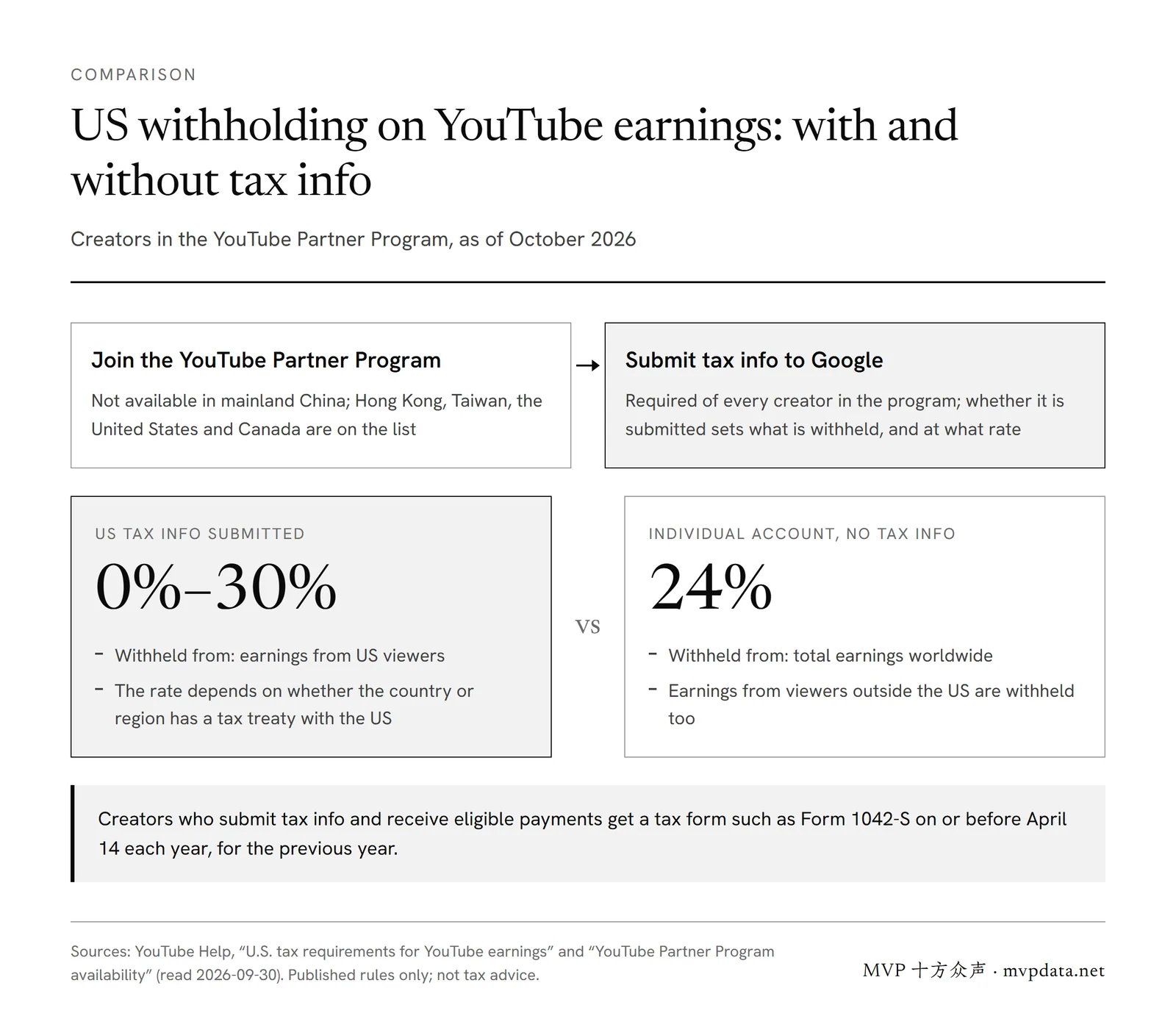
YouTube’s help page on US tax requirements makes four points:2
- Who submits. Google collects tax info from every creator in the Partner Program, wherever they live.
- With tax info. Only earnings from US viewers are withheld, at 0% to 30% depending on whether the creator’s country or region has a tax treaty with the US.
- Individual account, no tax info. Withholding applies to total worldwide earnings at 24%, so earnings from viewers outside the US are caught too.
- Tax forms. Creators who have submitted tax info and received eligible payments get a form such as the 1042-S on or before April 14 for the previous year.
| Situation | Withheld from | Rate |
|---|---|---|
| US tax info submitted | Earnings from US viewers | 0% to 30%, depending on any tax treaty with the US2 |
| Individual account, no tax info | Total earnings worldwide | 24%2 |
A worked example with those rates: a month’s earnings of USD 1,000, of which USD 400 comes from US viewers.
| Situation | Calculation | Withheld |
|---|---|---|
| Individual account, no tax info | 1,000 × 24% | USD 240 |
| Tax info submitted, top rate of 30% | 400 × 30% | USD 120 |
| Tax info submitted, rate of 0% | 400 × 0% | USD 0 |
The actual rate depends on the tax info submitted and on any tax treaty between the creator’s country or region and the US.2
How much foreign currency can an individual convert in China each year?
Under Article 2 of the Detailed Rules for the Measures on Individual Foreign Exchange, an individual’s conversion of foreign currency into renminbi, and a resident’s purchase of foreign currency, each have an annual total of USD 50,000 per person.5
- The limit. Conversion and purchase are counted separately, each at the equivalent of USD 50,000 per person per year, and the State Administration of Foreign Exchange (SAFE) may adjust the figure.5
- Above the limit. A bank handles the transaction against the supporting documents the rules require.5
- Still current. A SAFE Q&A of December 23, 2025 gives the same figure.5
Bringing income home also raises Chinese income tax. Under Article 13 of the Individual Income Tax Law, a resident individual with income from outside China files a return between March 1 and June 30 of the year after the income is received.3
What is the withholding tax for non-residents performing services in Canada?
The payer withholds 15% of the gross amount when it pays a non-resident (other than an employee) for services provided in Canada, under section 105 of the Income Tax Regulations.6
- What it is. The withholding is a payment on account of the non-resident’s overall tax liability to Canada, not necessarily the final tax.6
- Relief. A waiver or reduction can be requested, and the Canada Revenue Agency may consider it.6
- The arithmetic. On a CAD 10,000 service fee, the payer withholds CAD 1,500 and pays out CAD 8,500.
For a Chinese creator or performer paid for services in Canada, this rule sets how much arrives at the time of payment.
Who can file an O-1B petition?
A US employer, a US agent, or a foreign employer through a US agent can file the O-1B petition on Form I-129.7
The O-1B covers individuals with an extraordinary ability in the arts or extraordinary achievement in the motion picture or television industry.7 A Chinese creator working in the US therefore does not need a US employer: a foreign employer can file through a US agent.7
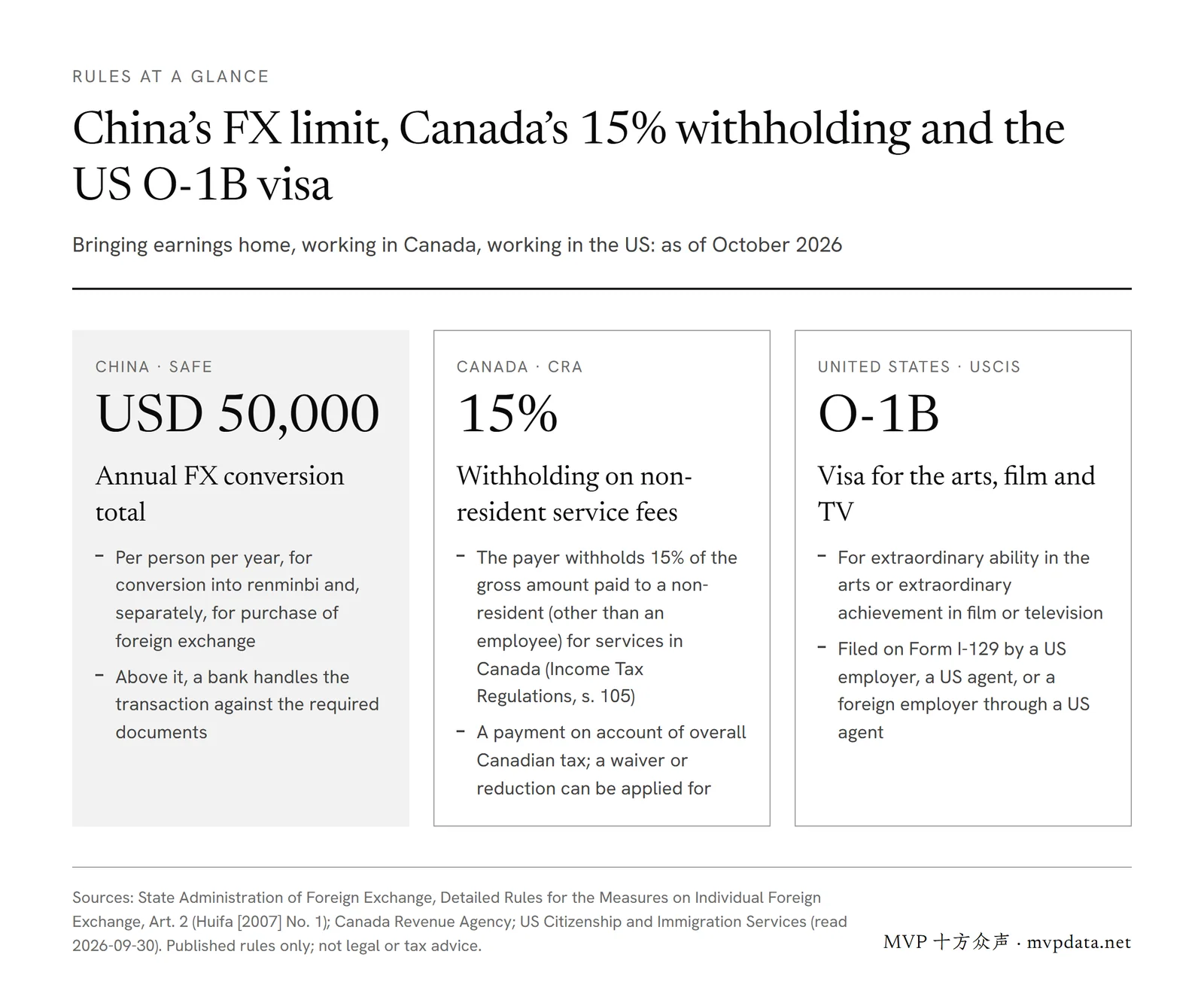
The three rules for bringing money home, working in Canada and working in the US, side by side:
| Rule | Amount or scope | What else it says |
|---|---|---|
| China’s conversion limit | Individuals’ conversion of foreign currency into renminbi, and residents’ purchase of foreign currency, each have an annual total of USD 50,000 per person | Managed by annual total; above it, a bank handles the transaction against the supporting documents the rules require (Detailed Rules, Art. 2)5 |
| Canada’s withholding | A payer withholds 15% of the gross amount paid to a non-resident (other than an employee) for services provided in Canada | A payment on account of the non-resident’s overall tax liability to Canada; a waiver or reduction can be requested (Income Tax Regulations, s. 105)6 |
| The US O-1B visa | For individuals with an extraordinary ability in the arts or extraordinary achievement in the motion picture or television industry | Filed on Form I-129 by a US employer, a US agent, or a foreign employer through a US agent7 |
What do people get wrong about YouTube tax and cross-border payments?
A common misreading is that YouTube takes a flat 30%: with US tax info submitted, only earnings from US viewers are withheld, at 0% to 30%. The table checks eight common claims against the source text (verified 2026-10-17).
| Claim | What the source says |
|---|---|
| YouTube withholds a flat 30% | With US tax info, only earnings from US viewers are withheld, at 0% to 30% depending on any treaty; for an individual account with no tax info, 24% of total worldwide earnings2 |
| Only earnings from US viewers are ever taxed | For an individual account with no tax info, withholding applies to total worldwide earnings2 |
| Creators outside the US don’t need to give YouTube tax info | Google collects tax info from creators in the Partner Program2 |
| Creators in mainland China can sign up for the Partner Program directly | Mainland China is not on the availability list; Hong Kong, Taiwan, the US and Canada are1 |
| Joining an MCN gets you a better revenue share from YouTube | Joining an MCN does not change the revenue share with YouTube; MCNs typically take a percentage of the creator’s portion4 |
| You can’t convert more than USD 50,000 a year in China | Above the annual total, a bank handles it against the supporting documents the rules require5 |
| Canada’s 15% withholding is the final tax | It is a payment on account of the non-resident’s overall tax liability, and a waiver or reduction can be requested6 |
| Only a US employer can file an O-1B petition | A US employer, a US agent, or a foreign employer through a US agent can file Form I-1297 |
How MVP handles YouTube for Chinese creators
MVP runs YouTube, Instagram, TikTok and other platforms abroad for creators and public figures expanding overseas, and works with Chinese-speaking creators in North America. MVP (Mega Volume Production, 十方众声) is headquartered in Toronto and contracts through 北京十方众声传媒有限公司 in mainland China and Mega Volume Production Inc. in Canada, working in talent management and cross-border brand marketing.
- The contracting entity follows the market. Business in mainland China is signed by 北京十方众声传媒有限公司; business abroad by Mega Volume Production Inc.
- Accounts stay with the creator. Accounts are held in the name of the creator or an entity the creator designates; MVP works through the platform’s collaborator or sub-account permissions and hands back all access when the engagement ends.
- A disclosed revenue split. MVP signs creators to a management contract and takes 15% to 30% of their commercial income, with the rest going to the creator; the exact share depends on the scope and is written into the contract, and every item of income and expense is shown to the creator. See influencer management.
- Running the channels. Content direction, posting schedules and performance reviews are on social media management; regional and tax conditions for going abroad are on incubation.
- Specialist work. Legal and other specialist work is done with outside professional firms.
To build a Chinese creator’s presence on YouTube and other platforms abroad, contact MVP.
This article summarises published rules as of October 2026; it is not legal or tax advice.
Notes
- YouTube Partner Program availability
- U.S. tax requirements for YouTube earnings
- 《中华人民共和国个人所得税法》 (Individual Income Tax Law of the People’s Republic of China)
- Multi-Channel Network (MCN) overview for YouTube Creators
- 《国家外汇管理局关于印发《个人外汇管理办法实施细则》的通知》 (SAFE Notice Issuing the Detailed Rules for the Measures on Individual Foreign Exchange)
- Tax treatment of non-residents who perform services in Canada
- O-1 Visa: Individuals with Extraordinary Ability or Achievement
Questions
When does YouTube send Form 1042-S?
On or before April 14 each year, covering the previous year. Creators who have submitted tax info and received eligible payments get a form such as the 1042-S.
Can a Hong Kong or Taiwan entity join the YouTube Partner Program?
Yes, both are on the list. As of October 2026, Hong Kong and Taiwan are among the places where the YouTube Partner Program is available, as are the United States and Canada.
How do you convert more than USD 50,000 a year in China?
Above the annual total, a bank handles the conversion against the supporting documents the rules require. Article 2 of the Detailed Rules sets the total at USD 50,000 per person per year, and SAFE may adjust it.
Can the 15% Canadian withholding on non-residents be reduced?
Yes, you can apply. The Canada Revenue Agency treats the amount as a payment on account of the non-resident’s overall Canadian tax and may consider a waiver or reduction.