Do Chinese influencers need a degree? What the rules actually say
As of October 2026, no Chinese rule requires influencers to hold a degree: those posting on medicine, finance, law or education must pass a platform credential check of their professional qualification, service credentials or background, and livestream hosts must also file a professional qualification with the platform. Health accounts face the strictest checks, with licences and proof of employment verified. The October 2025 “degree law” reports cite no official document.
Key takeaways
- Accounts registering to post on medicine and health, education, the economy or justice must supply service credentials, professional qualifications or professional background for the platform to verify and label (Article 11 of the Provisions on the Administration of Internet User Account Information, in force since August 1, 2022).
- Hosts who livestream on medicine and health, finance, law or education must hold the relevant professional qualification and file it with the platform (Article 13 of the 2022 Code of Conduct for Online Hosts).
- Platforms must suspend publishing in the field for finance, education, health and justice accounts that are uncertified or whose certification has lapsed (item 2 of the 2023 notice on self-media accounts).
- Health-education accounts have their medical licences and proof of employment checked, and the profile shows the department, whether the person is still employed there and the MCN the account is signed with (notice of July 28, 2025).
- The October 2025 English reports of a “degree law” name no document or document number; none of the seven official texts cited here (one of them a draft) mentions a degree.
Do influencers in China need a degree or licence to discuss medicine, finance, law or education?
No degree is required; what they need is a credential verified by the platform: it checks the service credentials, professional qualification or professional background the account submits, names the certified materials on the profile and adds a label for the field.1 Hosts who livestream on these subjects must also hold the relevant professional qualification and file it with the streaming platform.2
The short version:
- Which fields: the documents name medicine and health, finance (worded as “finance and economics” or “the economy” in some texts), law (or “justice”) and education.
- What counts: most accounts submit service credentials, professional qualifications or professional background; health-education accounts submit licences such as the physician’s qualification certificate, the physician’s practising certificate or the nurse’s practising certificate, plus proof of employment from their institution.3
- Who enforces it: the platforms. The documents set duties for platforms, and the platforms act on accounts.
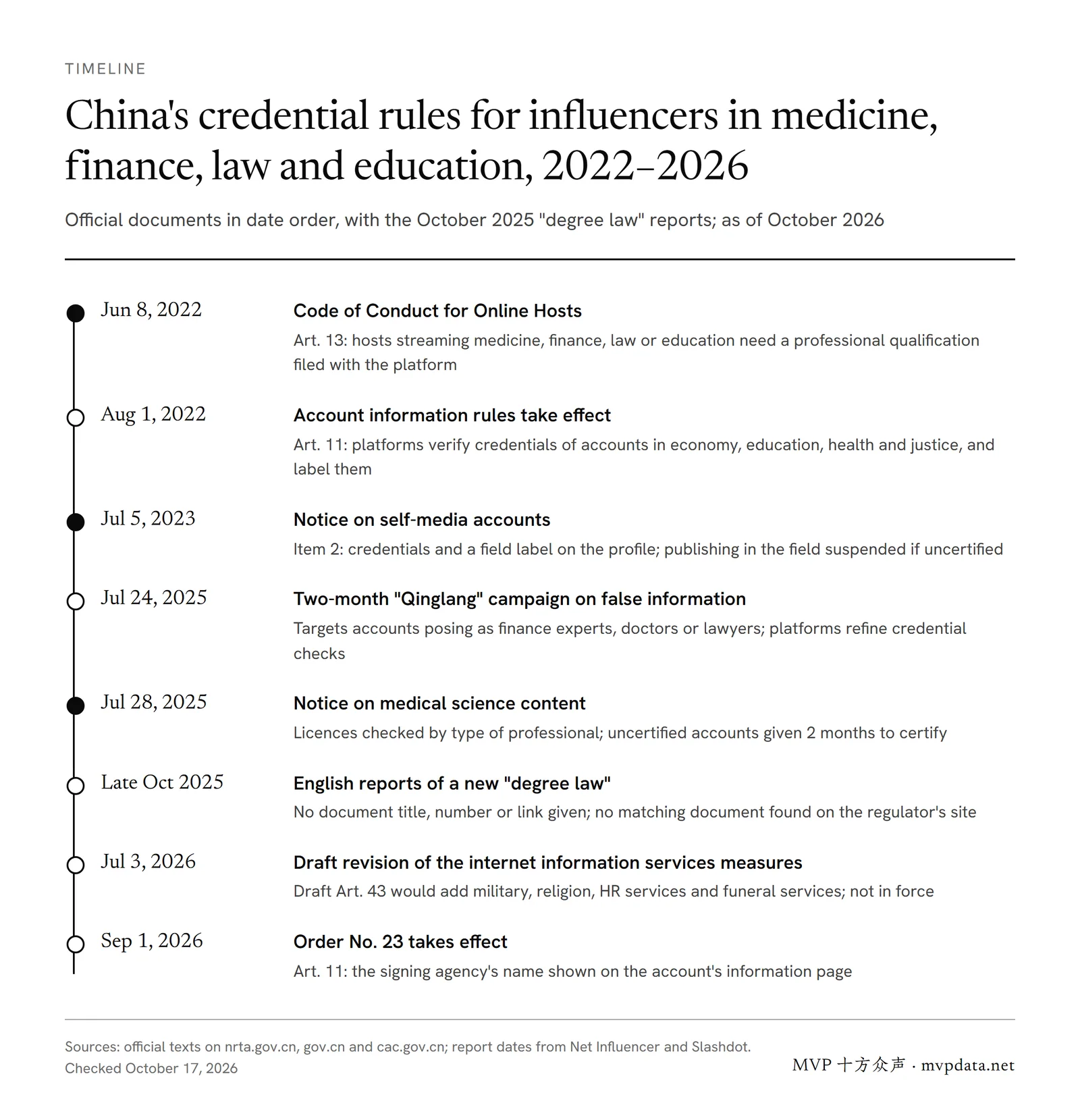
No text sets a degree requirement. None of the seven official texts cited here (one of them a draft) uses the Chinese words for an academic degree (学历, 学位). The documents, in date order, as of October 2026:
| Date | Document | Issued by | What it says about credentials |
|---|---|---|---|
| Issued June 8, 2022 | Code of Conduct for Online Hosts (NRTA No. 36 of 2022)2 | National Radio and Television Administration; Ministry of Culture and Tourism | Art. 13: livestreaming specialist content needs a professional qualification filed with the platform |
| In force August 1, 2022 | Provisions on the Administration of Internet User Account Information (CAC Order No. 10)4 | Cyberspace Administration of China | Art. 11: the platform verifies credentials for accounts in specialist fields and labels them |
| Issued July 5, 2023 | Notice on Strengthening the Administration of Self-Media Accounts1 | Secretariat of the Central Cyberspace Affairs Commission | Item 2: credentials and a field label on the profile; publishing in the field suspended if uncertified |
| Started July 24, 2025 | “Qinglang” campaign against false information from self-media accounts5 | Secretariat of the Central Cyberspace Affairs Commission | Two months against accounts posing as finance experts, doctors or lawyers; platforms refine credential checks |
| Issued July 28, 2025 | Notice on Regulating Health Science Content by Self-Media Accounts3 | The Commission’s secretariat and three other departments | Checks by type of medical professional, profile display, limits on disguised ads |
| Late October 2025 | English reports of a new “degree law”6 | Attributed by the reports to the Cyberspace Administration | No document title, number or link given |
| Second comment round July 3, 2026 | Draft revision of the Measures for the Administration of Internet Information Services7 | Cyberspace Administration of China | Draft Art. 43 would widen the fields checked; not in force |
| In force September 1, 2026 | Provisions on Multi-Channel Distribution Services (Order No. 23)8 | Cyberspace Administration of China and four other departments | Art. 11: the signing agency’s name on the account’s information page |
What does Article 13 of China’s Code of Conduct for Online Hosts require?
Article 13 says that for livestreamed content that needs a higher level of expertise, such as medicine and health, finance, law and education, the host should obtain the relevant professional qualification and file it with the streaming platform, and the platform should review and record it.2
The code was issued on June 8, 2022 by the National Radio and Television Administration (NRTA) and the Ministry of Culture and Tourism, and posted on the NRTA’s website on June 22 as document No. 36 of 2022.2 Article 1 sets its reach: anyone who provides online performances or audio-visual programs as a host, including people who livestream, interact with users in real time, or appear and speak in uploaded audio and video; AI-generated virtual hosts are covered by reference.2
Two points are easy to miss:
- The word is “professional qualification” (执业资质), the credential that lets someone practise in a field. The article does not mention degrees. What it adds is a filing step: the host files the qualification, and the platform reviews and records it.
- It is about livestreams. The credential rules for short videos and posts come from the account information rules and the 2023 notice, covered next.
What must an account in a specialist field submit when it registers?
The platform must ask for service credentials, professional qualifications or professional background, verify them, and add a special label to the account information. That is Article 11 of the Provisions on the Administration of Internet User Account Information, which covers accounts registering to produce content on the economy, education, medicine and health, justice and similar fields, and has applied since August 1, 2022.4
The 2023 notice on self-media accounts, from the secretariat of the Central Cyberspace Affairs Commission, spells out the follow-through:1
- Item 2: for self-media accounts producing content on finance, education, medicine and health or justice, platforms must verify strictly, show the names of the credential materials (service credentials, professional qualifications, professional background) on the profile and add a label for the field; for accounts that are uncertified or whose certification has expired, they must suspend publishing in that field.
- Item 12: accounts that publish in these fields without passing certification face removal of interaction features, muting or closure.
From July 24, 2025, the Commission ran a two-month “Qinglang” campaign against false information from self-media accounts.5 One of its four targets was false information in specialist fields, including accounts that skip certification, or use false or expired certification, to pose as finance experts, doctors or lawyers. Platforms were told to refine their certification process, show the certified field and identity to the public while protecting personal information, and keep checking that an account’s name, credentials and actual business match; an account that fails to certify for the first time gets a prompt.5
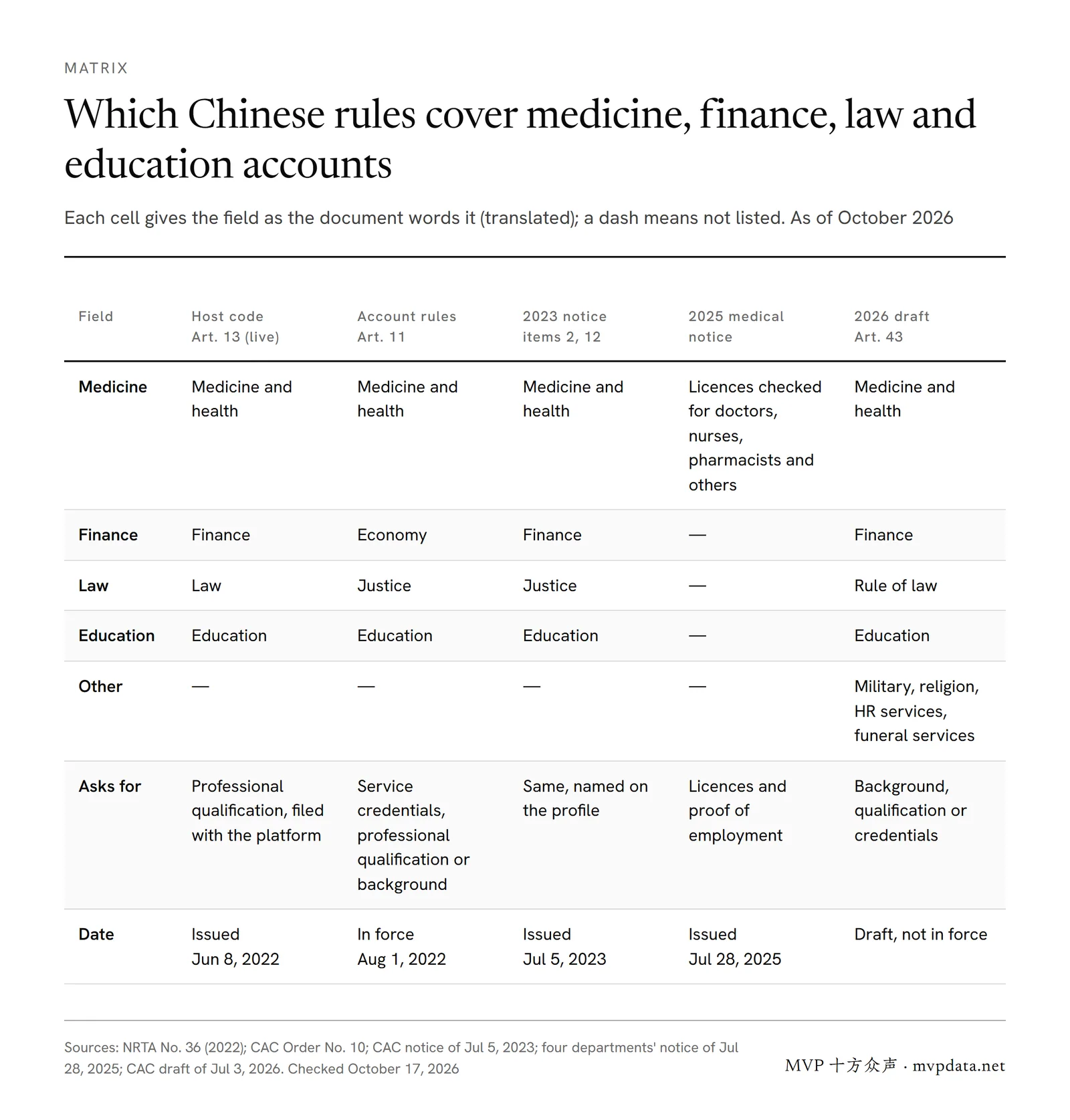
The documents do not word the four fields the same way. In each document’s own terms:
| Field | Host code Art. 13 (livestreams) | Account rules Art. 11 | 2023 notice items 2 and 12 | 2025 medical notice | 2026 draft Art. 43 |
|---|---|---|---|---|---|
| Medicine | Medicine and health | Medicine and health | Medicine and health | Licences checked for doctors, nurses, pharmacists and others | Medicine and health |
| Finance | Finance | Economy | Finance | — | Finance |
| Law | Law | Justice | Justice | — | Rule of law |
| Education | Education | Education | Education | — | Education |
| Other | — | — | — | — | Military, religion, HR services, funeral services |
| Asks for | Professional qualification, filed with the platform | Service credentials, professional qualification or background | The same, named on the profile | Licences and proof of employment | Professional background, qualification or service credentials |
The list of fields may grow. On July 3, 2026 the Cyberspace Administration opened a second round of public comment, closing August 2, 2026, on a draft revision of the Measures for the Administration of Internet Information Services.7 Draft Article 43 would have accounts registering to produce content on finance, education, medicine and health, the rule of law, military affairs, religion, human-resources services, funeral services and similar fields supply their professional background in the field and any qualification or service credential held under law, for the platform to verify and label; draft Article 76 puts the penalty for breaching it on the platform.7 It is a draft and does not apply until a final text is issued; when we checked on October 17, 2026, we found no adopted text on the Cyberspace Administration’s website.
What does China’s 2025 notice require of doctors and other health creators?
Health education has more detailed rules than any other field. A notice issued on July 28, 2025 by the secretariat of the Central Cyberspace Affairs Commission, the general offices of the National Health Commission and the State Administration for Market Regulation, and the National Administration of Traditional Chinese Medicine, posted on August 1, has platforms check licences by type of professional, show credentials and employment on the profile, and keep uncertified accounts from publishing professional health-education content.3 Its eight items:
| Item | What it requires |
|---|---|
| 1. Checks by type | Staff of medical institutions are sorted into physicians (Western and Chinese medicine), nurses, pharmacists, medical technicians and researchers, and their certificates checked: physician’s qualification certificate, physician’s practising certificate, nurse’s practising certificate, the pharmacy professional qualification, plus proof of employment from the institution naming the department; staff of medical schools and drug research bodies submit proof of employment from their institution |
| 2. Profile display | Certificate names and professional scope; the exact name of the hospital department, school or research unit; whether the person is still employed there; the MCN the account is signed with |
| 3. Sources and labels | Reposted professional content, old news, staged medical scenes, AI-generated health content and personal health stories must carry a source or an AI-generation label |
| 4. Verification | Doctors’ and nurses’ practice details are checked against the National Health Commission’s official look-up |
| 5. No credential, no content | Existing uncertified accounts are given two months to certify; new accounts may not publish professional health-education content before certification |
| 6. Conduct | Strict control of unlawful paid online consultations, of certified accounts livestreaming without the certified doctor on camera, and of steering users to other platforms or uncertified accounts |
| 7. No disguised ads | Health and wellness tips may not be used to advertise medical services, drugs, medical devices, health food or foods for special medical purposes, and the same page may not carry a seller’s address, contact details or shopping links |
| 8. Graded measures | Interaction removed, followers cleared, earning permissions removed, muting, closure |
All eight items come from the same notice.3 How doctors and lawyers can build a personal brand is covered on our personal brand page, under “Can doctors and lawyers build a personal brand?”
Where did the October 2025 reports of a Chinese “degree law” come from?
No official document matches them: the reports give no document title, number or link, what they describe broadly matches documents issued between 2022 and July 2025, and none of those documents requires a degree.
What the reports said:
- Net Influencer, on October 28, 2025, wrote that the Cyberspace Administration of China “started implementing new regulations on October 25” requiring degrees for influencers on professional topics, and mentioned a ban on medical advertising and duties for platforms to verify credentials; it cites no official document.6
- A Slashdot story of October 29, 2025 said the “new law went into effect on Saturday”, requiring degrees, certifications or licences for medicine, law, education and finance, with platforms such as Douyin, Bilibili and Weibo verifying credentials and ensuring citations and disclaimers; it repeated another outlet’s report of fines, and names or links no Chinese government document.9
- Lindsey Gamble’s blog said the law “took effect this month” and that breaking it “can result in account suspension, content removal, or fines”; its only source for the rule is an article in India’s Economic Times.10
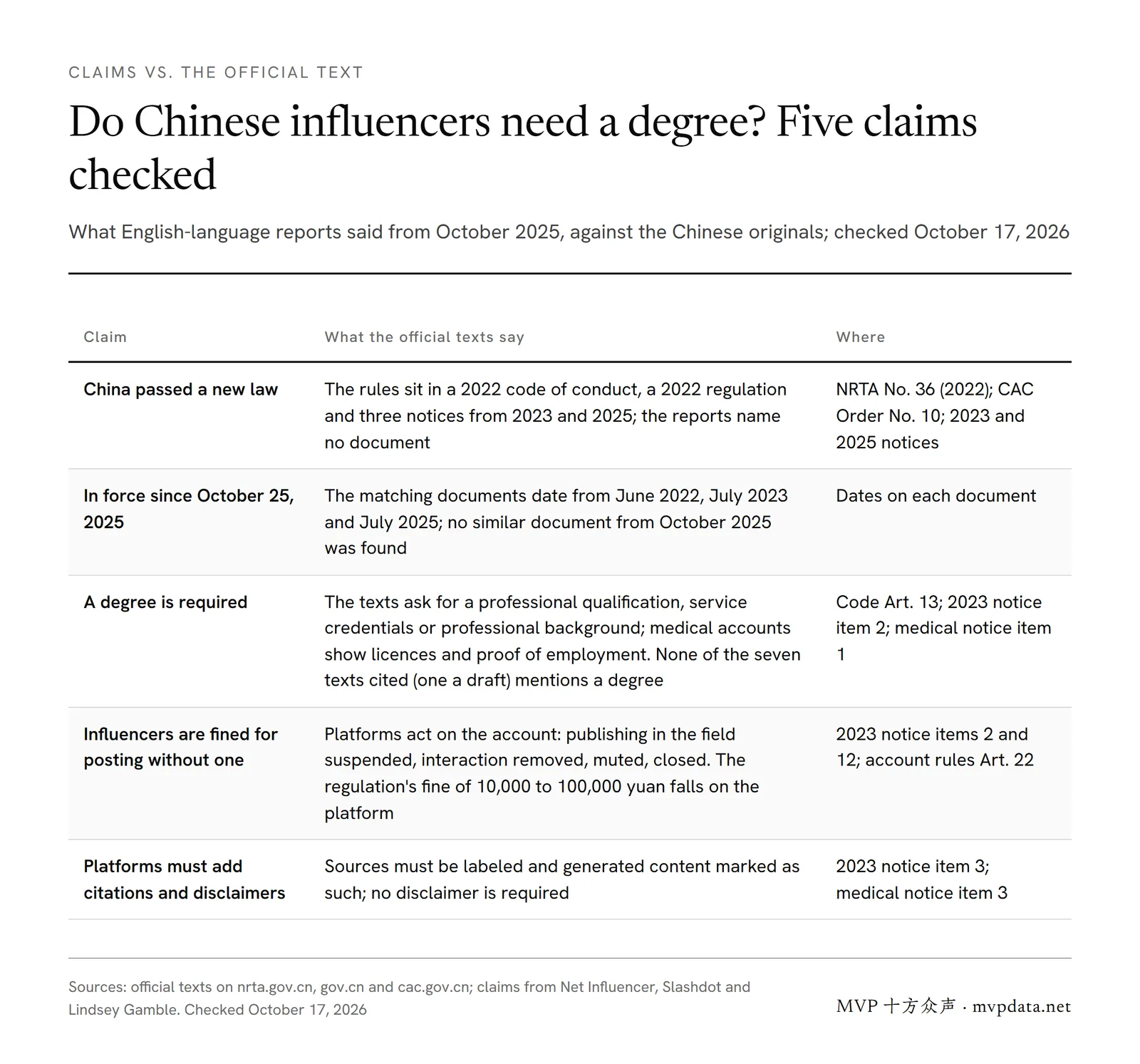
Checked claim by claim against the originals:
| Claim | What the official texts say | Where |
|---|---|---|
| China passed a new law | The requirements sit in a 2022 code of conduct and a 2022 regulation, and in three notices from 2023 and 2025 | NRTA No. 36 (2022);2 CAC Order No. 10;4 the 2023 notice;1 the 2025 notices5,3 |
| In force since October 25, 2025 | The matching documents date from June 2022, July 2023 and July 2025 | The dates on each document |
| A degree is required | The texts ask for a professional qualification, service credentials or professional background; medical accounts submit licences and proof of employment | Code Art. 13; 2023 notice item 2;1 medical notice item 13 |
| Influencers are fined for posting without one | Platforms act on the account: publishing in the field suspended, interaction removed, muted, closed; the fine in the account rules, 10,000 to 100,000 yuan, falls on the platform | 2023 notice items 2 and 12;1 account rules Art. 224 |
| Platforms must add citations and disclaimers | Sources must be labeled and technically or AI-generated content marked; no disclaimer is required | 2023 notice item 3;1 medical notice item 33 |
Our check, on October 17, 2026: a search of the Central Cyberspace Affairs Commission’s website for documents from around October 2025 found no credential document for self-media accounts that matches the reports. The platform checks and the limits on medical advertising that the reports mention appear in the 2023 notice on self-media accounts and in the July 2025 medical notice.
What must appear on a Chinese creator’s account profile?
Three kinds of information: the names of the certified materials and a label for the field, the licences, department and employment status of a health-education account, and the name of the agency the account is signed with.
| What is shown | Which accounts | Basis |
|---|---|---|
| Names of the credential materials (service credentials, professional qualification, professional background) and a field label | Finance, education, health and justice self-media accounts | 2023 notice item 21 |
| A special label in the account information | Accounts registered for the economy, education, medicine and health, or justice | Account rules Art. 114 |
| Certificate names and professional scope, the exact department or unit, whether still employed, the MCN the account is signed with | Health-education accounts | Medical notice item 23 |
| The MCN the account belongs to, shown prominently | Self-media accounts signed with an MCN | 2023 notice item 111 |
| The multi-channel distribution agency the account belongs to | Public accounts signed with an agency, from September 1, 2026 | Order No. 23 Art. 118 |
Order No. 23, in force since September 1, 2026, put the agency name into a departmental regulation: the platform must show, prominently, the name of the agency a signed account belongs to on that account’s information page.8 Its other requirements, on agency registration and identity checks at signing, are in China’s multi-channel distribution rules.
What should a brand check before booking a health or finance creator in China?
Three things first: whether the certification on the profile covers the subject of the campaign, which agency the account is signed with, and whether the content could count as a disguised advertisement. A checklist:
- Certified field: the credential names and field label on the profile match the subject of the content.1
- Medical details: certificate names and scope, department and current employment should all be on the profile.3
- Signing agency: the account’s information page should show the agency it belongs to, which can be checked against whoever is offering the deal.8
- How the ad is written: health and wellness content may not double as an ad for medical services, drugs, medical devices, health food or foods for special medical purposes, and the same page may not carry a seller’s address, contact details or shopping links.3
- Who is on camera: on a certified account’s livestream, the certified doctor appears in person; the notice lists streams without the certified doctor on camera among the practices platforms must control strictly.3
- Sources and labels: cited material carries its source, and AI-generated health content carries a generation label.3
How a brand from outside China works with creators on Chinese platforms is set out under cross-border influencer marketing.
How does MVP work with professionals building a public profile?
MVP builds personal brands for established professionals, with a fixed team that stays with each one for the long term and handles positioning, operations and deal negotiation.
For doctors, lawyers and other licensed specialists, MVP first reads their profession’s rules and the platform’s credential rules, then assesses each case on its own; health-education accounts must show the agency they are signed with, which is one reason each case is assessed separately.
In practice:
- Before working together: a review of public information and reputation.
- During the work: risk response is handled in-house; legal work is done with outside law firms, while MVP reviews contract risk and organizes evidence and does not give legal opinions.
- For brands: MVP also runs cross-border influencer marketing in both directions, connecting North American brands with creators in China, and Chinese brands with Chinese-speaking creators in North America.
MVP (Mega Volume Production, 十方众声) is headquartered in Toronto and contracts through two companies, 北京十方众声传媒有限公司 and Mega Volume Production Inc., working in talent management and cross-border brand marketing. For how a professional’s personal brand gets started, see personal brands and operations; to talk it through, contact MVP.
This article only sets out published rules and is not legal advice.
Notes
- 《关于加强“自媒体”管理的通知》 (Notice on Strengthening the Administration of “Self-Media” Accounts)
- 《网络主播行为规范》 (Code of Conduct for Online Hosts)
- 《关于规范“自媒体”医疗科普行为的通知》 (Notice on Regulating Health Science Content by Self-Media Accounts)
- 《互联网用户账号信息管理规定》 (Provisions on the Administration of Internet User Account Information)
- 《关于开展“清朗·整治‘自媒体’发布不实信息”专项行动的通知》 (Notice on the “Qinglang” Campaign against False Information Published by Self-Media Accounts)
- China Now Requires Degrees For Influencers Discussing Professional Topics
- 《国家互联网信息办公室关于《互联网信息服务管理办法(修订草案征求意见稿)》再次公开征求意见的通知》 (Notice of the Cyberspace Administration of China Seeking Public Comment Again on the Draft Revision of the Measures for the Administration of Internet Information Services)
- 《互联网信息内容多渠道分发服务管理规定》 (Provisions on the Administration of Multi-Channel Distribution Services for Internet Information Content)
- New China Law Fines Influencers If They Discuss ‘Serious’ Topics Without a Degree
- China’s New Law Requires Influencers to Have Degrees or Licenses to Post on “Serious” Topics Like Finance, Health, Medicine, and Law
Questions
Can someone without a professional licence talk about health or money online in China?
It depends on what the platform certifies. The materials it checks include service credentials and professional background, not only licences, and platforms must suspend publishing in the field for uncertified finance, education, health and justice accounts. Medical content is stricter: an account without medical certification may not publish professional health-education content.
How long does an existing health account have to get certified?
Two months. The 2025 notice tells platforms to review existing health-education accounts and give uncertified ones two months to complete certification; newly registered accounts may not publish professional health-education content until they are certified.
How is personal information protected when credentials are shown on the profile?
Platforms must protect personal information while showing credentials. The 2025 medical notice requires platforms to protect personal information and take suitable measures for credential data, and the 2025 Qinglang campaign asks platforms to show the certified field and identity while protecting personal information.
Do these rules apply to Chinese-language creators on YouTube or Instagram?
They are aimed at platforms in China. Article 2 of the account information rules applies them to accounts registered and used with internet information service providers within the People’s Republic of China, and the two self-media notices address websites and platforms. Platforms abroad apply their own rules.