Morality clauses: how talent exits when the brand is in trouble
As of October 2026, Chinese law gives talent three ways out of an endorsement contract when the brand runs into trouble: agreed termination events (Civil Code Art. 562), statutory termination for a breach that defeats the contract’s purpose (Art. 563), and the rules for ending a likeness license (Art. 1022). Article 562 also supports a reverse morality clause that names brand-side events as the talent’s own triggers.
Key takeaways
- When the brand is in trouble, talent can exit an endorsement contract in China on three grounds: agreed termination events (Art. 562), statutory termination (Art. 563) and the rules for ending a likeness license (Art. 1022).
- Where a likeness license has no agreed or no clear term, either party may end it at any time, giving notice a reasonable time in advance.
- Whatever the ground, the terminating party must give notice; the contract ends when the notice arrives, and if the other side objects, either party may ask a court or arbitral body to confirm.
- A US federal court ruling notes that, under the New York law governing that contract, a brand may not use a morality clause arbitrarily or irrationally even where the clause calls its decision conclusive.
- An endorser can be jointly liable with the brand for false advertising, so the talent’s own termination triggers belong in the contract before signing.
What does a morality clause in an endorsement contract usually say?
A morality clause lets the brand end the contract when the endorser breaks the law or gets caught up in something that damages their public image. An endorser’s reputation and the brand’s goodwill are tied together, and the clause gives the brand a fast way out when the endorser’s side of that tie fails.
A 2012 ruling of the US District Court for the Middle District of North Carolina quotes the morality clause from an athlete’s endorsement agreement.1 As the court quotes it, the brand could terminate at once if the endorser:
- committed, or was arrested for, any crime;
- became involved in any situation tending to bring them into public disrepute, contempt, scandal or ridicule;
- became involved in any situation tending to shock, insult or offend the majority of the consuming public.
The clause added that the brand’s decision on these matters “shall be conclusive”.1 How the court treated that sentence is covered in the section on US courts below.
In China, brands also have a regulatory reason to write these clauses. The 2022 Guiding Opinions on Further Regulating Advertising Endorsements by Celebrities, issued by the State Administration for Market Regulation and six other departments, require a company to look into an endorser’s professional record and personal credit before choosing them, and to refuse endorsers known for unlawful or unethical conduct. “Celebrities” in the opinions covers well-known artists, entertainment stars and online influencers.2
The clause quoted above gives the termination right to the brand only. Brands get into trouble too: a product turns out to be unsafe, the regulator penalizes the company for false advertising, or the fee stops arriving. The endorser’s name goes down with the brand, which raises the question of what the talent’s side can do about it.
How can the talent’s side exit when the brand is in trouble?
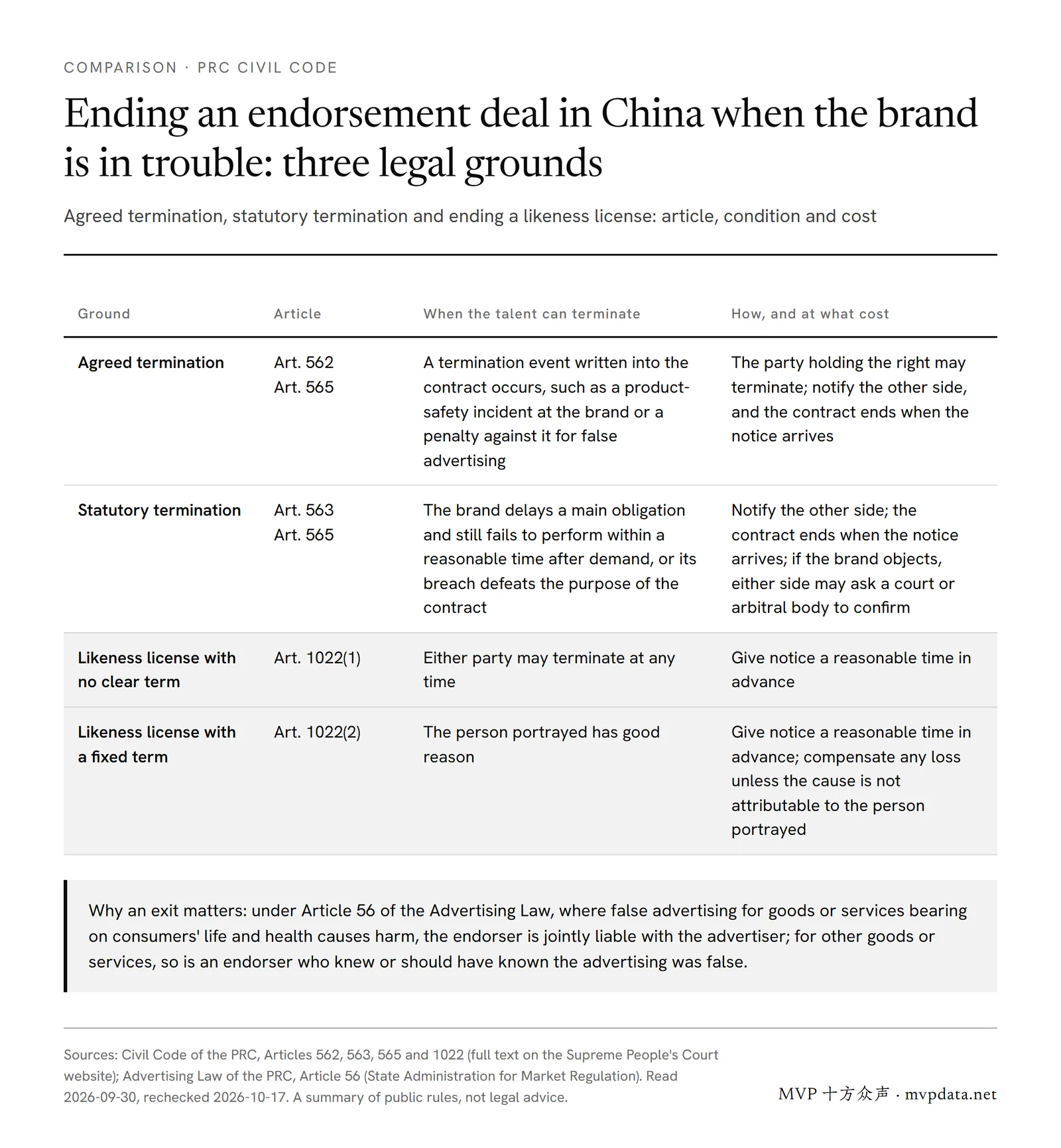
As of October 2026, the talent has three grounds under China’s Civil Code: a termination event agreed in the contract, statutory termination, and the rules for ending a likeness license.3
| Ground | Article | When the talent can terminate | How, and at what cost |
|---|---|---|---|
| Agreed termination | Arts. 562 and 5653 | A termination event written into the contract occurs, such as a product-safety incident at the brand or a penalty against it for false advertising | The party holding the right may terminate; it must notify the other side, and the contract ends when the notice arrives |
| Statutory termination | Arts. 563 and 5653 | The brand delays a main obligation and still fails to perform within a reasonable time after demand, or its breach defeats the purpose of the contract | Notify the other side; the contract ends when the notice arrives; if the brand objects, either side may ask a court or arbitral body to confirm |
| Likeness license with no clear term | Art. 1022(1)3 | Either party may terminate at any time | Give notice a reasonable time in advance |
| Likeness license with a fixed term | Art. 1022(2)3 | The person portrayed has good reason | Give notice a reasonable time in advance; compensate any loss unless the cause is not attributable to the person portrayed |
Each ground works differently:
- Agreed termination. Article 562 says the parties may terminate by mutual agreement, and may also agree on events that entitle one of them to terminate; when such an event occurs, the party holding the right may do so.3 The article does not say which party, so the talent’s own triggers have to be negotiated into the contract before signing. A mutual walk-away, agreed once trouble starts, is also covered by this article.
- Statutory termination. Article 563 lists five situations. Three are the ones that come up when a brand is in trouble: before performance is due, the other party states, or shows by its conduct, that it will not perform a main obligation; it delays a main obligation and still fails to perform within a reasonable time after being asked; or its delay or other breach makes it impossible to achieve the purpose of the contract.3 Statutory termination turns on breach. A scandal at the brand only counts if it amounts to a breach of something the brand promised in the contract.
- Ending a likeness license. Where the endorsement licenses the brand to use the talent’s likeness, Article 1022 applies. If the license has no agreed or no clear term, either party may end it at any time, with notice a reasonable time in advance. If the term is fixed, the person portrayed may end it for good reason, again with reasonable notice, and must compensate any loss the termination causes unless the cause is not attributable to them.3 Under Article 1023, licenses to use a name follow the same rules, and a person’s voice is protected the way a likeness is.3
All three grounds require notice. Under Article 565, a party that terminates under the law must notify the other side, and the contract ends when the notice arrives; if the other side objects, either party may ask a people’s court or arbitral body to confirm whether the termination is valid.3
How should the talent’s termination triggers be written into the contract?
Write a reverse morality clause: list the things that can go wrong on the brand’s side, just as the brand lists the endorser’s misconduct, and make each one a termination event for the talent, with how it is established, how notice is given and how money is settled afterwards. Article 562 supports this: the parties may agree on termination events, and when one occurs, the party holding the right may terminate.3
The talent needs this exit because the brand’s risk can land on the endorser. Under Article 56 of the Advertising Law, where false advertising for goods or services that bear on consumers’ life and health causes them harm, the endorser is jointly liable with the advertiser; for other goods or services, the endorser is jointly liable if they knew or should have known the advertising was false and still recommended or vouched for it.4 The rest of an endorser’s duties and liabilities under Chinese law are set out in China’s celebrity endorsement rules.
The 2022 opinions also expect an endorser, before taking an endorsement, to check the company’s registration, approvals and credit record, and to keep a file on each endorsement.2 Where to look these records up is listed under public records to check before a deal. Whatever turns up in that check is a natural candidate for a termination trigger.
The table below lists the clauses that decide how an exit works. The first two columns are drafting suggestions; the third gives the legal rule each one connects to.
| Clause | What to write | Rule it connects to |
|---|---|---|
| Termination events | The brand’s product is found unsafe; the brand is penalized for false advertising; it is listed as a defaulting judgment debtor; problems arise with its trademark or licenses | Parties may agree on events entitling one of them to terminate (Art. 562)3 |
| How an event is established | A penalty decision or court judgment, or the talent’s reasonable judgment | The US ruling shows a “conclusive” decision clause can still be reviewed by a court1 |
| Notice | Which address or email receives written notice, and who signs for it | The contract ends when notice arrives (Art. 565)3 |
| Term of the likeness license | A stated term, and that the license ends with the endorsement contract | Rules for ending a likeness license (Art. 1022)3 |
| Published content | How many days after termination paid promotion stops, what comes down, what may stay up | No uniform statutory rule; set by the contract |
| Fees and liquidated damages | How fees already paid are settled, and any liquidated damages | Remedies and damages after termination (Art. 566); liquidated damages can be adjusted (Art. 585)3 |
Liquidated damages are not always paid as written. Under Article 585, where the agreed amount is lower than the loss caused, a party may ask a court or arbitral body to increase it; where it is excessively higher than the loss, a party may ask for an appropriate reduction.3
How do US courts treat a clause that makes the brand’s decision “conclusive”?
Not as the end of the matter. The 2012 ruling denied the brand’s motion for judgment on the pleadings, and noted that under the New York law governing the contract, a party exercising discretion under a contract may not do so arbitrarily or irrationally.1
Three points about the ruling are worth keeping in mind:
- It is a ruling on the pleadings. The court declined to let the brand win on the papers alone. It is not a final judgment on the dispute.1
- It applies New York law. The contract was governed by New York law, and the court measured the limits of the brand’s discretion against it.1 An endorsement contract governed by Chinese law is judged under the Civil Code, so the ruling cannot simply be carried over.
- The wording can be reviewed. Even where a clause calls the brand’s decision conclusive, the way the brand uses that decision can still be tested in court.1 For the talent’s side, this makes “who decides, and by what standard” a point worth settling in negotiation.
What are the steps to terminate an endorsement contract in China?
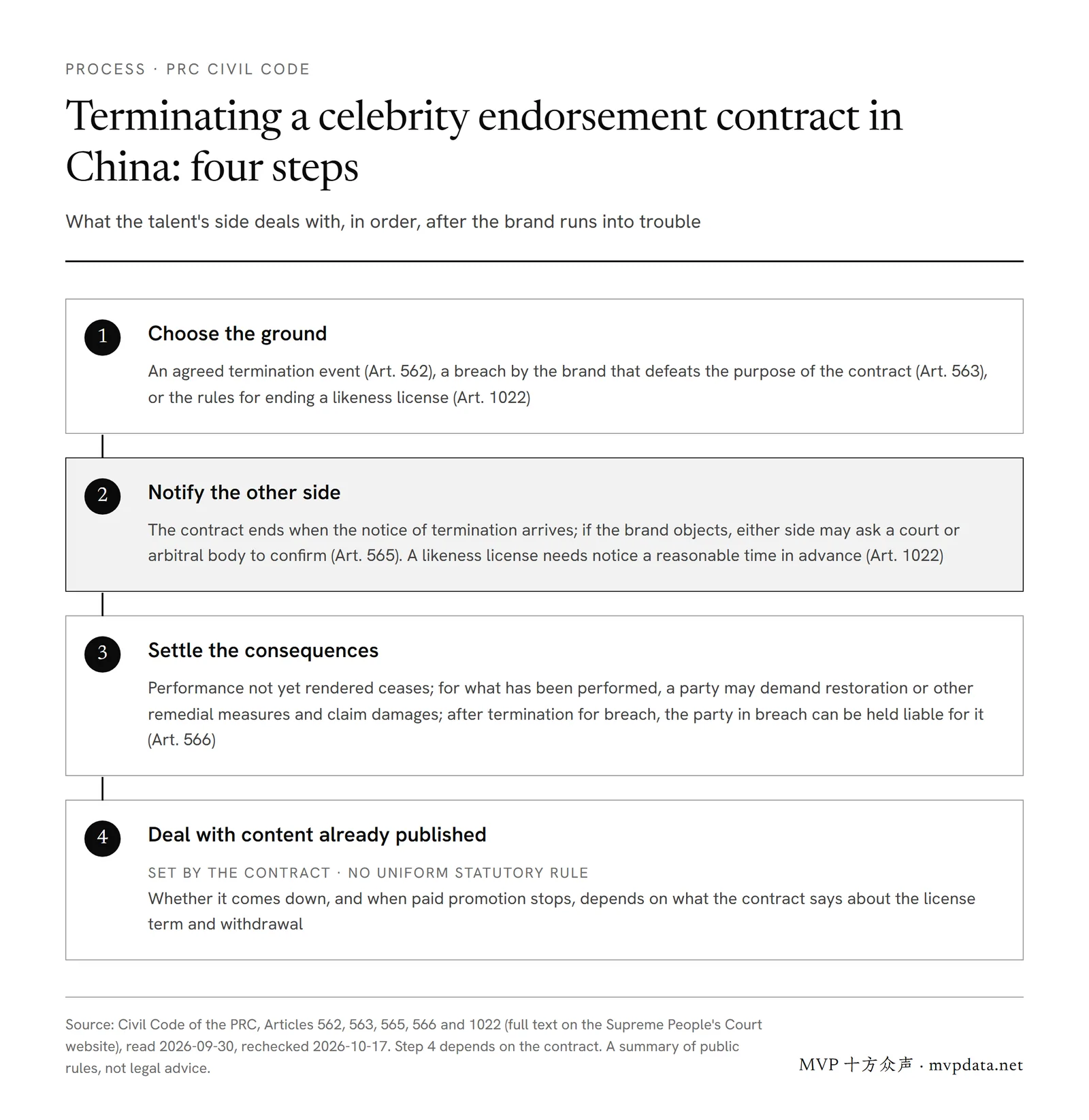
There are four: choose the ground, notify the other side, settle the consequences, and deal with content already published. The first three follow Civil Code articles; the fourth depends on the contract.3
| Step | What happens | Basis |
|---|---|---|
| 1. Choose the ground | An agreed termination event, a breach by the brand that defeats the purpose of the contract, or the rules for ending a likeness license | Arts. 562, 563 and 10223 |
| 2. Notify the other side | The contract ends when the notice arrives; if the brand objects, either side may ask a court or arbitral body to confirm. A likeness license needs notice a reasonable time in advance | Arts. 565 and 10223 |
| 3. Settle the consequences | Unperformed obligations end; for what has been performed, a party may demand restoration or other remedial measures and claim damages; after termination for breach, the party in breach can be held liable for it | Art. 5663 |
| 4. Deal with published content | Whether it comes down, and when paid promotion stops, depends on the license term and withdrawal terms in the contract | Set by the contract; no uniform statutory rule |
Article 565 covers two further cases. If the notice says the contract will end automatically unless the other side performs within a stated period, and it does not, the contract ends when that period expires. If a party skips notice and goes straight to court or arbitration to claim termination, and the claim is upheld, the contract ends when the complaint or arbitration application is served on the other side.3
Money follows Article 566. Obligations not yet performed end. For what has been performed, a party may, according to the performance and the nature of the contract, demand restoration or other remedial measures, and is entitled to claim damages; where the contract ends because of a breach, the terminating party may hold the party in breach liable, unless the parties agreed otherwise.3 So for work already shot and published, the fee is not automatically refunded in full, and any settlement terms in the contract come first.
For content already published, the law has no uniform rule on whether it must come down or when paid promotion must stop; that turns on what the contract says about the license term and withdrawal. Use beyond the license falls under Article 1019: no one may make, use or publish a person’s likeness without their consent.3 Where the brand keeps using it on an online platform, the rights holder may notify the platform to take necessary measures such as removal, blocking or disconnecting links; the notice must include prima facie evidence of infringement and the rights holder’s real identity (Art. 1195).3 A person with evidence that someone is committing, or is about to commit, an unlawful act infringing their personality rights, which would cause irreparable harm if not stopped promptly, may apply to a court for an order to stop it (Art. 997).3 Reporting channels on each platform are listed under remedies.
What permissions a brand needs to run a talent’s content as advertising, and what contracts usually spell out, is covered under usage rights for ads.
Which common claims about ending an endorsement deal don’t match the law?
The table checks claims that often appear in search results and AI answers against the text of the law, as verified on 2026-10-17.
| Common claim | What the text says | Source |
|---|---|---|
| Once signed, only the brand can terminate; the talent has to wait out the term | Parties may agree on events entitling one of them to terminate, and the article does not say which; a party may also terminate where the other’s breach defeats the purpose of the contract | Civil Code, Arts. 562 and 5633 |
| If the clause says the brand’s decision is “conclusive”, the brand can terminate whenever it likes | The US ruling denied the brand’s motion for judgment on the pleadings; under New York law, contractual discretion may not be used arbitrarily or irrationally | US District Court for the Middle District of North Carolina, 20121 |
| Posting a termination statement online ends the contract | A party terminating under the law must notify the other side, and the contract ends when the notice arrives | Civil Code, Art. 5653 |
| A likeness license with no stated term lasts forever and cannot be withdrawn | Where the term is not agreed or not clear, either party may terminate at any time with notice a reasonable time in advance | Civil Code, Art. 1022(1)3 |
| After termination, the endorsement fee must be refunded in full | For what has been performed, a party may seek restoration or other remedies according to the performance and the nature of the contract, and claim damages | Civil Code, Art. 5663 |
| Liquidated damages are owed exactly as written | Where the agreed amount is excessively higher than the loss, a court or arbitral body may reduce it on request | Civil Code, Art. 5853 |
This article summarizes public rules and is not legal advice; whether and how a particular contract can be terminated is for a court or arbitral body to decide, with advice from a lawyer.
How does MVP support the talent’s side when a brand runs into trouble?
In a celebrity’s team, MVP mainly runs new-media operations and personal brand management; when a brand runs into trouble, it handles public-opinion monitoring, crisis response and contract risk review, working with outside law firms on legal matters. In practice:
- Before a deal: MVP checks public information and reputation before any partnership. The public records involved are listed under brand partnerships.
- Negotiation and contracts: MVP negotiates the fee, what each side has to do, the schedule and the deliverables. In the contract it looks hardest at exclusivity, how and for how long the talent’s image and voice may be used, and what happens on breach. See brand partnerships.
- When the brand is in trouble: long-term engagements include public-opinion monitoring and crisis response, and a one-off incident can be handled as a single project, priced per project. Public statements during a crisis go out in the name of the talent or their studio, never MVP’s. See crisis PR and reputation management.
- Legal matters: MVP reviews contract risk and organizes evidence, and works with outside law firms on legal matters; it does not give legal opinions.
- Working with agencies: MVP does not sign management contracts with celebrities. It works as a service team alongside their agency and studio and does not go around the agency. See celebrities.
MVP (Mega Volume Production, 十方众声) is headquartered in Toronto and contracts through two companies, 北京十方众声传媒有限公司 and Mega Volume Production Inc., working in talent management and cross-border brand marketing. If you are negotiating an endorsement, or a brand you represent has run into trouble, contact MVP.
Notes
- Order and Memorandum Opinion, No. 1:11CV570
- 《关于进一步规范明星广告代言活动的指导意见》 (Guiding Opinions on Further Regulating Advertising Endorsements by Celebrities)
- 《中华人民共和国民法典》 (Civil Code of the People’s Republic of China)
- 《中华人民共和国广告法》 (Advertising Law of the People’s Republic of China)
Questions
Can talent end a likeness license at any time if it has no fixed term?
Yes. Under Article 1022(1) of the Civil Code, where the term of a likeness license is not agreed or not clear, either party may terminate it at any time, but must notify the other side a reasonable time in advance.
When does a termination notice take effect in China?
When it reaches the other side (Art. 565). A notice that gives the other side a deadline to perform takes effect when the deadline passes unmet; a party that sues without notice and is upheld terminates when the complaint is served.
Does the talent have to refund the endorsement fee after termination?
Not necessarily in full. Under Article 566, unperformed obligations end; for what has been performed, a party may seek restoration or other remedies according to the performance and the nature of the contract, and claim damages. Settlement terms in the contract come first.
What if the brand keeps running the talent’s image after the deal ends?
Check the license term first; use beyond it falls under Article 1019, which bars using a person’s likeness without consent. The talent can ask the platform to remove or block it, with prima facie evidence and their real identity (Art. 1195).