Douyin Xingtu Fees 2026: What Brands, Creators and MCNs Pay
As of October 2026, Xingtu (巨量星图), Douyin’s creator marketplace, charges both sides: brands pay 5% on top of the creator fee (10% on open submissions, nothing for now on Xingguang orders), and creators have 5% deducted, or 3% where an MCN settles. The rates are in the Settlement Management Rules in force since January 1, 2026. On a direct booking of RMB 10,000, the brand pays RMB 10,500 and an individual creator receives RMB 9,500 before tax.
Key takeaways
- Xingtu charges a platform service fee to the brand and to the creator side separately; each side pays its own.
- Brands pay by order type: 5% on direct bookings, co-creation, recruitment and short-drama orders, 10% on open submissions, and nothing for now on Xingguang orders, charged on the creator fee plus any service-provider fee.
- On the creator side, individual and PGC creators pay 5% of the creator fee and MCN agencies 3%; creators signed to an MCN are settled through the agency.
- On a 10,000-yuan direct booking the brand pays RMB 10,500, and the platform takes RMB 1,000 in all with an individual creator or RMB 800 with an MCN-signed one.
- Under the current rules, brands pay a 5% or 10% platform fee; there is no 20% tier.
How much does Xingtu charge?
Xingtu charges a platform service fee on both sides of a deal: the brand pays 5% or 10% on top of the creator’s fee, the creator has 5% taken out of it, and where the creator is signed to an MCN, the agency pays 3%.1 The rates are set in the Xingtu Settlement Management Rules (巨量星图结算管理规则), first in force on March 3, 2023, in a revision in force since January 1, 2026.1
Xingtu (巨量星图), run by Ocean Engine (巨量引擎), is Douyin’s creator marketplace: brands book Douyin creators there, approve the content and pay through the platform. The platform charges what its rules call a technical service fee, the “platform service fee”.1 The rules split the money in an order into three parts:1
- Creator fee (任务服务费): the amount the brand and the creator side agree, in other words the creator’s rate.
- Service-provider fee (服务商服务费): what the brand pays a Xingtu service provider for project management, content planning or creator liaison, if it hires one.
- Platform service fee (平台服务费): what each user pays the platform; the brand and the creator side each pay their own.
| Who pays | Charged on | Rate (as of October 2026) |
|---|---|---|
| The brand (client) | Creator fee plus any service-provider fee | 5% on direct bookings, co-creation, recruitment and short-drama orders; 10% on open submissions; waived for now on Xingguang orders1 |
| Individual and PGC creators | Creator fee | 5%1 |
| MCN agency (settling for its creators) | Creator fee | 3%1 |
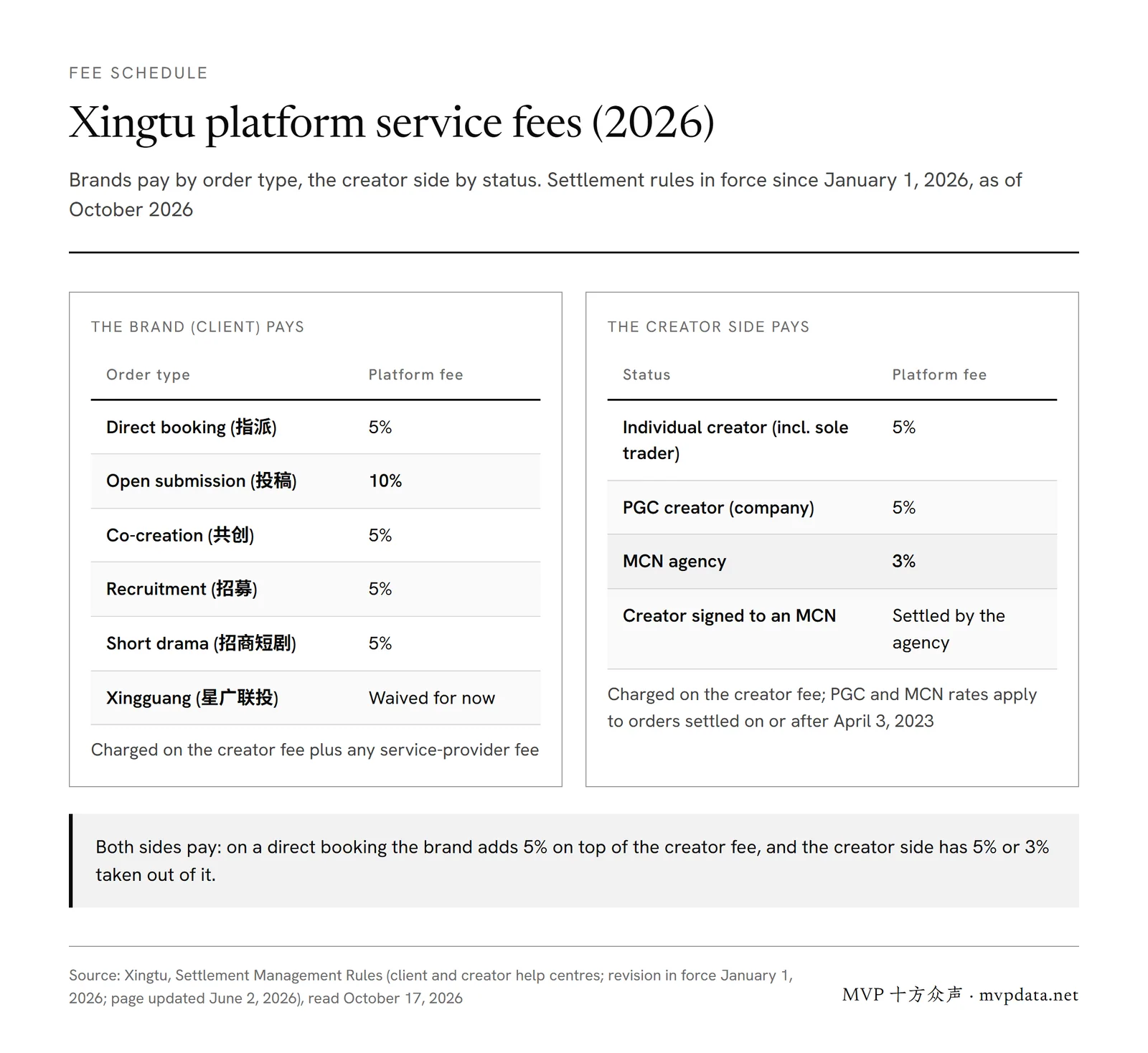
Xingtu publishes the rules in both its client and its creator help centre; the client copy, read on October 17, 2026, shows an update of June 2, 2026 and the revision in force since January 1, 2026.1
What service fee does a brand pay for each Xingtu order type?
A brand pays 5% on direct bookings, co-creation, recruitment and short-drama orders, 10% on open-submission orders, and, for the time being, nothing on Xingguang orders.1 The fee is charged on the creator fee plus any service-provider fee, so where a brand hires a service provider, that fee is marked up too.1
| Order type | How it works | How the creator fee is set | Brand’s platform fee |
|---|---|---|---|
| Direct booking (指派) | The brand names one creator, who accepts, makes and posts the content | Agreed between the parties | 5% |
| Open submission (投稿) | The brand sets a pool of eligible creators; those who take part are paid on performance | By the payout rule in the order and the content’s results | 10% |
| Co-creation (共创) | A lead creator and participants post together with the co-creation feature | Agreed between the parties | 5% |
| Recruitment (招募) | Creators apply, the brand picks; only those picked and delivering are paid | Agreed between the parties | 5% |
| Short drama (招商短剧) | The brand orders a chosen short drama and opens several orders under it | Agreed between the parties | 5% |
| Xingguang (星广联投) | A service provider screens creators; content is reviewed, posted and promoted | Billed by impressions | Waived for now |
Every row comes from the Settlement Management Rules.1 The rules also list Douyin mini-program commission orders, paid on conversion data, which the platform-fee table does not cover.1
Four points matter before a brand places an order:
- Prepayment. The brand tops up its Xingtu account first; the platform starts providing service only once paid, and the brand should top up again when the balance cannot cover a project.1
- No service-provider fee on recruitment or Xingguang orders. The rules say clients pay none on these two types.1
- The Xingguang waiver has no end date. The rules say only that the client fee is waived “for a limited time” and that charging will follow a platform announcement; the platform may also start charging where it charges nothing today, on notice.1
- Open submissions are priced on a prize pool. Payout is by views (CPM) or by conversions; CPM counts natural views only, leaving out fraudulent data and views bought through DOU+ or content boosting. The pool must be at least RMB 10,000, the platform fee is 10% of the prize amount, and top-ups before the billing period are at least RMB 10,000 each.2
Overseas brands should note two more rules. Xingtu settles in renminbi, converting at the bank’s rate on the day; transfer fees, exchange gains or losses and refund costs fall on the client, as does any tax the client’s own tax authority requires to be withheld.1 For amounts already settled, a brand can apply online for an invoice of the same amount, which the platform posts back.1
How are creator and MCN fees deducted on Xingtu?
The creator-side fee comes straight out of the creator fee: 5% for individual and PGC creators, and 3% paid by the MCN agency where a creator is signed to one, since the agency settles with the platform on the creator’s behalf.1 The rules define a creator’s earnings simply as the creator fee minus the platform service fee.1
| Status | Who it covers | Platform fee | Who gets paid | Invoice to the platform |
|---|---|---|---|---|
| Individual creator (自然人达人) | Joins as a person, including one registered as a sole trader | 5% of the creator fee | The creator, paid automatically to a bank card since September 20, 20263 | Sole traders issue a 6% or 3% VAT special invoice1 |
| PGC creator | A creator working with the platform through a registered business | 5%, on orders settled on or after April 3, 2023 | Settled once a compliant invoice is in1 | 6% as a general taxpayer, 3% as a small-scale one1 |
| MCN agency | An agency approved by the platform that manages and sells for its creators | 3%, on orders settled on or after April 3, 2023 | The agency’s company account | 6% or 3%, as above1 |
| MCN-signed creator | A creator bound to an agency that settles for them | None of their own; the agency pays | The agency, which then pays the creator3 | None1 |
For a creator signed to an MCN, the platform’s involvement stops at the agency. An agency and its creator can set a revenue split in Xingtu; once the creator confirms it, the platform pays each side its share at the ratio in force when the order was taken, though for now splits apply only to Douyin direct bookings. Where no split has ever been set, 100% goes to the agency, which settles with the creator, and any payment dispute between them is the agency’s to resolve.3 How a management contract shares that income is covered on Influencers.
Individual creators also pay tax at source. Since October 1, 2025, income an individual creator takes from Xingtu is taxed as remuneration for services, and the platform withholds VAT, surcharges and individual income tax, so the amount received is the amount withdrawn minus the tax withheld.4 Where a month’s withdrawals stay within RMB 100,000, no VAT or surcharges are withheld at the time; if the tax office later reports income across platforms above RMB 100,000 for that month, the platform deducts them from the next month’s balance.4 Sole traders pay income tax on business income instead, and companies pay no individual income tax.4
Where does a 10,000-yuan Xingtu order go? A worked example
At the official rates, a direct booking with a creator fee of RMB 10,000 and no service provider costs the brand RMB 10,500; an individual creator receives RMB 9,500, and an MCN agency RMB 9,700.1 The example below uses the published rates only; the real figures are whatever the order page shows.
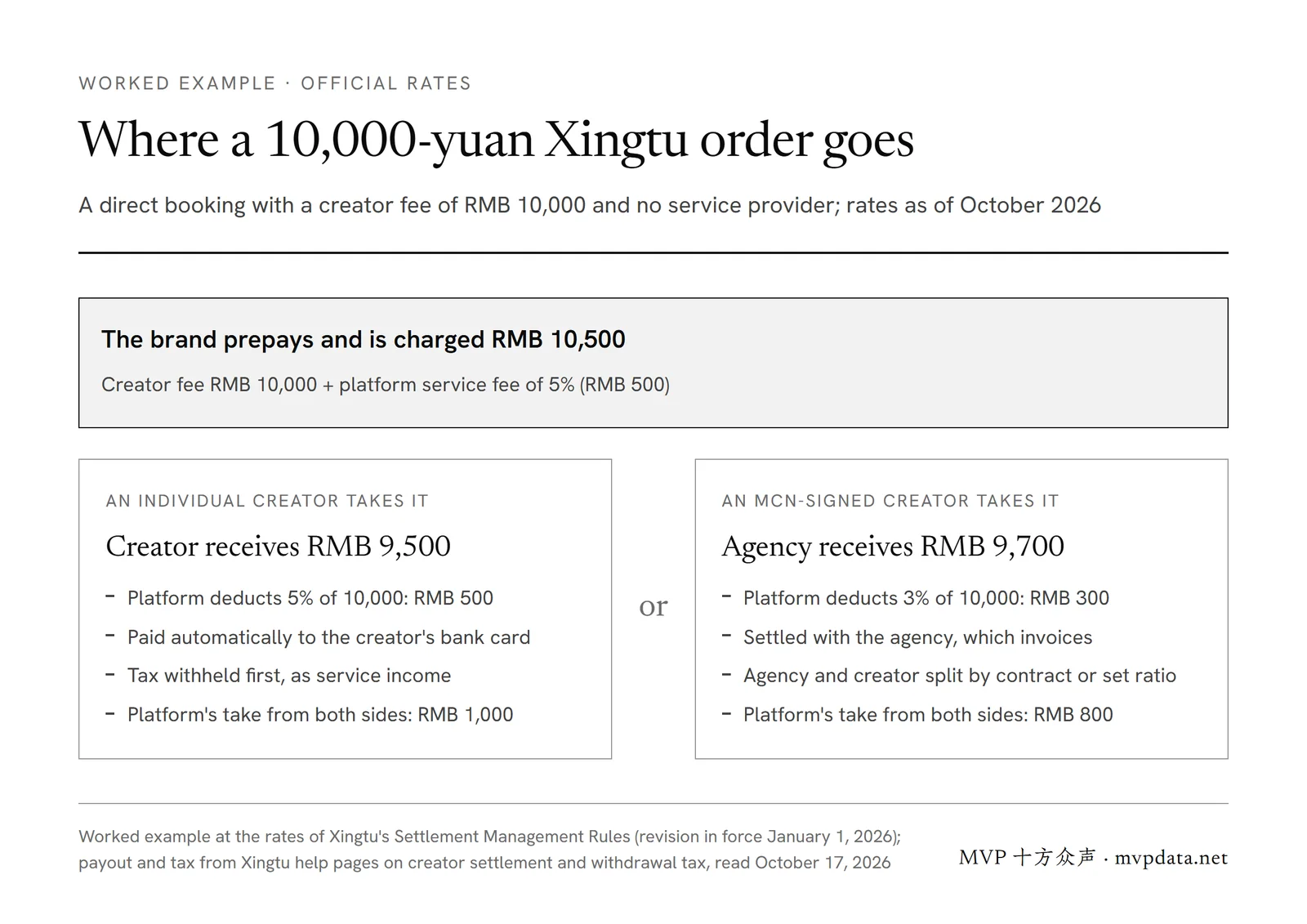
| Item (RMB) | Individual creator | MCN-signed creator |
|---|---|---|
| Creator fee (the creator’s rate) | 10,000 | 10,000 |
| Brand’s platform fee (5%) | 500 | 500 |
| Brand pays in total | 10,500 | 10,500 |
| Creator-side platform fee | 500 (5%) | 300 (3%) |
| Creator or agency receives | 9,500 | 9,700 |
| Platform’s take, both sides | 1,000 | 800 |
The rates behind the table: 5% for a brand’s direct booking, 5% for an individual creator, 3% for an MCN agency.1
Make it an open-submission order with the same RMB 10,000 prize pool and the brand pays RMB 11,000, because the fee on open submissions is 10% of the prize amount.2
Three caveats apply:
- An individual creator’s RMB 9,500 is before tax. The platform withholds tax on it as remuneration for services, so less arrives in the bank.4
- An agency’s RMB 9,700 is agency revenue. What the creator takes home depends on the contract with the agency or the split set in Xingtu.3
- Cancelled orders follow the same logic. The platform calculates and deducts its fee first, then pays out the compensation due; for an MCN-signed creator the compensation goes to the agency.5
How does Xingtu settlement work, and when do creators get paid?
Xingtu is paid up front: the brand prepays, and once the content is posted and accepted, the platform deducts its fees and settles;1 individual creators are paid automatically to a bank card,3 and MCN agencies are paid within 10 working days of the platform receiving a compliant invoice.6
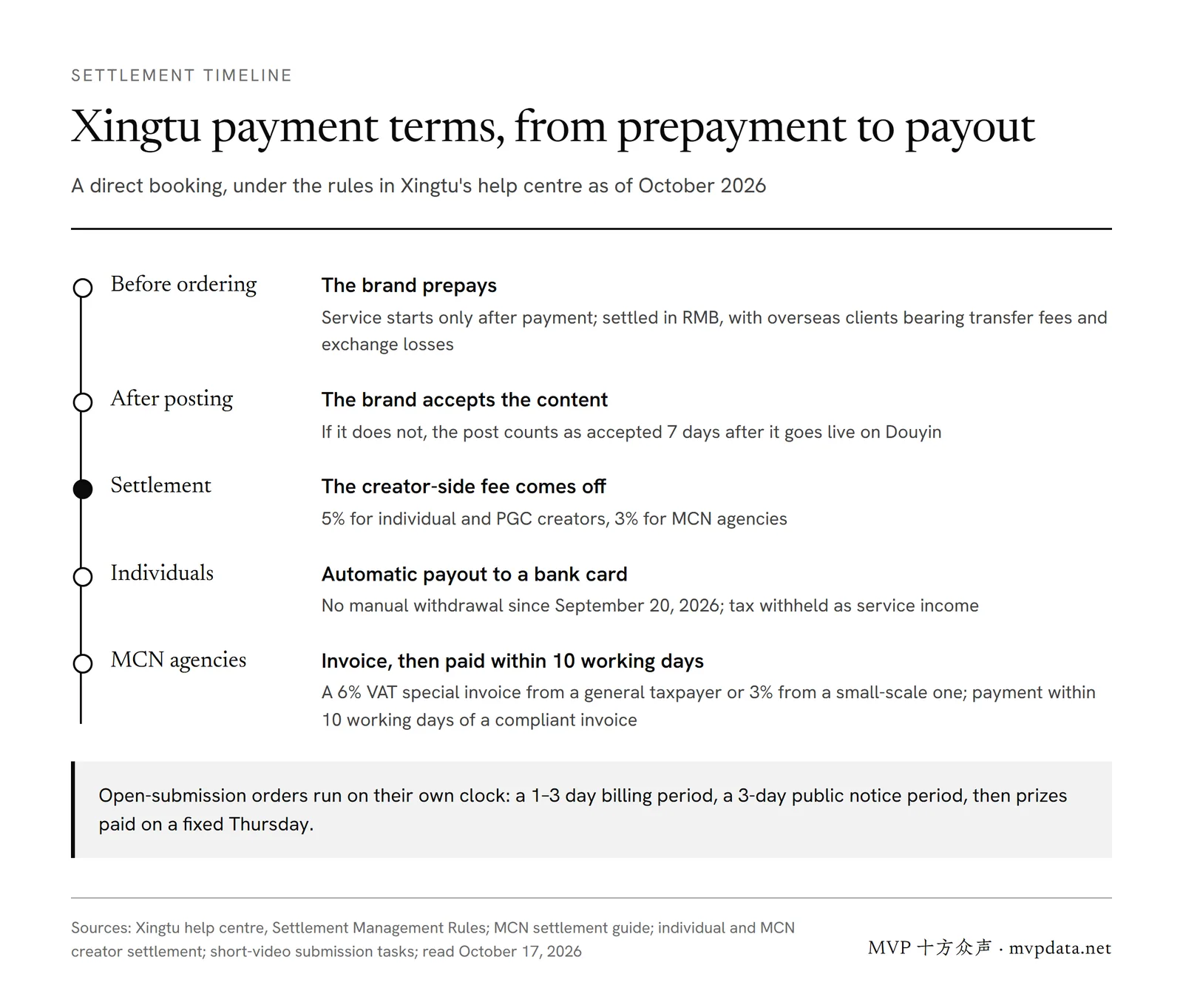
| Step | Rule |
|---|---|
| Ordering | The brand prepays; service starts only once paid1 |
| Acceptance | The brand accepts direct-booking, co-creation and short-drama content; if it does not, the post counts as accepted 7 days after it goes live on the creator’s main account on Douyin or a sister app; open-submission and recruitment content needs no acceptance, only to meet the order’s requirements1 |
| Xingguang confirmation | Content counts as confirmed if the brand raises no objection within three days of posting1 |
| Settlement | The platform deducts the creator-side fee from the creator fee and settles the rest1 |
| Individual creators | Since September 20, 2026, earnings are paid automatically to the creator’s own account; only a bank card can be linked3 |
| MCN agencies | Paid within 10 working days of a compliant invoice; only the company that took the order may invoice, never a third party6 |
| Open submissions | A billing period of 1–3 days (1–7 for conversion orders), a 3-day public notice period, then prizes paid on a fixed Thursday2 |
Invoice errors are what delay payouts. Sole traders, PGC creators and MCN agencies must give the platform a VAT special invoice, at 6% as a general taxpayer or 3% as a small-scale taxpayer; the only accepted items are “video production” and “information services”, never mixed; one settlement form takes one invoice type, with paper, electronic and fully digital invoices kept apart; and a faulty invoice is sent back, which pushes payment out.1 Creators signed to an MCN do not invoice the platform at all; the agency does.1
Which Xingtu fee figures online are out of date?
Two claims still found online do not match the rules in force since January 1, 2026; the table sets each against the text of the rules, as checked on October 17, 2026.
| What you may read | What the rules say |
|---|---|
| “Xingtu takes 20%” | Brands pay 5% or 10%, nothing for now on Xingguang orders; the creator side pays 5% or 3%1 |
| “Creators must withdraw their Xingtu earnings themselves” | Since September 20, 2026, individual creators are paid automatically to their bank card3 |
The figure in the first claim usually traces back to retellings of an August 2020 change to fees on live-selling orders.7 That change covered live-selling orders only, and the retellings are not even consistent about what the figure was charged on, so it is no basis for a current rate.
A few other points are easy to get wrong, and the rules are clear on each:
| Easy to get wrong | What the rules say |
|---|---|
| Only the brand pays a platform fee | Both sides pay: the creator side has 5% deducted from the creator fee, or 3% paid by the MCN agency1 |
| MCN agencies settle with Xingtu fee-free | Agencies pay 3% of the creator fee on orders settled on or after April 3, 20231 |
| Open submissions cost 5% like a direct booking | Open submissions cost 10% of the prize amount, with a pool of at least RMB 10,0002 |
| Xingguang orders carry the usual 5% | The client fee is waived for now, with no end date given1 |
Xingtu’s own pages also disagree on one figure. On Xingguang orders, a creator earns from natural traffic plus a share of the ad spend on their video: the Settlement Management Rules put that share at 3%,1 while the Xingguang task guide, updated September 7, 2026, says 2.5% and refers to the order page for the final terms.8 Creators need at least 10,000 Douyin followers to take Xingguang orders.8
Beyond Xingtu fees, what else goes into a Douyin influencer budget?
Beyond the platform fee, a Douyin influencer budget has to cover the creators’ own rates, any service-provider fee, the cost of cancelling, samples and paid boosting, and, for an overseas brand, the cost of moving money into China.
| Cost | Who sets it | What the rules say |
|---|---|---|
| Creator rates | The creator, in the Xingtu back end; the platform suggests a rate and a reasonable range | The suggestion reflects follower growth, video data, conversion results and the account’s commercial record; custom videos should be priced above product placements9 |
| Service-provider fee | Paid when a provider is hired, as agreed on the order page | None on recruitment or Xingguang orders; where it applies, it is part of the base for the platform fee1 |
| Cancellation | Owed when the brand cancels after the creator accepts | See the table below5 |
| Samples | Sent by the brand | Recruitment orders support sending samples;5 on open submissions, a brand that ticks “samples needed” sees creators’ addresses and ships them itself2 |
| Paid boosting | Bought separately | On open submissions paid by views, views from DOU+ and content boosting do not count;2 on Xingguang orders the platform runs the promotion and the creator earns a share of the spend8 |
| Cross-border payment | Borne by the overseas brand | Transfer fees, exchange gains or losses, refund costs and any tax its own authority requires withheld1 |
Creator rates can change. Within the reasonable range, a creator gets one change a month that takes effect at once, covering short-video direct bookings (placements and custom videos), short-to-live warm-up and seeding orders (短直预热, 短直种草) and custom short dramas; any other change applies from the 1st of next month, as often as the creator likes. A short-video or live-stream rate raised into the range from below applies at once and does not use up the monthly change.9 A creator who wins orders above the suggested rate may keep charging it.9
Cancellation costs depend on how far the order has gone. Where the brand prepaid in full and cancels after the creator has accepted, it owes:
| Stage | Short video or image post | Live stream |
|---|---|---|
| Before the creator uploads a script | 0 | No action by the creator within 3 days of accepting: 0 |
| After the script is uploaded | 10% of the order | 10% of the order |
| After the video or post is uploaded / after both sides confirm the script | 50% of the order | 50% of the order |
| After two rounds of brand feedback or the brand’s confirmation / cancelling on the day of the stream | 100% of the order | 100% of the order |
The percentages are from the Xingtu Task Cancellation Rules, in a revision in force since January 1, 2026.5 Once a direct-booking video is posted or the stream has started, neither side can cancel, and an open-submission order cannot be cancelled once approved.5 Where the brand paid only a deposit, the order cancels with a full refund if the creator does not accept in time or the brand does not pay the balance within 14 days of acceptance.5
The rates and steps above are taken from Xingtu’s help centre as it stood on October 17, 2026; the platform may change its fee standards, and the order page is what counts at the time of booking.1 This article summarizes published rules and is not legal or tax advice.
How does MVP run Douyin creator campaigns for brands?
MVP runs cross-border influencer marketing for international brands entering China and for Chinese brands, working with Chinese-language creators on Douyin, Xiaohongshu (RedNote), Weibo, Bilibili and WeChat. On Douyin, bookings go through the platform’s official marketplace and content is labelled as the platform requires; how creators are chosen and approached is on cross-border influencer marketing.
- Targets in the contract. Reach and other measures are agreed in the proposal, written into the contract and backed by evidence you can check, such as the platform’s own reports.
- Ads and press in the same plan. For paid social and Chinese-language press releases as well, see China entry: PR and social ads; for the permissions a brand needs to run creator content as ads, see usage rights for ads.
- Quoted to the brief. MVP prices each project on its requirements; ask MVP for a quote.
MVP (Mega Volume Production, 十方众声) is headquartered in Toronto and contracts through 北京十方众声传媒有限公司 in mainland China and Mega Volume Production Inc. in Canada, working in talent management and cross-border brand marketing. To plan a Douyin creator campaign, contact MVP.
Notes
- 《巨量星图结算管理规则》 (Xingtu Settlement Management Rules (client help centre))
- 《抖音短视频投稿任务》 (Xingtu: Douyin short-video submission tasks)
- 《个体达人/MCN达人结算》 (Xingtu: settlement for individual and MCN creators)
- 《个体达人提现税务规则介绍》 (Xingtu: tax on individual creators’ withdrawals)
- 《巨量星图任务取消规则》 (Xingtu Task Cancellation Rules)
- 《巨量星图MCN机构结算说明》 (Xingtu: settlement for MCNs)
- 《如何看待巨量星图直播带货专项服务费率变化通知?》 (What to make of Xingtu’s notice changing the service fee on live-selling tasks?)
- 《星广联投任务介绍》 (Xingtu: Xingguang joint-placement tasks)
- 《达人报价设置及常见问题》 (Xingtu: setting creator rates)
Questions
Can a brand get an invoice for Xingtu fees?
Yes. A brand can apply online for an invoice equal to the amount settled, and the platform posts it back. It runs the other way for the creator side: sole traders, PGC creators and MCN agencies must issue the platform a 6% or 3% VAT special invoice.
What currency do overseas brands pay Xingtu in?
Renminbi. Money an overseas client sends is converted at the bank rate on the day, and the client bears the transfer fees, exchange gains or losses and any refund costs, plus any tax its own tax authority requires to be withheld.
Can a Douyin creator change their Xingtu rate at any time?
Yes. Within the platform’s reasonable range, a creator gets one change a month that takes effect at once on short-video direct bookings and a few related order types; any other change applies from the 1st of next month. A short-video or live-stream rate raised into the range from below takes effect at once.
What is the minimum budget for a Xingtu open-submission order?
The prize pool must be at least RMB 10,000, and the platform adds 10% of the prize amount as its fee. The budget can be topped up after launch and before the billing period, again by at least RMB 10,000 each time.