China Social Media Users 2026: Official Numbers by Platform
As of October 2026, WeChat leads the China social media platforms that report users: Tencent puts combined Weixin and WeChat monthly active users at 1.439 billion as of June 30, 2026. Kuaishou averaged 797.3 million MAU over the quarter, Weibo 561 million, QQ 520 million and Bilibili 371 million, all in Q2 2026 results, while Douyin and Xiaohongshu (RedNote) publish no regular user numbers. China had 1.125 billion internet users at the end of 2025, 1.114 billion of them on social networks, according to CNNIC.
Key takeaways
- Weixin and WeChat had 1.439 billion combined monthly active users on June 30, 2026, more than any other Chinese social platform that discloses users.
- In Q2 2026 Kuaishou averaged 412.3 million DAU and 797.3 million MAU; Weibo had 561 million MAU and 254 million DAU in June; Bilibili had 116.5 million DAU and 371 million MAU.
- Douyin and Xiaohongshu publish no regular user numbers; the “600 million daily active users” on ByteDance’s Ocean Engine site includes Douyin Huoshan and carries no date.
- CNNIC’s 1.114 billion social network users and 1.074 billion short-video users are counts by type of app and cannot be split into any one platform’s users.
- Company MAU and DAU count active users as each platform measures them (Kuaishou counts unique accounts); CNNIC estimates residents aged 6 and over. The two cannot be added or compared directly.
How many users do China’s major social platforms have in 2026?
As of October 2026, WeChat leads the Chinese social platforms that report users: Tencent says Weixin and WeChat together had 1.439 billion monthly active users on June 30, 2026.1 Kuaishou, Weibo, QQ and Bilibili follow. Every number below comes from the company’s own Q2 2026 results, none of them audited, and each is measured on a different basis or date, so read the last two columns with the numbers.
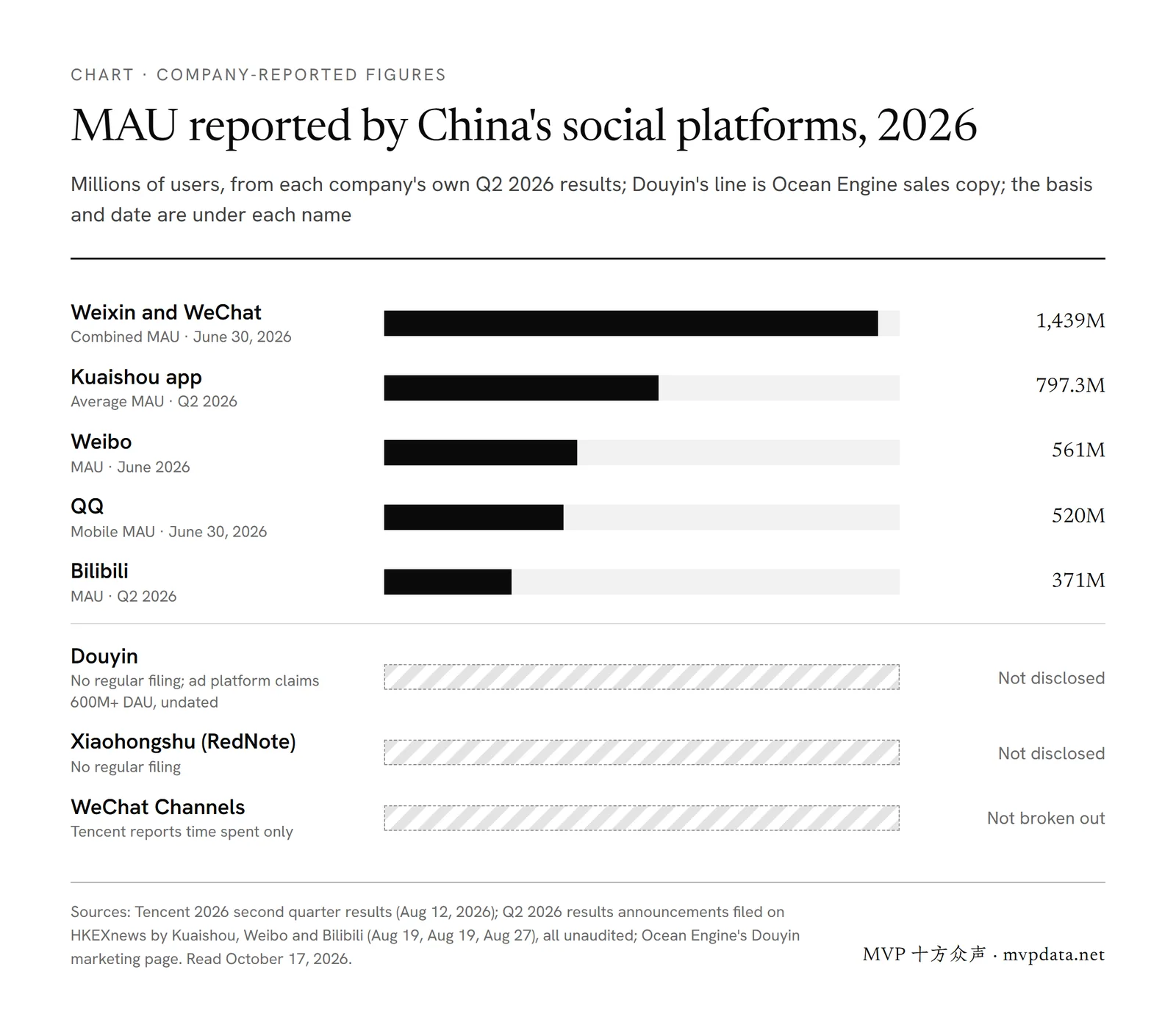
| Platform | Monthly active users | Daily active users | Date or period | Source |
|---|---|---|---|---|
| Weixin and WeChat (combined) | 1,439 million | Not disclosed | As of June 30, 2026 | Tencent results, Aug 12, 20261 |
| Kuaishou app | 797.3 million | 412.3 million | Q2 2026 average | HKEX filing, Aug 19, 20262 |
| 561 million | 254 million | June 2026 (DAU is the June average) | HKEX filing, Aug 19, 20263 | |
| QQ (mobile) | 520 million | Not disclosed | As of June 30, 2026 | Tencent results, Aug 12, 20261 |
| Bilibili | 371 million | 116.5 million | Q2 2026 (DAU is the quarterly average) | HKEX filing, Aug 27, 20264 |
| Douyin | Not disclosed | Not disclosed | — | No regular filing |
| Xiaohongshu (RedNote) | Not disclosed | Not disclosed | — | No regular filing |
| WeChat Channels (Shipinhao) | Not broken out | Not broken out | — | Tencent reports time spent only1 |
The year-on-year direction differs by platform. Combined Weixin and WeChat MAU rose 2% from 1.411 billion, while QQ’s mobile MAU slipped from 532 million to 520 million.1 Kuaishou’s average MAU climbed from 714.8 million to 797.3 million and its average DAU from 408.9 million to 412.3 million.2 Bilibili’s DAU grew 7%.4
How many people in China use the internet, social media and short video?
China had 1.125 billion internet users at the end of 2025, an internet penetration rate of 80.1%; 1.114 billion of them used social networks (98.9%) and 1.074 billion watched short video (95.4%).5 The figures come from the 57th Statistical Report on China’s Internet Development, published by the China Internet Network Information Center (CNNIC) on February 5, 2026, the most recent nationwide official count.
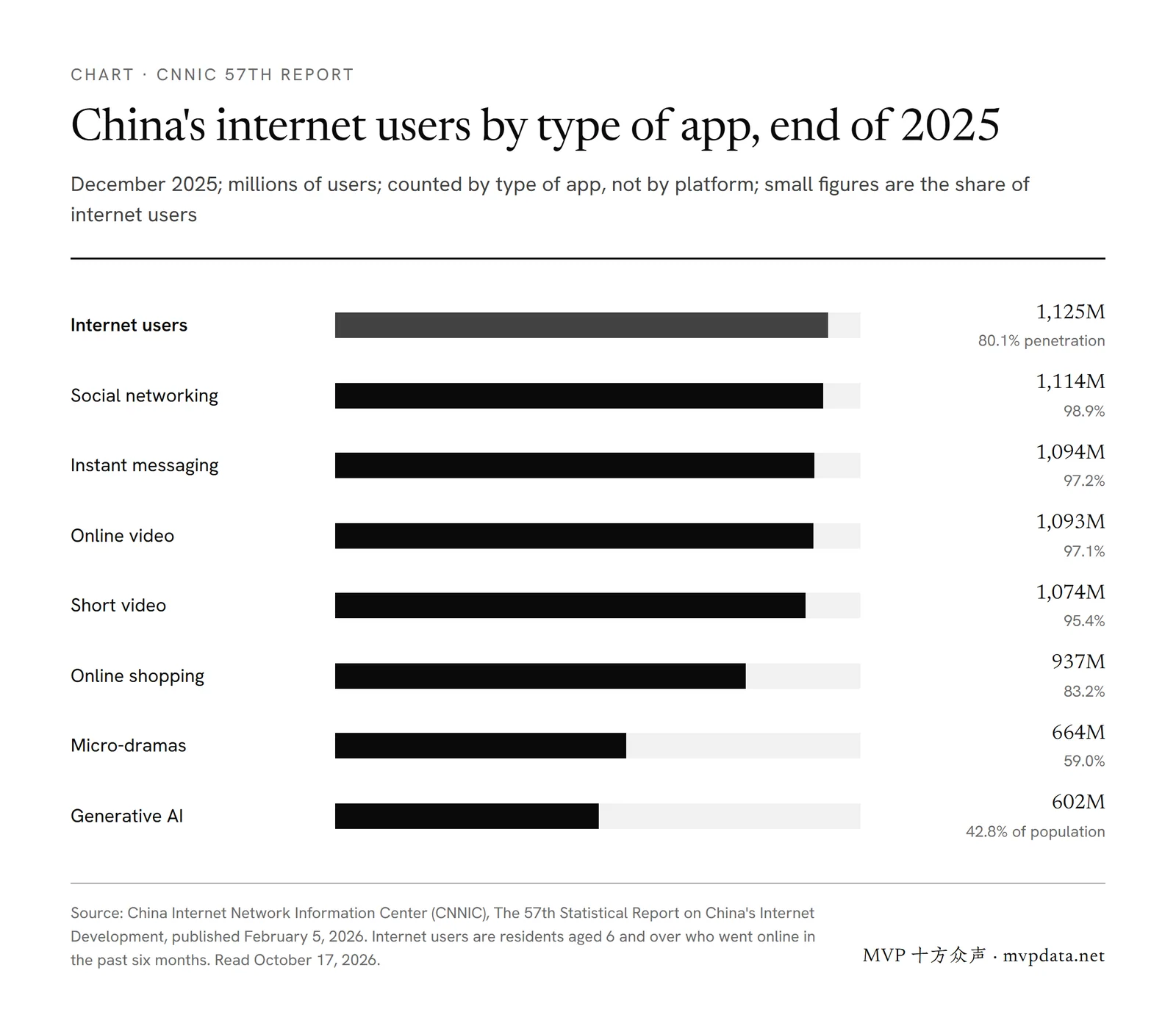
| Category (December 2025) | Users | Share of internet users |
|---|---|---|
| Internet users | 1,125 million | 80.1% penetration |
| Social networking | 1,114 million | 98.9% |
| Instant messaging | 1,094 million | 97.2% |
| Online video | 1,093 million | 97.1% |
| of which short video | 1,074 million | 95.4% |
| Online shopping | 937 million | 83.2% |
| Micro-dramas (part of online video) | 664 million | 59.0% |
| Generative AI | 602 million | 42.8% of the population |
All figures in the table are from the CNNIC report.5 The same report counts 1.121 billion mobile internet users; 99.6% of internet users go online by phone.5
CNNIC answers “how many people in China use this kind of app”, not “how many use this platform”: the report counts users by type of application and does not break them down by platform.5 For WeChat or Kuaishou specifically, the companies’ own results are the source.
What do Tencent, Kuaishou, Weibo, Bilibili and Zhihu disclose about users?
All five listed companies report user data with their quarterly results, but each picks its own metric, date and definition: Tencent gives period-end MAU, Kuaishou gives quarterly averages with a written definition, Weibo gives June figures, Bilibili leads with average DAU, and Zhihu reports paying members only.
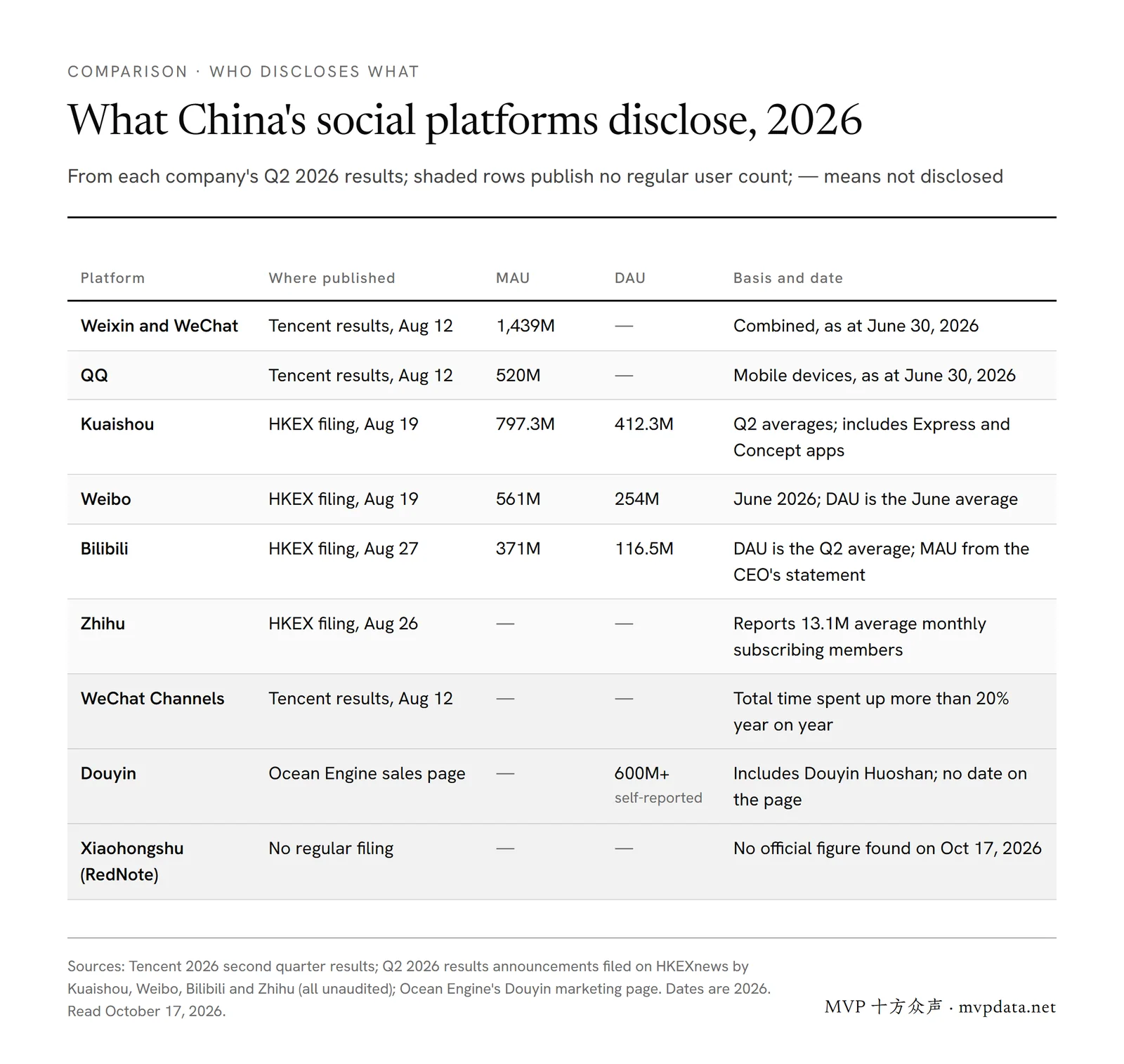
- Tencent lists “Combined MAU of Weixin and WeChat” and “Mobile device MAU of QQ” as at June 30 in its operating metrics table, without defining MAU. WeChat Channels gets no user number; Tencent reports only that its total time spent grew more than 20% year on year.1
- Kuaishou gives quarterly average DAU and MAU and defines them: DAU is the number of unique user accounts, excluding spam accounts, that access an app at least once during the day, and MAU is the same over a calendar month. “Kuaishou App” covers Kuaishou Flagship, Kuaishou Express and Kuaishou Concept.2
- Weibo reports 561 million MAU in June 2026 and 254 million average DAU in June, without definitions.3
- Bilibili highlights 116.5 million average DAU and 113 minutes of average daily time spent; the 371 million MAU figure appears in the chairman and CEO’s statement, without saying whether it is an average.4
- Zhihu gave no MAU or DAU for Q2 2026. The user metric it reports is 13.1 million average monthly subscribing members.6
Each filing is public on the company’s investor site or on HKEXnews, and every number in this article links to the original document.
Why are there no official user numbers for Douyin and Xiaohongshu?
When we checked on October 17, 2026, neither Douyin nor Xiaohongshu (RedNote) published quarterly results with user numbers, so both are marked “not disclosed”. The figures that circulate online are either the platform’s own marketing copy or estimates by third parties and the press.
The only Douyin figure on an official page is on the Douyin marketing page of Ocean Engine (Juliang Yinqing), ByteDance’s advertising platform. It says Douyin’s daily active users have passed 600 million, “including Douyin Huoshan”, but gives no date or period for the figure, and the page carries no update date.7 Two things follow:
- The figure combines two apps, Douyin and Douyin Huoshan, much as Kuaishou combines three, so it cannot be set against a single app’s number.
- It is a line from an advertising sales page, not a periodic disclosure, and does not belong in the same column as the listed companies’ quarterly figures.
For Xiaohongshu we found no current total on the official channels we checked. The RedNote MAU figures in circulation mostly come from third-party measurement firms or press reports, on differing bases and dates, and this article does not use them. What a brand usually needs is not the platform’s total but the size of its own target audience there, which the platforms’ official ad and creator tools show; the official brand-deal platforms are listed in platform rules.
MAU, DAU and CNNIC user counts: what is the difference?
Company MAU and DAU count active users as each platform measures them, and Kuaishou’s definition says unique accounts; CNNIC’s user counts are estimates of people drawn from a sample survey. The two cannot be added together or compared directly.
| Metric | What it counts | Window | Published by |
|---|---|---|---|
| MAU | Unique accounts that access the app at least once in a calendar month, excluding spam (Kuaishou’s definition) | One month | The platform’s company |
| DAU | Unique accounts that access the app at least once in a day (Kuaishou’s definition); quarterly figures are usually daily averages | One day | The platform’s company |
| CNNIC users | Residents aged 6 and over who went online in the past six months, grouped by the types of app they use | Six months | CNNIC |
Kuaishou’s definitions are in its results announcement;2 CNNIC’s are in the report’s appendix on survey method and terms.5
The two differ in three ways:
- Unit. One person can hold several accounts, so accounts and people are not the same count.
- Coverage. CNNIC runs a computer-assisted telephone survey (CATI) of residents aged 6 and over with a home landline or mobile phone in the 31 provinces of mainland China, excluding Hong Kong, Macao and Taiwan. Results are weighted to provincial population data, and proportions carry a maximum error of 0.64 percentage points at 95% confidence.5 Kuaishou’s MAU counts account activity, and its definition sets no condition on where the user lives.2
- Window. CNNIC looks back six months, MAU one month, DAU one day. The shorter the window, the smaller the number.
So “1.114 billion social network users” and “1.439 billion Weixin and WeChat MAU” do not contradict each other: the first is the number of Chinese internet users on social networks, the second is Tencent’s combined monthly active user count for two apps.5,1
Which widely repeated China user statistics need correcting?
The claims below turn up in search results and AI answers; each was checked against the original documents on October 17, 2026.
| Claim | What the source says | Source |
|---|---|---|
| China’s 1.1 billion social network users are one platform’s users | CNNIC counts by type of app; 1.114 billion is internet users on social networks, across all platforms | CNNIC 57th report5 |
| Douyin publishes official quarterly MAU | No regular filing; Ocean Engine’s “600 million DAU” includes Douyin Huoshan and is undated | Ocean Engine7 |
| WeChat MAU covers the domestic app only | Tencent reports Weixin and WeChat combined: 1.439 billion | Tencent results1 |
| Kuaishou MAU is the main app’s MAU | “Kuaishou App” combines Kuaishou Flagship, Express and Concept | Kuaishou filing2 |
| Zhihu reports MAU every quarter | Q2 2026 reports only 13.1 million average monthly subscribing members | Zhihu filing6 |
| WeChat Channels has its own user number | Tencent reports only that Channels’ total time spent rose more than 20% | Tencent results1 |
| Listed companies’ user numbers are audited | Tencent, Kuaishou, Weibo and Bilibili all label their Q2 results unaudited | Company filings1,2,3,4 |
The safe way to quote a platform’s users is to give three things together: the metric (MAU or DAU), the date, and the original document. Without all three, nobody can check the number.
How should a brand use these numbers when choosing platforms?
A platform’s total users set the ceiling on its reach; the choice also depends on whether your audience is there, how active it is, and whether the ad and creator tools are open to you. In platform planning the numbers have three uses.
- Use CNNIC to choose formats. Short video reaches 95.4% of China’s internet users and online shopping 83.2%.5 Both are national channels; the decision is which platforms to use and how to split the budget.
- Compare platforms only on matching numbers. Use the same metric at the same date. From the filed figures, Kuaishou’s Q2 average DAU was about 52% of its average MAU (412.3 million ÷ 797.3 million),2 and Weibo’s June ratio about 45% (254 million ÷ 561 million).3 A higher DAU-to-MAU ratio means users return more often. Bilibili’s DAU is a quarterly average and its MAU comes from the CEO’s statement, so its ratio is not on the same basis.4
- Treat “not disclosed” as something to verify. Douyin and Xiaohongshu have no comparable official figure, so size them with the platforms’ own audience tools and live campaign data rather than with totals that circulate online.
Which Chinese platforms a foreign brand should use, and the official back end for each, is covered in China entry: PR and social media ads; for work with Chinese creators, see cross-border influencer marketing.
How does MVP choose platforms and plan ad spend for brands entering China?
MVP runs China entry PR and social advertising for foreign brands: Chinese-language press releases, ads on Douyin, Xiaohongshu, WeChat and Channels, Weibo, Bilibili, Kuaishou and Baidu, official Chinese brand accounts, and work with Chinese creators. It has done this work since 2023.
- Spend follows the data. Content goes out organically first, and paid reach goes to what performs; how much to spend, on whom and when to stop are decided by the numbers.
- Accounts and billing. Ad accounts are opened in MVP’s name, and MVP settles the ad spend.
- Targets in the contract. Impressions, ROI and other targets are agreed at the proposal stage, written into the contract and backed by evidence you can check, such as the platforms’ own reports.
MVP (Mega Volume Production, 十方众声) is headquartered in Toronto and contracts through two companies, 北京十方众声传媒有限公司 and Mega Volume Production Inc., working in talent management and cross-border brand marketing. The full scope is on China entry: PR and social media ads; to discuss a launch, contact MVP. The figures on this page are kept up to date against each company’s latest results and CNNIC’s latest report.
Notes
- Tencent Announces 2026 Second Quarter Results
- Results Announcement for the Three and Six Months Ended June 30, 2026
- Announcement of Second Quarter and Interim 2026 Financial Results
- Inside Information: Announcement of the Second Quarter 2026 Unaudited Financial Results
- 《第57次《中国互联网络发展状况统计报告》(报告全文)》 (The 57th Statistical Report on China's Internet Development (full report))
- Inside Information: Unaudited Financial Results for the Quarter Ended June 30, 2026
- 抖音营销_抖音营销投放平台_抖音营销_巨量引擎官网 (Douyin marketing, Ocean Engine official site)
Questions
How many monthly active users does WeChat have?
Tencent reported 1.439 billion combined monthly active users for Weixin and WeChat as of June 30, 2026, up 2% from 1.411 billion a year earlier and 0.5% from 1.432 billion on March 31, 2026. The same release puts QQ’s mobile MAU at 520 million.
What are Kuaishou’s daily active users?
Kuaishou averaged 412.3 million daily active users and 797.3 million monthly active users in Q2 2026; for the first half of 2026 the averages were 412.5 million DAU and 784.5 million MAU. Its “Kuaishou App” figure covers three apps: Kuaishou Flagship, Express and Concept.
How many users does Bilibili have?
Bilibili averaged 116.5 million daily active users in Q2 2026, up 7% year over year, with 113 minutes of average daily time spent. Its chairman and CEO said in the results announcement that monthly active users reached 371 million.
How often are these user numbers updated?
Listed companies update them with each quarter’s results; Tencent, Kuaishou, Weibo, Bilibili and Zhihu all published Q2 2026 results in August. CNNIC’s latest report, the 57th, came out on February 5, 2026, with data to December 2025.