China Advertising Law absolute terms: when an ad may say “best”
China’s Advertising Law bans absolute terms such as “national-level”, “highest-grade” and “best” in Article 9(3), and as of October 2026 local regulators apply it with SAMR’s 2023 Enforcement Guidelines on Absolute Terms in Advertising. A claim that points at the product and fits none of the guidelines’ nine carve-outs can cost the advertiser a fine of CNY 200,000 to 1,000,000; a first use with slight harm, promptly corrected, may go unpunished.
Key takeaways
- The only legal basis for China’s “banned superlatives” is Article 9(3) of the Advertising Law; SAMR’s guidelines, published as Announcement 2023 No. 6, are the reference local regulators use to enforce it.
- The guidelines list nine cases where the absolute-terms rule does not apply: three where the term does not point at the product, six where it does but neither misleads nor disparages rivals. All nine assume the claim can be proved.
- A breach of Article 9(3) carries a fine of CNY 200,000 to 1,000,000 for the advertiser; a first use with slight harm, promptly corrected, may go unpunished, and no penalty is not the same as no liability.
- The “banned word lists” that circulate online have no legal source; the test is whether the term points at the product and whether the claim can be proved.
- Creator posts and live-sale scripts that amount to commercial advertising are covered too; a streamer carries the duties of an advertiser, a publisher or an endorser, depending on the role.
What does China’s Advertising Law say about absolute terms?
Article 9(3) of China’s Advertising Law prohibits ads from using terms such as “国家级” (“national-level”), “最高级” (“highest-grade”) and “最佳” (“best”).1 Chinese marketers call these 极限词, “extreme words”; the law’s own term is 绝对化用语, absolute terms. Item 2 of the guidelines the State Administration for Market Regulation (SAMR) issued in 2023 spells out the scope: the three named terms, plus any other term with the same or a similar meaning.2
As of October 2026, five documents decide whether a line of Chinese ad copy is acceptable. The guidelines themselves are not law: item 1 says they are a reference for local market regulators in their work.2
| Document | Number and date | What it governs |
|---|---|---|
| Advertising Law of the PRC | Second amendment, 29 April 2021 | Art. 9(3) bans absolute terms; Art. 57 sets the penalty1 |
| Enforcement Guidelines on Absolute Terms in Advertising | SAMR Announcement 2023 No. 6, published 20 March 2023 | When the rule does not apply; when no penalty may or must follow2 |
| Administrative Penalty Law of the PRC | Revised 2021, in force 15 July 2021 | General rules for lighter penalties (Art. 32) and no penalty (Art. 33)3 |
| Measures for the Administration of Internet Advertising | SAMR Order No. 72, in force 1 May 2023 | Online ads and live commerce fall under the Advertising Law4 |
| Beijing working guidelines | Jing Shi Jian Fa [2024] No. 10, 20 March 2024 | How Beijing reads “first violation”, “slight harm” and “prompt correction”5 |
SAMR issued the guidelines because enforcement had become uneven. In its official Q&A, the head of SAMR’s Advertising Supervision Department said the purpose of Article 9(3) is to stop advertisers exaggerating, misleading consumers or disparaging competitors, but some local regulators had applied it mechanically, “一刀切” (one size fits all), leaving some penalties out of proportion; the guidelines unify the standard across localities.6
How do you check whether a superlative in Chinese ad copy is allowed?
Items 4 to 7 of the guidelines give a four-step test: is it an ad, does the term point at the product being sold, is it one of the listed exceptions, and can the advertiser prove it.2
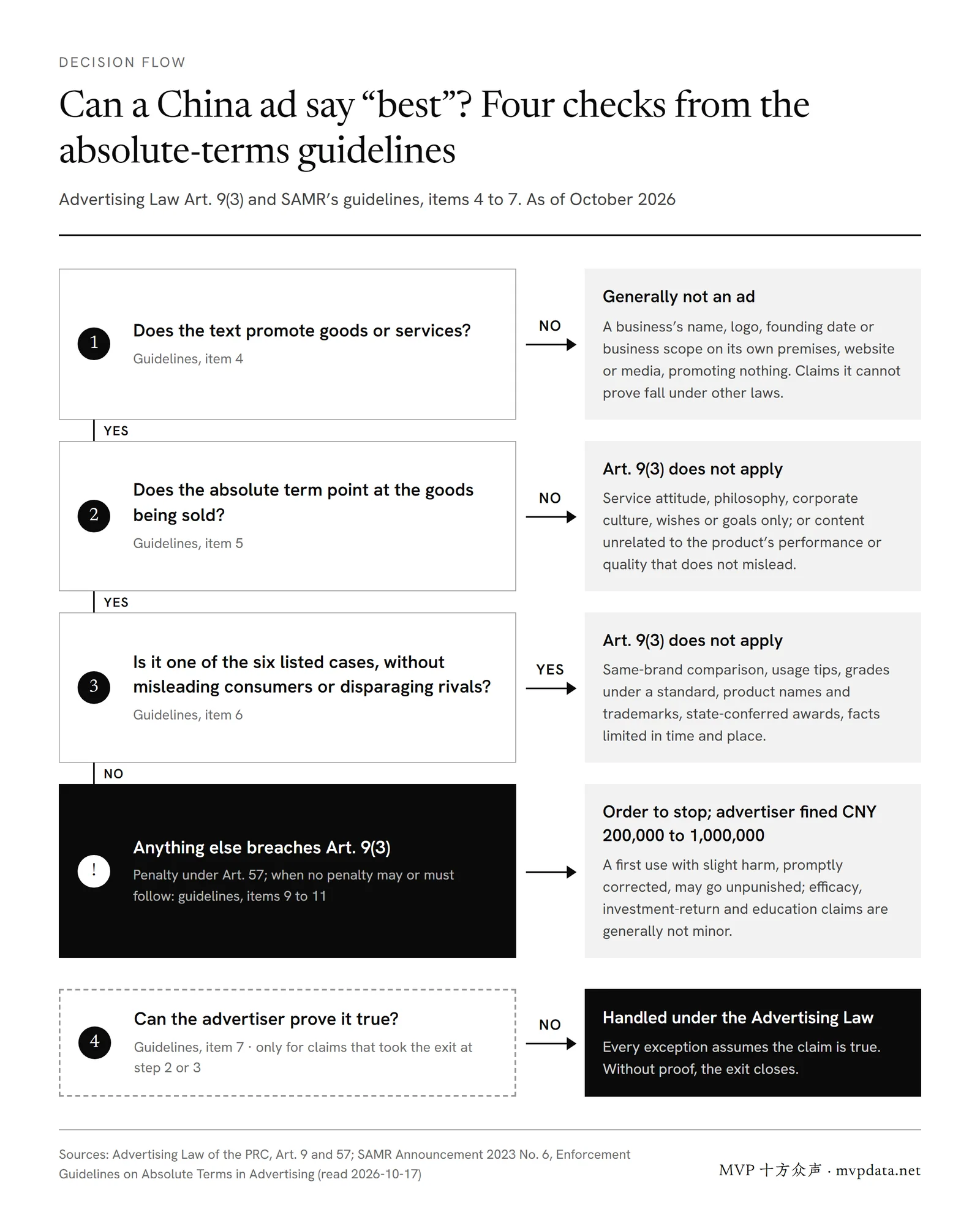
- Is it advertising at all? A business that publishes its own name, abbreviation, logo, founding date or business scope on its premises, its own website or other media it may lawfully use, without directly or indirectly promoting goods or services, is generally not advertising. Absolute terms in that information that cannot be proved, and that may affect consumers’ right to know or harm other businesses, are dealt with under other laws.2
- Does the term point at the product? Under item 5, the absolute-terms rule does not apply where the wording only expresses service attitude, business philosophy, corporate culture, a subjective wish or a goal, or where it bears no direct relation to the product’s performance or quality and does not mislead.2
- Is it one of the six cases in item 6? Where the term does point at the product but falls into one of six listed cases, and has no effect of misleading consumers or disparaging other businesses, the rule does not apply either.2
- Can the advertiser prove it? A claim within items 5 or 6 that the advertiser cannot prove true is dealt with under the Advertising Law (item 7).2 SAMR’s Q&A puts it plainly: wording that does not breach the absolute-terms rule is still pursued if the advertiser cannot show it is true.6
A claim that passes none of these exits breaches Article 9(3). The penalties are set out below.
Which uses of “best” do SAMR’s guidelines exclude?
Items 5 and 6 of the guidelines list nine situations in which an absolute term falls outside the Advertising Law’s rule.2 In the three cases of item 5 the term does not point at the goods being promoted; in the six cases of item 6 it does, but without the objective effect of misleading consumers or disparaging other businesses.2
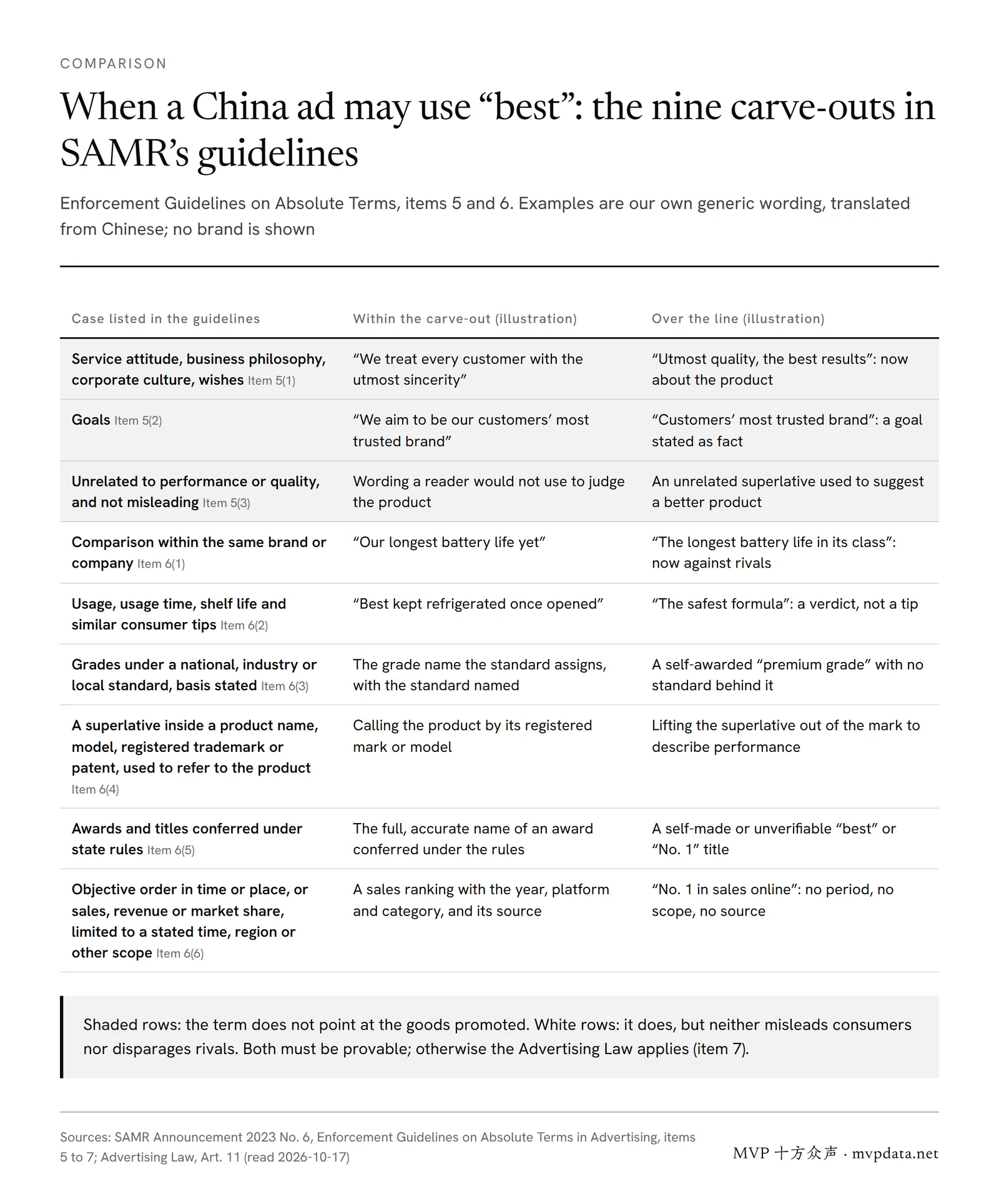
The table below is the text of the figure. The first column follows the guidelines; the examples are our own generic illustrations, translated from Chinese copy, and come neither from the guidelines nor from any brand.
| Case in the guidelines | Item | Within the carve-out (illustration) | Over the line (illustration) |
|---|---|---|---|
| Service attitude, business philosophy, corporate culture, subjective wishes | 5(1) | “We treat every customer with the utmost sincerity” | “Utmost quality, the best results” |
| Goals | 5(2) | “We aim to be our customers’ most trusted brand” | “Customers’ most trusted brand” |
| No direct relation to performance or quality, and not misleading | 5(3) | Wording a reader would not use to judge the product | An unrelated superlative used to suggest a better product |
| Comparison among the same brand’s or company’s own goods | 6(1) | “Our longest battery life yet” | “The longest battery life in its class” |
| Consumer tips on use, usage time or shelf life | 6(2) | “Best kept refrigerated once opened” | “The safest formula” |
| Grades under a national, industry or local standard, with the basis stated | 6(3) | The grade name the standard assigns, with the standard named | A self-awarded grade with no standard behind it |
| A superlative inside a product name, model, registered trademark or patent, used to refer to the product | 6(4) | Calling the product by its registered mark or model | Lifting the word out of the mark to describe performance |
| Awards and titles conferred under state rules | 6(5) | The full, accurate name of an award conferred under the rules | A self-made or unverifiable title |
| Objective order in time or place, or sales, revenue or market share, limited to a stated time, region or other scope | 6(6) | A sales ranking with the year, platform and category, and its source | “No. 1 in sales online” |
Read the last row together with two other articles of the law. Article 11 requires figures, statistics, survey results and quotations in an ad to be true and accurate and to state their source; Article 28 treats an ad that relies on unverifiable statistics or survey results as false advertising.1 Naming the period and scope of a sales ranking meets the guidelines’ condition; the number itself still has to stand up.
What are the penalties, and when may there be none?
An ad containing anything Article 9 prohibits must be withdrawn on the regulator’s order, and the advertiser is fined CNY 200,000 to 1,000,000, with its business licence liable to revocation in serious cases; an ad agency or publisher has its advertising fees confiscated and is fined CNY 200,000 to 1,000,000 (Article 57, item 1).1 Beneath that penalty, the guidelines mark out when there should be no fine and which claims are never treated as minor.2
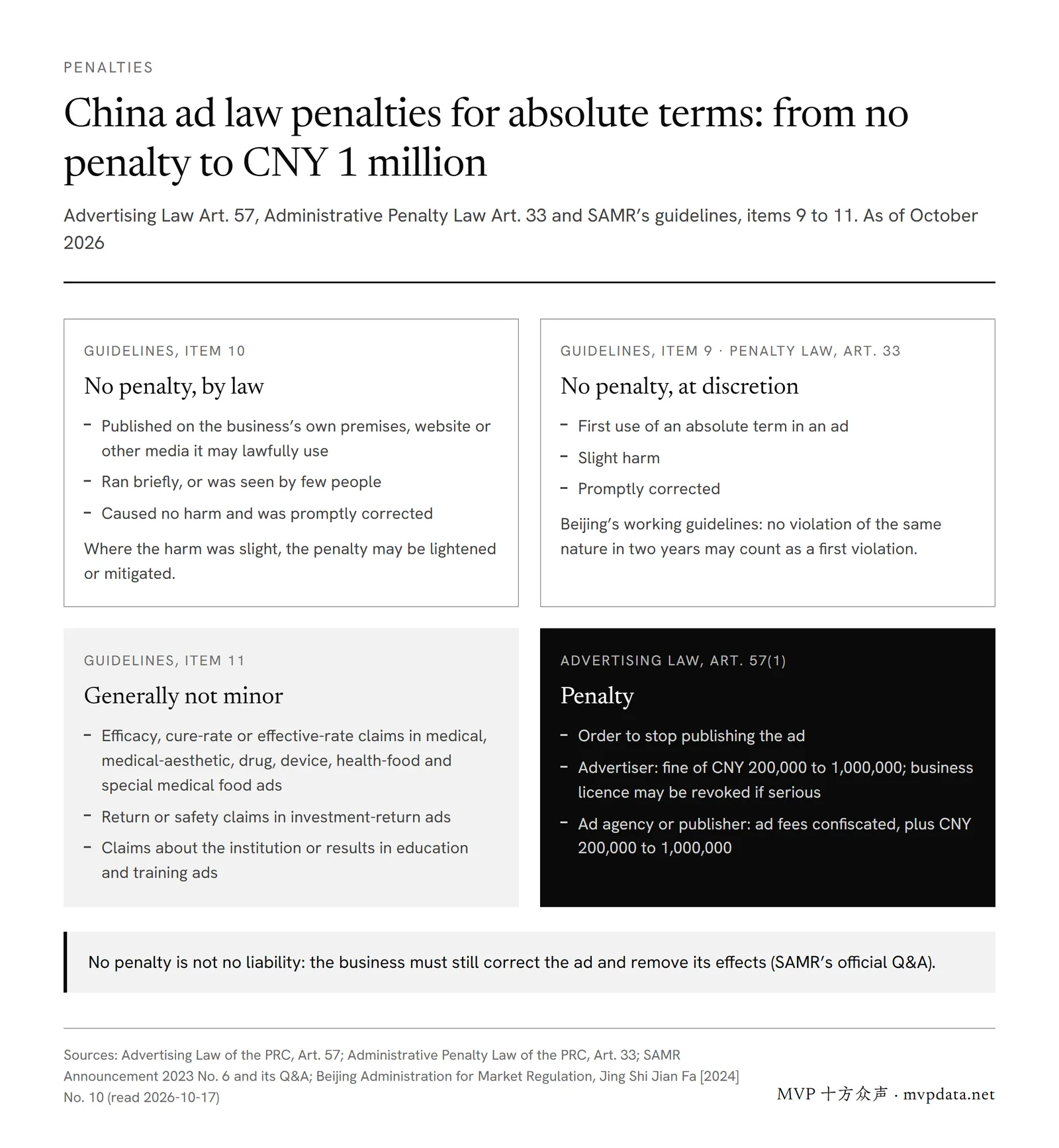
| Outcome | Conditions | Source |
|---|---|---|
| No penalty, mandatory | On the business’s own premises, website or other media it may lawfully use; short-lived or seen by few people; no harm caused and promptly corrected. Where harm was slight, the penalty may be lightened or mitigated | Guidelines, item 102 |
| No penalty, discretionary | Outside the cases of items 5 and 6, a first use of an absolute term in an ad, with slight harm, promptly corrected | Guidelines, item 92; Administrative Penalty Law, Art. 333 |
| Generally not minor | Efficacy, cure-rate or effective-rate claims in medical, medical-aesthetic, drug, medical-device, health-food and special-medical-purpose food ads; return or safety claims in investment-return ads; claims about the institution or results in education and training ads | Guidelines, item 112 |
| Penalty | Order to stop; advertiser fined CNY 200,000 to 1,000,000, licence revocable if serious; agency or publisher loses its fees and is fined CNY 200,000 to 1,000,000 | Advertising Law, Art. 571 |
Four points round out the picture:
- Context counts. Item 8 tells regulators to weigh the ad’s content and context, and the facts, nature, circumstances, social harm and the party’s fault.2
- The general rules. Under Article 33 of the Administrative Penalty Law, a minor violation promptly corrected that caused no harm is not penalised, and neither is a party with sufficient evidence that it was not at fault, unless a law or administrative regulation provides otherwise. Under Article 32, a penalty must be lightened or mitigated where, among other things, the party acted on its own to remove or reduce the harm.3
- A local example. Beijing’s 2024 working guidelines treat a violation as a first one when questioning the party and checking the National Enterprise Credit Information Publicity System and the case platform reveal no violation of the same nature in the past two years; a business that checked the supporting documents and the truth and legality of the ad before publishing can be found not at fault.5 These rules apply in Beijing only; elsewhere, local rules govern.
- No penalty is not no liability. SAMR’s Q&A stresses that a business spared a fine must still correct the violation and remove its effects.6
Are the “China advertising banned words” lists online reliable?
No list has legal standing. Article 9(3) names three terms, “national-level”, “highest-grade” and “best”, followed by “等” (and the like);1 the guidelines define the rest by “the same or a similar meaning” and attach no list of banned words.2 The same word can be unlawful when it points at the product and cannot be proved, and lawful in one of the listed cases, which a word list cannot capture.
The table sets common claims in search results and AI answers against the original texts, checked on 17 October 2026.
| What is often said | What the texts say |
|---|---|
| SAMR publishes an official list of banned advertising words | The law names three terms and “the like”.1 Item 12 of the guidelines refers to a list of minor violations exempt from penalty, which is a list of situations, not of words2 |
| Any superlative in a China ad is illegal | Items 5 and 6 list nine cases where the rule does not apply2 |
| Using an absolute term means a fine of at least CNY 200,000 | CNY 200,000 to 1,000,000 is the range in Article 57;1 items 9 and 10 of the guidelines2 and Article 33 of the Administrative Penalty Law provide for no penalty3 |
| First violations are never fined | Item 9 says a first use “may” go unpunished, and only with slight harm and prompt correction; the sectors in item 11 are generally not minor2 |
| Copy without superlatives carries no risk | Item 72 and SAMR’s Q&A both say claims that cannot be proved are still pursued under the Advertising Law;6 Article 28 covers false advertising separately1 |
| Everything on a company website counts as advertising | A business’s own information that promotes no product is generally not advertising (item 4)2 |
Does the rule apply to creator posts and live-stream scripts?
Yes, whenever the content is commercial advertising. Article 2 of the Measures for the Administration of Internet Advertising applies the Advertising Law and the Measures to commercial advertising that directly or indirectly promotes goods or services through websites, web pages, apps and other internet media, in text, images, audio, video or any other form.4 An absolute term in a seeding post (种草, a product-recommendation post), a short video or a live-sale script is tested the same way as in any other ad.
Who answers for it depends on the role each party plays.
| Role | How the law defines it | Source |
|---|---|---|
| Advertiser | Whoever designs, produces or publishes an ad, alone or through others, to promote goods or services; answers for the truth of the ad | Advertising Law, Art. 2 and 41 |
| Seller in a live stream | Selling through a live stream that amounts to commercial advertising carries the advertiser’s duties | Internet Advertising Measures, Art. 194 |
| Streamer or live-room operator commissioned to design, produce or publish the ad | Carries the duties of an ad agency or publisher | Same article4 |
| Streamer recommending or vouching for a product in their own name or image | Where this amounts to an endorsement, carries the endorser’s duties | Same article4 |
The penalty in Article 57 is aimed at the advertiser and at ad agencies and publishers.1 The same post must also be recognisable as advertising: a knowledge, experience-sharing or review post that promotes a product with a purchase link must be clearly marked “广告” (advertisement) under Article 9 of the Measures.4 Disclosure rules for China, the US and Canada are compared in ad disclosure in three markets; for the term itself, see zhongcao.
What should a foreign brand check when translating English ad copy into Chinese?
Pull every comparative and superlative out of the English and run each line through the four steps again. Much of the standard vocabulary of English marketing, translated literally, lands squarely on Article 9(3); copy that works in North America does not carry over to China on its own.
| Common English claim | Literal Chinese | What to check |
|---|---|---|
| “best-in-class” | 「同类最佳」 | Points at the product and compares it with others; outside item 6, Article 9(3) applies2 |
| “No. 1 bestseller” | 「销量第一」 | Item 6(6): state the period, region or other scope and be able to prove it;2 give the data’s source (Art. 11)1 |
| “clinically proven most effective” | 「临床证明最有效」 | Efficacy superlatives in medical, drug and health-food ads are generally not minor (item 11);2 these ads also need review before publication (Art. 46)1 |
| “our best formula yet” | 「本品牌迄今最好的配方」 | Item 6(1), comparison within the same brand, allowed if provable2 |
| “award-winning” with the award’s name | An award name containing 「最佳」 | Item 6(5) covers only awards and titles conferred under state rules2 |
A short checklist before the Chinese copy is final:
- For every 「最」, 「第一」, 「首」 or 「顶」, note what it points at: the brand’s attitude, a comparison among your own products, or a comparison with rivals.
- Give every sales figure, ranking or market share a year, a platform or a region, and keep the data and its source on file.1
- For medical, medical-aesthetic, drug, device, health-food, special medical food, investment-return, education and training products, remove absolute terms about results.2
- Keep a record of the pre-publication review and the supporting documents. Beijing’s working guidelines count checking the documents and the truth and legality of the ad before publishing as evidence of no fault.5
How MVP reviews brand copy for China
MVP writes the Chinese materials for brands entering China and reviews creator content against the brief and the rules of the market where it runs before it goes live, with the brand signing off on the final version. In practice:
- China entry PR and social ads: Chinese press releases, ad creative for Chinese platforms, each platform’s review rules and in-flight adjustments are handled by MVP’s team, and the brand approves the creative before launch. See China market entry.
- Cross-border influencer marketing: the brand sets out its product, target market and what must not be said; MVP writes the creator brief from that. When the content comes in, MVP checks that product claims stay within bounds and that the partnership is marked as advertising, and the brand approves it before it is published. See influencer marketing.
- Legal matters: MVP works with outside law firms; it reviews contract risk and organises evidence, and does not give legal opinions.
MVP (Mega Volume Production, 十方众声) is headquartered in Toronto and contracts through 北京十方众声传媒有限公司 and Mega Volume Production Inc., working in talent management and cross-border brand marketing. To advertise or work with creators in China, contact MVP.
This article summarises public rules as of 17 October 2026 and is not legal advice; whether a particular line of copy is acceptable is for the local market regulator to decide.
Notes
- 《中华人民共和国广告法(2021 修正)》 (Advertising Law of the People’s Republic of China (amended 2021))
- 《市场监管总局关于发布《广告绝对化用语执法指南》的公告》 (SAMR Announcement on Issuing the Enforcement Guidelines on Absolute Terms in Advertising)
- 《中华人民共和国行政处罚法(2021 修订)》 (Administrative Penalty Law of the People’s Republic of China (revised 2021))
- 《互联网广告管理办法》 (Measures for the Administration of Internet Advertising)
- 《北京市市场监督管理局关于印发深入落实市场监管总局广告绝对化用语执法指南工作指引的通知》 (Beijing Administration for Market Regulation: working guidelines for implementing the SAMR absolute-terms guidelines)
- 《市场监管总局广告监管司负责同志就《广告绝对化用语执法指南》答记者问》 (SAMR Advertising Supervision Department official answers questions on the absolute-terms guidelines)
Questions
Are “No. 1” and “first” absolute terms in China?
They can be. The guidelines cover any term with the same or a similar meaning as “national-level”, “highest-grade” or “best”. But a factual ranking or sequence limited to a stated time, region or other scope falls outside the rule, provided the advertiser can prove it.
Can a company website say its business is the “best”?
A business’s own name, logo, founding date or business scope on its own website is generally not advertising if it promotes no product, so the absolute-terms rule does not apply. A claim there that cannot be proved and harms consumers or competitors can still be pursued under other laws.
Do English-language ads shown in China have to follow this rule?
Yes, if they are commercial advertising in China. Article 2 of the Advertising Law sets its scope by whether the advertising takes place within the People’s Republic of China, not by the language of the ad, so an English ad run for audiences in mainland China is judged the same way.
Can a product name or trademark containing “best” appear in a China ad?
Yes, when it is used to refer to the product. Item 6(4) of the guidelines exempts absolute terms inside a product name, model, registered trademark or patent used that way; lifting the word out to describe performance is not covered.