Ad Standards Influencer Disclosure Guidelines 2025: What Changed
The Fall 2025 edition of the Ad Standards influencer disclosure guidelines, current as of October 2026, changes the Fall 2023 edition this way: it accepts #Gifted and #InvitedGuest, lets a clear paid-partnership tool stand on its own, and adds guidance on safe zones, affiliate links, child audiences, and AI-generated influencers and images. The guidelines are the Canadian advertising industry’s own recommended practice; the law behind them is the Competition Act, enforced by the Competition Bureau.
Key takeaways
- The Fall 2025 edition of the Ad Standards guidelines accepts #Gifted and #InvitedGuest alongside #ad and #sponsored, and calls #ad on its own “the gold standard”.
- A platform’s paid-partnership tool is now enough on its own when it is prominent, clear and effective; the Fall 2023 edition asked for the creator’s own disclosure as well.
- An AI-generated influencer still discloses its brand connection and, as the guidelines recommend, says it is virtual (#VirtualInfluencer, #AIinfluencer, #AIcreated); product images generated or significantly altered by AI are labeled #MadeWithAI or #AIcreated.
- Affiliate links carry #affiliate, #AffiliateLink or #CommissionEarned on every page and post where a link appears; a note in the bio is not enough.
- The guidelines are industry guidance; misleading marketing is enforced under the Competition Act, where a court can order a corporation to pay up to the greater of $10 million and three times the benefit on a first order.
What changed in the 2025 Ad Standards influencer disclosure guidelines?
The Fall 2025 edition keeps the principles of the Fall 2023 edition and changes seven areas: it accepts more labels, sharpens the rules on gifts and events, lets a clear platform tool stand on its own, tightens on-screen placement with safe zones, and adds guidance on AI, affiliate links and children. Ad Standards describes the update as expanded guidance on gifted products versus event invitations, paid-partnership tools, affiliate marketing, child audiences, and AI-generated content and influencers.1 Its own “About this Update” page says the core principles remain unchanged.2
As of October 2026, the current edition is the one marked “Update: Fall 2025”; the date in its file name is October 8, 2025, and Ad Standards’ program page says the guidelines were “updated most recently in 2025” and links only that edition.2,1 The edition before it is marked “Update: Fall 2023”.3 The guidelines themselves were first created in 2018 by Ad Standards’ Influencer Marketing Steering Committee, to help influencers and advertisers meet the Canadian Code of Advertising Standards and its Interpretation Guideline #5 of 2016.1
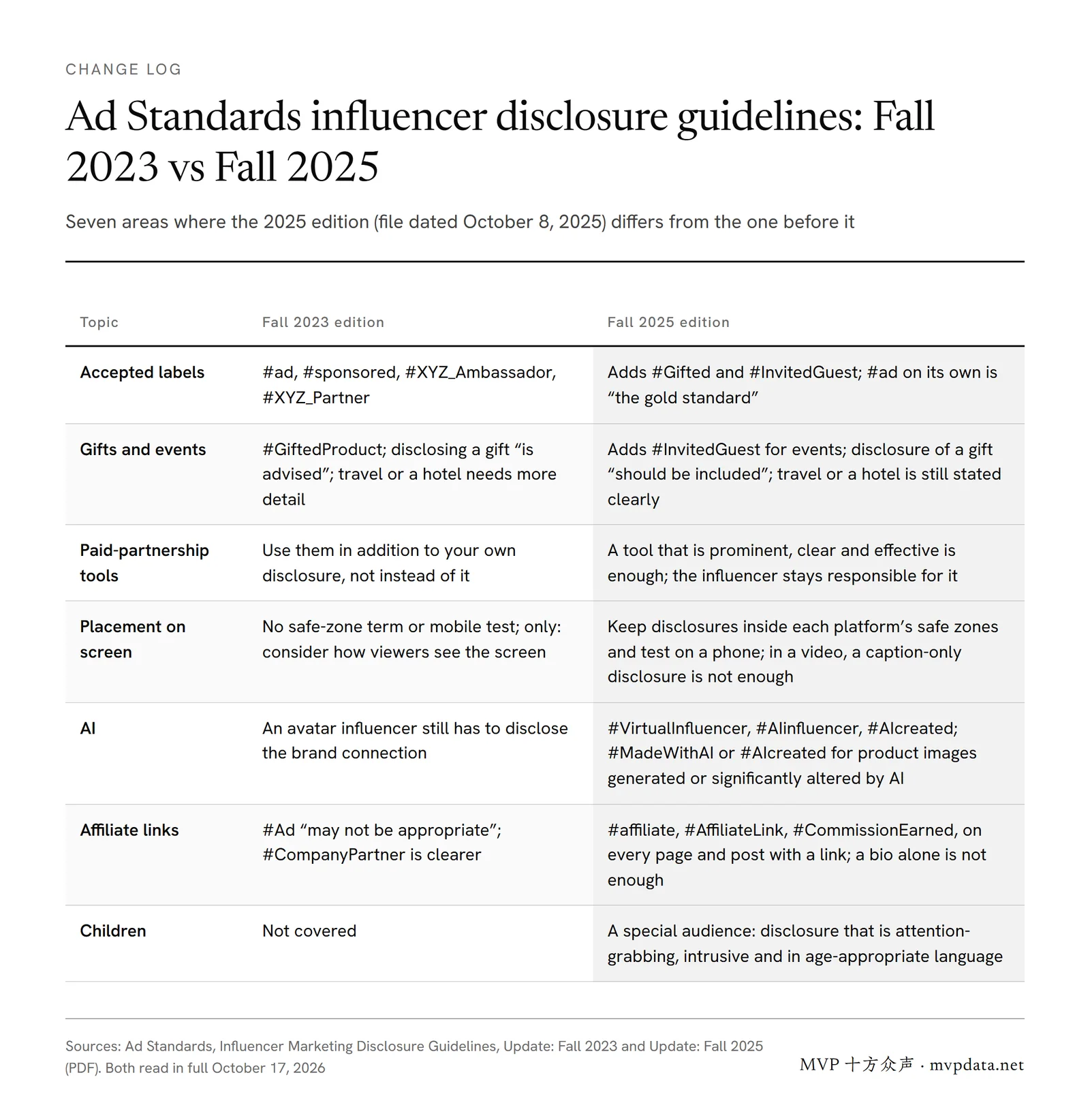
The full change log, area by area, with what each edition says:
| Area | Fall 2023 edition | Fall 2025 edition |
|---|---|---|
| Accepted labels | #ad, #sponsored, #XYZ_Ambassador, #XYZ_Partner3 | Adds #Gifted (a free gift with no obligation to post) and #InvitedGuest (an event invitation with no obligation to post); #ad on its own, not merged with other words, is “the gold standard”2 |
| Gifts and events | Gifts: #GiftedProduct, and disclosure of a gift “is advised”. Events: “thanks to X brand for inviting me” suffices if only access was given; travel or accommodation requires more detail3 | Gifts: #GiftedProduct, #Gifted or #InvitedGuest, and disclosure of the gift “should be included”. Events: #InvitedGuest added; the rule that travel or accommodation must be stated clearly carries over2 |
| Paid-partnership tools | Use the tool in addition to, not instead of, your own disclosure in the caption3 | Where a tool gives prominent, clear and effective disclosure, nothing more is required; the influencer remains responsible for checking it on every device2 |
| Placement on screen | No safe-zone term or mobile test; only: consider how viewers see the screen on each platform. Video: in the caption and in the video, within the first 30 seconds3 | Consider each platform’s safe zones and test that disclosures are visible on a mobile device. Video: adds that a disclosure only in the caption is not sufficient; spoken or on-screen disclosure in the video is sufficient2 |
| AI | One table row: an avatar influencer must still disclose the material connection; nothing on AI images3 | AI-generated influencers: disclosure still necessary, and the recommended practice is to say the spokesperson is virtual with #VirtualInfluencer, #AIinfluencer or #AIcreated. Product images generated or significantly altered by AI: #MadeWithAI or #AIcreated2 |
| Affiliate links | A separate section: #Ad “may not be appropriate”, #CompanyPartner “would be clearer”3 | #affiliate, #AffiliateLink or #CommissionEarned, on every page and post where links are presented; a bio alone is not sufficient2 |
| Children | Not covered3 | A special audience: disclosure must be noticeable, detailed, attention-grabbing, intrusive and in age-appropriate language2 |
Who must disclose a material connection in Canada, and who enforces it?
Everyone in the deal shares the duty: the 2025 guidelines put it on the brand, the influencer and any agency, PR firm or company that arranges the sponsorship, and the law behind it is the Competition Act, enforced by the Competition Bureau.2 Ad Standards runs a separate, self-regulatory track under the Canadian Code of Advertising Standards.4
A material connection, in the guidelines’ definition, is any connection that may affect the weight or credibility of what the influencer says: money or other compensation, free products with or without conditions, discounts, gifts, contest entries, employment, and personal or family relationships. An influencer is anyone with the potential to influence others, “regardless of the number of followers or viewers they may have”.2
| Competition Bureau | Ad Standards | |
|---|---|---|
| What it is | The federal body primarily responsible for enforcing laws on misleading marketing2 | The advertising industry’s self-regulatory body; administers the Code4 |
| The rule | Competition Act s. 52 (criminal) and s. 74.01 (civil): no representation to the public that is false or misleading in a material respect5 | Code Clause 1(b) (no omission that misleads), Clause 2 (no ad disguised as something else), Clause 7 (genuine testimonials)4 |
| How a case starts | The Commissioner, or a person granted leave under s. 103.1, applies to a court5 | A complaint, adjudicated by the Standards Council or, in Quebec, le Conseil des normes4 |
| What can follow | Civil: an order to stop, a published notice, and a penalty up to the greater of $750,000 ($1,000,000 for a later order) and three times the benefit for an individual, or $10,000,000 ($15,000,000) and three times the benefit (or, if the benefit cannot reasonably be determined, 3% of annual worldwide gross revenues) for a corporation (s. 74.1). Criminal, where the representation is made knowingly or recklessly: on indictment, a fine at the court’s discretion or up to 14 years’ imprisonment (s. 52(5))5 | Council decides whether the Code was breached and may consider the Disclosure Guidelines in doing so2 |
Three points in the Act matter for brands. Making a representation includes permitting one to be made (s. 52(1.2)); the general impression of a representation counts as well as its literal meaning (s. 74.03(5)); and no notice, penalty or restitution order is made against a person who shows they exercised due diligence to prevent the conduct (s. 74.1(3)).5 The guidelines say of themselves that they are not legal advice and do not ensure compliance with the Code or the Competition Act.2
Which labels are accepted now: #ad, #sponsored, #Gifted, #InvitedGuest, #AffiliateLink?
For a paid post, #ad or #sponsored; for a free gift with no obligation to post, #Gifted or #GiftedProduct; for an event invitation, #InvitedGuest; for commission links, #affiliate, #AffiliateLink or #CommissionEarned.2 Hashtags are not mandatory: clear words that state the connection work too.2
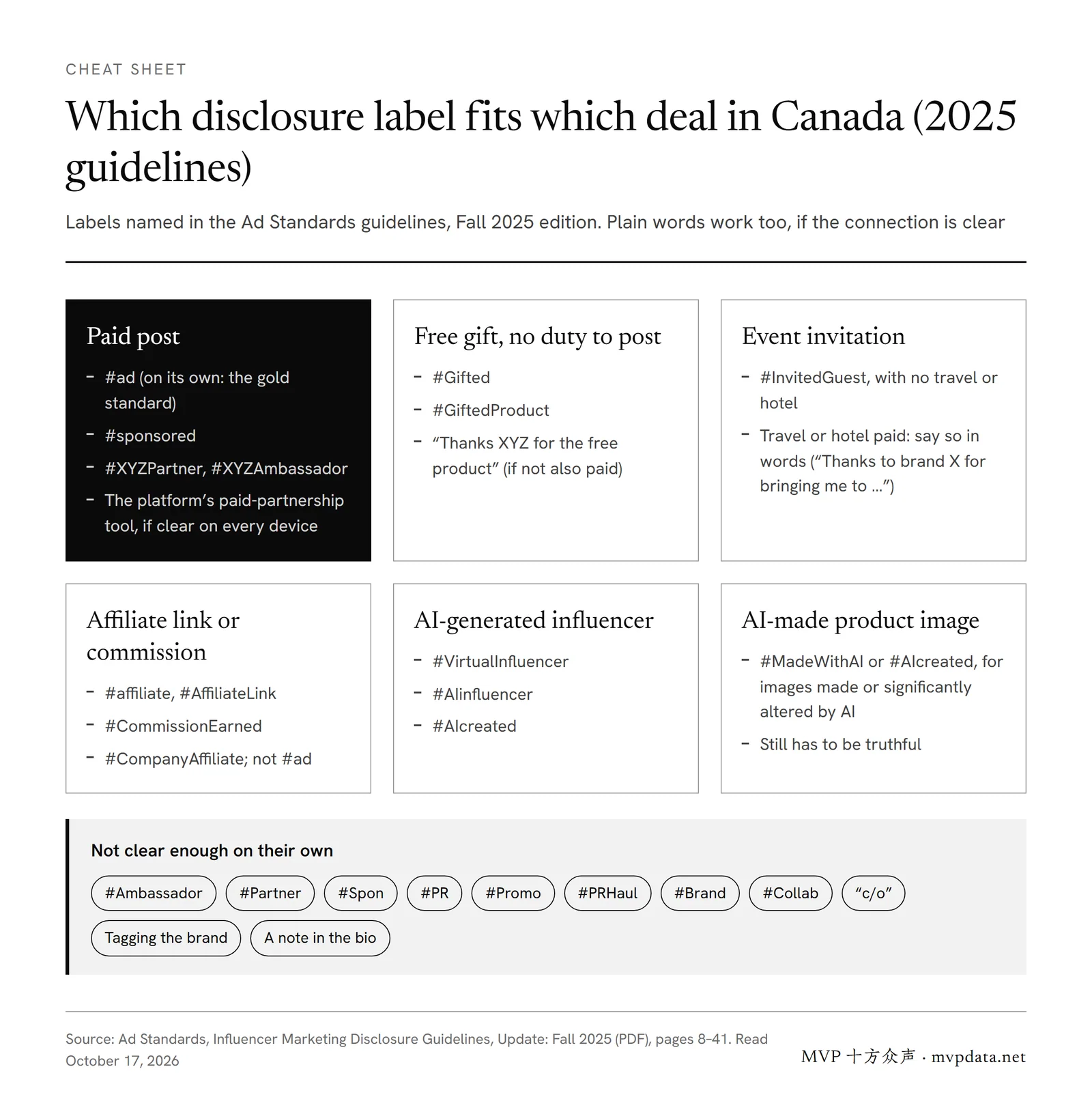
| Situation | Labels named in the 2025 guidelines | Watch for |
|---|---|---|
| Paid post | #ad, #sponsored, #XYZPartner, #XYZAmbassador (XYZ being the brand), or the platform’s paid-partnership tool | #ad merged into a brand hashtag (the guidelines’ example is “#coolstyllead”) is likely to be missed |
| Free gift, no obligation to post | #Gifted, #GiftedProduct, or “Thanks XYZ for the free product” | The thank-you works only if the brand did not also pay |
| Event invitation | #InvitedGuest, “thanks to X brand for inviting me” | Travel or a hotel paid by the brand has to be stated, e.g. “Thanks to brand X for bringing me to …” |
| Affiliate link or commission | #affiliate, #AffiliateLink, #CommissionEarned; for affiliate content, #CompanyPartner or #CompanyAffiliate rather than #ad | On every page and post with a link |
| Employee posting about the employer | #XYZEmployee | Applies even when the post is not about a specific product |
| AI-generated influencer | #VirtualInfluencer, #AIinfluencer, #AIcreated | The brand connection is disclosed as well |
| Product image generated or significantly altered by AI | #MadeWithAI, #AIcreated | The image still has to be truthful |
All rows: Ad Standards, Fall 2025 edition.2
The guidelines list these as not clear enough: the ambiguous hashtags #Ambassador, #Partner, #Spon, #PR, #Promo, #PRHaul, #Brand and #Collab, as well as “c/o”, a plain “thank you” to a brand, misspelled labels or labels with spaces inside, and merely tagging the brand.2 A label buried in a list of hashtags can count as hidden; the disclosure should come before the hashtags and mentions, ideally at the beginning of the post.2
Sharing information about an event open to the public, with no swag, tickets or expected compensation, creates no material connection and needs no label.2
How must AI-generated influencers and AI-made images be disclosed?
An AI-generated influencer discloses its brand connection like any other, because not being a real person does not change that duty; the guidelines also recommend saying the spokesperson is virtual, with #VirtualInfluencer, #AIinfluencer or #AIcreated.2 An image that shows a product’s benefits or attributes and was generated or significantly altered by AI is labeled, for example #MadeWithAI or #AIcreated, because it can affect the truthfulness of the endorsement.2
The label does not fix a misleading image. The 2025 edition says images or videos made with filters or AI must stay truthful about the product’s benefits, results and attributes, and “a disclaimer cannot correct a misleading impression”. An AI influencer should not give a testimonial about something it cannot experience; the guidelines’ example is “this food sure tastes great!”.2 A brand’s own mascot avatar on the brand’s own pages is plainly advertising; if the avatar has its own following and is used by third parties as an endorser, those third parties disclose the connection.2
Most Canadians surveyed want AI influencers to say so. In a survey Caddle ran for Ad Standards on October 29, 2025 (2,242 surveys), 78% said AI influencers must clearly disclose their identity, and only 24% felt confident telling AI-generated influencers from human ones.6
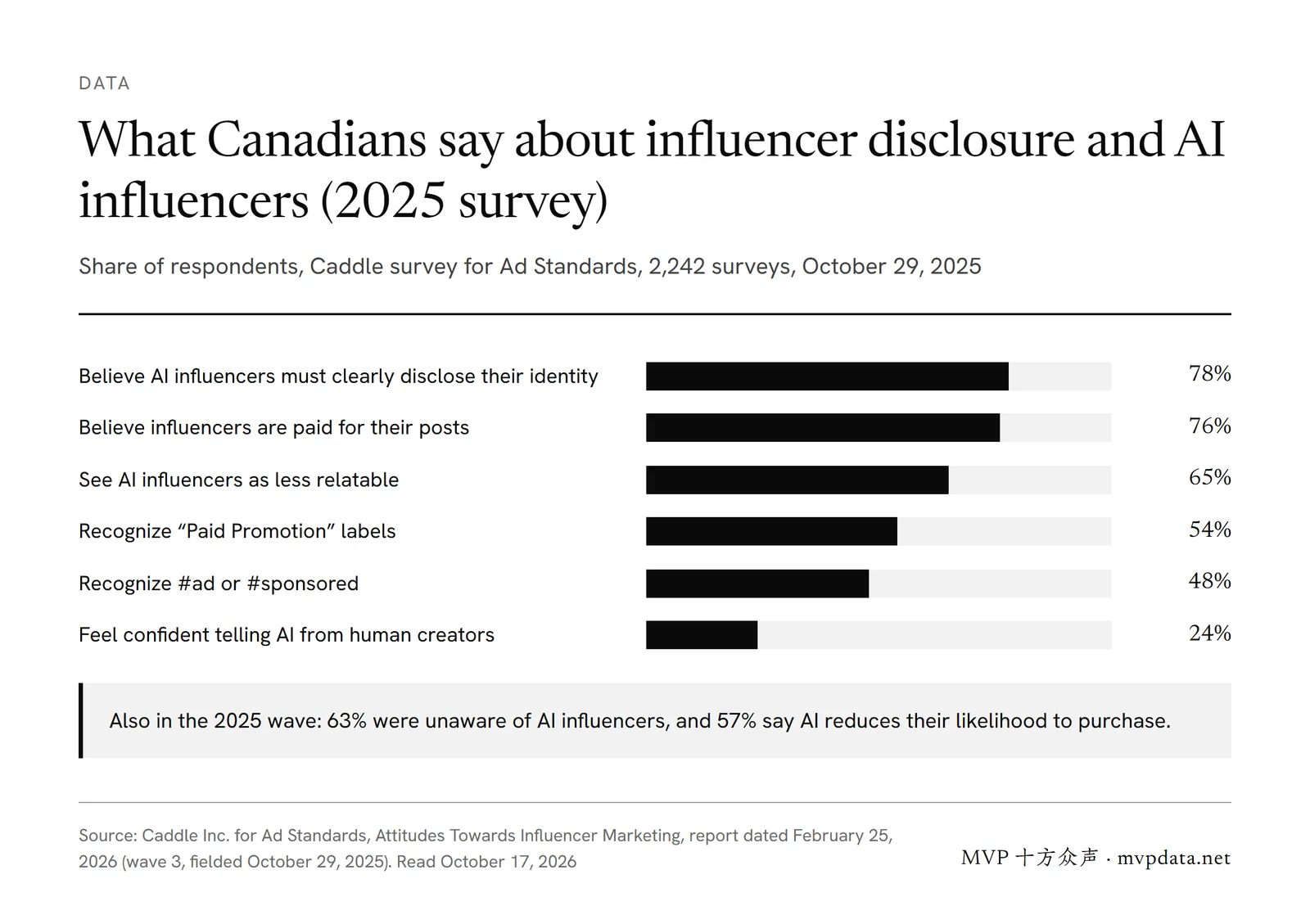
| Survey answer (2025 wave, 2,242 surveys) | Share |
|---|---|
| AI influencers must clearly disclose their identity | 78% |
| Influencers are paid for their posts | 76% |
| AI influencers are less relatable | 65% |
| Unaware of AI influencers | 63% |
| AI influencers are less effective | 58% |
| AI reduces their likelihood to purchase | 57% |
| Recognize “Paid Promotion” labels | 54% |
| Recognize #ad or #sponsored | 48% |
| Confident telling AI from human creators | 24% |
Source: Caddle Inc. for Ad Standards, report dated February 25, 2026.6
Where must the disclosure appear on screen, and what are safe zones?
Up front and inside the content: at the start of a video, spoken or on screen within the first 30 seconds; in the main caption text before any list of hashtags; and within each platform’s safe zones, the areas of a post that stay visible and unobstructed across devices and formats.2 The guidelines give no measurements for safe zones; they ask influencers to consider each platform’s and to test that the disclosure shows on a mobile device.2
The starting point is the viewer’s screen: a disclosure should catch the viewer’s immediate attention and be clear, conspicuous and broadly understood regardless of the device used, whether desktop, tablet or smartphone. Disclosures in overlays that are too small or faint could be considered hidden.2
| Post type | Where the disclosure goes (Fall 2025 edition) |
|---|---|
| Static post (Instagram, Facebook, TikTok, Pinterest) | In the caption as part of the main message, not among hashtags; name the brand; use the paid-partnership tool if available and check it shows on every device |
| Character-limited post (X, Threads) | #ad or #sponsored; each post carries its own, even in a series; the brand is clear |
| Video (YouTube, TikTok, Instagram/Facebook, Pinterest) | In the video and in the caption; at the beginning, spoken or on screen within the first 30 seconds; in longer videos, repeating it is more effective; say so if the brand shaped the content |
| Stories (Instagram, Snapchat, Facebook, TikTok) | At the beginning of the story; at the start of a series meant to be watched in a row; on each story posted on its own |
| Blog | Written out before any link, clickable or not; name the brand |
All rows: Ad Standards, Fall 2025 edition.2
On platform tools, the 2025 edition reverses the 2023 position. In 2023, the paid-partnership tool was to be used “in addition to, not instead of” the creator’s own caption disclosure.3 In 2025, where a tool gives prominent, clear and effective disclosure, additional disclosure is not required, but the influencer has to make sure it does so on any device and should add their own if in doubt. A tool that labels only the caption still leaves the video needing its own disclosure.2
Facebook and Instagram videos often play without sound, so a visual disclosure is needed inside the video.2 When content is reshared from another platform, the disclosure has to remain clear and conspicuous.2
What applies to affiliate links and to content aimed at children?
Affiliate links need a disclosure that a commission or other benefit is earned, on every page and post where a link appears; content with a child audience needs a disclosure that is attention-grabbing, intrusive and explained in age-appropriate language.2
For affiliate links, the 2025 edition names #affiliate, #AffiliateLink and #CommissionEarned, or written words such as “Each time you make a purchase through a link that I provide, I receive a commission” or “I’ll get $1 off future purchases for each person who signs up using my link”. On a blog, the disclosure goes before the link.2 For affiliate content in a static post, the guidelines say not to use #ad but a disclosure that you are the company’s partner or affiliate.2
For children, the guidelines treat them as a special audience, less equipped than adults to evaluate advertising, so an influencer with a child audience has to make sure the audience understands that the content is a message from the brand.2 Clause 12 of the Code adds that advertising directed to children must not exploit their credulity, lack of experience or sense of loyalty.4 In Quebec, the question comes before disclosure: the Consumer Protection Act prohibits commercial advertising that targets children under 13, and the Office de la protection du consommateur oversees compliance, with its own guide to the criteria it applies.7
What should a brand’s creator brief say under the 2025 edition?
A brief written to the 2025 edition names the exact label for the deal type, where the disclosure sits in the caption and in the video, whether the platform’s paid-partnership tool is switched on, which AI use must be labeled, and in which language. Each item maps to a rule in the guidelines:2
- The connection: what was given (payment, product, trip, commission) and the label that fits it (#ad, #Gifted, #InvitedGuest, #AffiliateLink).
- Placement: at the start of the caption, before hashtags and before any link; in the video within the first 30 seconds, spoken or on screen; inside the platform’s safe zones, checked on a phone.
- Platform tool: switched on, and checked on every device; the creator’s own disclosure is added if the tool does not show clearly or covers only the caption.
- AI: whether the creator, the visuals or the product images are AI-generated or significantly altered, and the label for each.
- Audience and language: whether children are in the audience, and the languages the endorsement is made in.
- Extra posts: brand mentions outside the contracted posts are disclosed too.
The Competition Act’s due-diligence clause (s. 74.1(3)) is set out above;5 a written brief and a record of checking each post before it goes live are where a brand keeps track of the steps it took.
Common claims set against the text, checked on October 17, 2026:
| Common claim | What the text says |
|---|---|
| “Ad Standards enforces the disclosure rules with fines.” | Ad Standards administers a self-regulatory Code, and complaints are adjudicated by the Standards Council or le Conseil des normes;4 monetary penalties are set in the Competition Act and ordered by a court (s. 74.1).5 |
| “Instagram’s Paid partnership label always needs a hashtag on top.” | That was the Fall 2023 position;3 the Fall 2025 edition says a prominent, clear and effective tool needs nothing more.2 |
| “#ad covers affiliate links.” | For affiliate content, the guidelines name #affiliate, #AffiliateLink or #CommissionEarned, and a partner or affiliate disclosure rather than #ad.2 |
| “Virtual influencers are exempt because no real person is paid.” | Not being a real person does not change the requirement to disclose.2 |
| “Small accounts do not count as influencers.” | An influencer is defined regardless of the number of followers or viewers.2 |
| “Tagging the brand is disclosure enough.” | The guidelines list “simply tag the brand” as a don’t: viewers cannot be sure that a tag means a material connection.2 |
| “The Fall 2023 edition is still current.” | Ad Standards’ program page says the guidelines were “updated most recently in 2025” and links only that edition;1 the Fall 2023 edition is the one before it.3 |
How MVP handles creator disclosure from Toronto
MVP (Mega Volume Production, 十方众声) is headquartered in Toronto and contracts through two companies, 北京十方众声传媒有限公司 and Mega Volume Production Inc.; it works in talent management and cross-border brand marketing. Since 2023 it has run cross-border influencer marketing in both directions: North American brands with creators in mainland China and Asia, and Chinese brands with Chinese-speaking creators in North America. One MVP team finds and vets creators, writes the brief, negotiates, reviews content and its ad disclosure before it goes live, and reports results against platform data. Work runs in Chinese and English.
- For brands: how MVP runs creator campaigns across markets, on cross-border influencer marketing.
- The same disclosure question in China, the US and Canada, side by side: the three-market labeling table; the term itself: material connection.
- For creators who want representation in both markets: influencer management.
To brief a campaign with Canadian creators, contact MVP.
This article sets out published guidelines and statutes as read on October 17, 2026. It is not legal advice.
Notes
- Influencer Marketing
- Influencer Marketing Disclosure Guidelines
- Influencer Marketing Disclosure Guidelines (Update: Fall 2023)
- The Code Online
- Competition Act (R.S.C., 1985, c. C-34)
- Attitudes Towards Influencer Marketing
- Advertising Directed at Children
Questions
Do I need to disclose a gift if the brand did not ask me to post?
Yes. The Fall 2025 guidelines say a gift should be disclosed even when there was no agreement or obligation to post, because viewers may weigh the review differently. #Gifted is often good disclosure; #GiftedProduct or plain words such as “Thanks XYZ for the free product” also work, provided the brand did not also pay you.
Does a disclosure in my Instagram bio count?
Not on its own. The guidelines say a blanket disclosure in a profile, bio or about section falls below the recommended standard, because people read single posts and watch single videos without seeing the bio. For affiliate links, the disclosure has to appear on every page and post where a link is presented.
Do celebrities with well-known brand deals have to disclose every post?
Not always. Where followers reasonably expect the connection because of wide exposure in other media, a disclosure may not be necessary, but the guidelines call this difficult to judge and advise: when in doubt, spell it out. Brand mentions outside the contracted posts still need a disclosure.
What language should a sponsored post’s disclosure be in?
The language of the endorsement. If the content and captions are in French, the disclosure should be in French; if they are in English, in English. A post made in two languages carries the disclosure in each language the endorsement is made in.